
Skin Longevity Skincare: Building Products Around Resilience, Evidence & Long-Term Use
Learn how beauty brands can develop skin longevity skincare through formulation, barrier support, sensory design, evidence, claims and OEM/ODM planning.
“Longevity” is appearing on more skincare briefs.
But for beauty brands, the most useful question is not:
“Which longevity ingredient should we add?”
It is:
“What kind of product should we build around long-term skin quality?”
Skin longevity is better understood as a product-development framework than as one hero ingredient or one universal cosmetic claim.
For a beauty brand, that framework can connect:
Consumer Need
↓
Product Role
↓
Formula Architecture
↓
Barrier & Support Strategy
↓
Sensory Design
↓
Evidence
↓
Packaging
↓
Long-Term Use
↓
Manufacturing
This makes longevity relevant to R&D, product development, and portfolio planning.
It also creates an important boundary:
Longevity science can inspire product development. The finished cosmetic and its supporting evidence still determine what the brand can appropriately claim.
1. Skin Longevity Is Not Simply a New Name for Anti-Aging
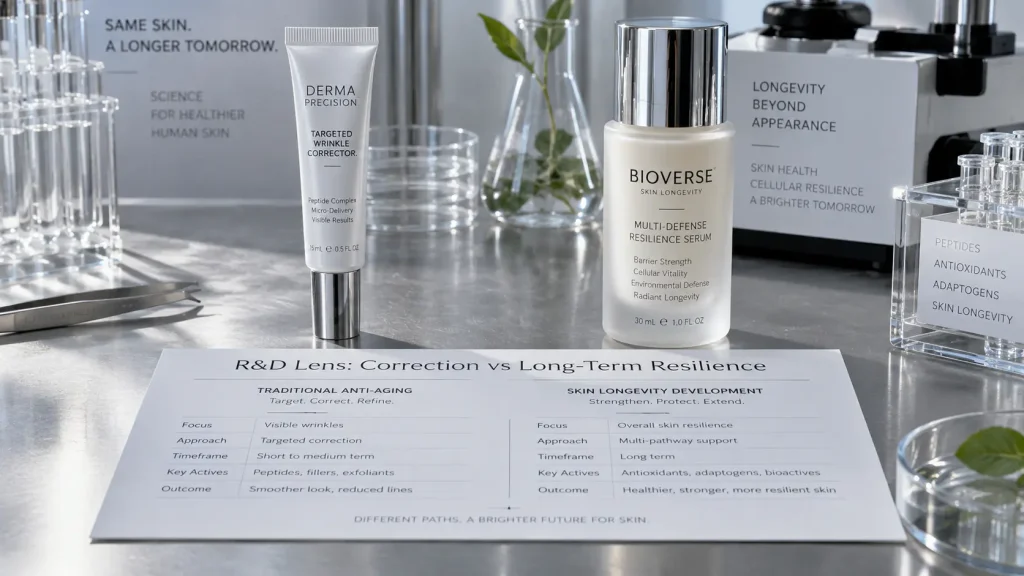
Traditional anti-aging skincare often starts with visible concerns such as:
- Fine lines
- Wrinkles
- Firmness
- Uneven tone
- Texture
- Loss of radiance
Skin longevity begins from a slightly different question:
How can the skincare routine support the appearance, comfort, resilience, and condition of healthy-looking skin over time?
The two approaches overlap.
A longevity-oriented product may still address wrinkles, firmness, hydration, radiance, or texture.
But the development emphasis can shift.
Traditional Anti-Aging
Often emphasizes:
Correction + Visible Signs + Targeted Treatment
Skin Longevity
Can place more emphasis on:
Maintenance + Resilience + Routine Consistency + Long-Term Skin Quality
That shift can influence:
- Product positioning
- Ingredient selection
- Texture
- Usage frequency
- Product-line architecture
- Testing
- Claims
Recent beauty coverage has increasingly described longevity as a broader skincare mindset rather than one new ingredient category.
Scientific literature has also begun using concepts such as skinspan to discuss long-term skin health and appearance.
However, these developments should not be treated as automatic substantiation for commercial longevity claims.
Skin longevity can guide the product brief without becoming the claim itself.
2. Start With the Consumer Need — Not the Longevity Ingredient
When a client says:
“We want a longevity product.”
the temptation is to immediately discuss:
PDRN
Peptides
Copper Peptides
Exosome-Inspired or Biotech Concepts
Antioxidants
Barrier-Support Actives
But the product role should come first.
Several completely different products could sit under a longevity-oriented portfolio.
Daily Resilience Serum
Could focus on:
Hydration + Barrier Support + Lightweight Daily Use
Premium Firming Treatment
Could focus on:
Firmer-Looking Skin + Peptide Strategy + Refined Treatment Texture
Barrier Longevity Cream
Could focus on:
Moisture Retention + Comfort + Richer Daily Support
Early Age-Care Product
Could focus on:
Consistency + Hydration + Protection-Oriented Routine + Less Aggressive Anti-Aging Language
These are different product briefs.
They require different:
- Ingredient systems
- Textures
- Formats
- Packaging
- Claims
- Testing strategies
Longevity is the positioning framework. The product still needs one clear job.
3. Build an Ingredient System — Not an Ingredient Stack
Longevity skincare can easily become an ingredient arms race.
A brief starts with peptides.
Then adds PDRN.
Then ceramides.
Then antioxidants.
Then ectoin.
Then microbiome-oriented ingredients.
Then another biotech active.
The formula sounds more advanced.
It does not automatically become a better long-term skincare product.
A longevity-oriented formula may draw on ingredient directions such as:
- Peptides
- Copper peptides
- Ceramides and barrier lipids
- Antioxidants
- Humectants
- Ectoin
- Retinoid or retinoid-alternative strategies
- Microbiome-oriented systems
- Other appropriately supported active systems
But ingredient selection should follow the product role rather than the popularity of individual actives.
For deeper ingredient-specific development considerations, see:
The better development question is:
Which ingredients support the same product story, remain technically compatible, and make sense in the intended routine?
A long ingredient list is not the same thing as a long-term skincare strategy.
4. Barrier Support Can Be the Foundation of a Longevity Strategy
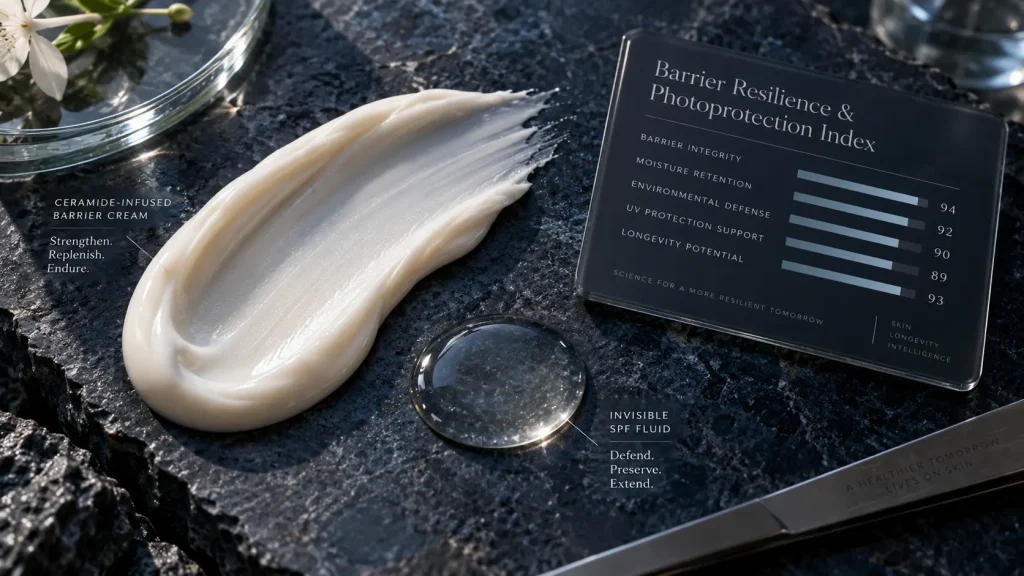
Skin longevity does not have to begin with the most technologically complex active.
For many products, the foundation may be much more familiar:
- Hydration
- Barrier lipids
- Comfortable cleansing
- Moisturization
- Environmental protection
- Consistent daily use
A sophisticated serum can still fail as a long-term product if it repeatedly creates discomfort or is too difficult to use consistently.
Likewise, a well-designed barrier product can play an important role in a long-term skincare routine without relying on a futuristic ingredient story.
This creates an important distinction.
A longevity product can be:
technology-led
or:
routine-led
Both can make sense when the product role is clearly defined.
For more on barrier-oriented formulation choices, see:
Barrier Repair Cream vs Lotion vs Gel: Which Texture Is Right for Your Skincare Brand?
A longevity strategy can begin with advanced science. It can also begin with better daily fundamentals.
5. Photoprotection Belongs in the Long-Term Skin Conversation
Longevity positioning can easily become dominated by novel actives.
But long-term skin quality also depends on much more established skincare behavior.
For routines involving sun exposure, photoprotection remains an important part of the broader long-term strategy.
That does not mean a longevity serum can replace sunscreen.
It means the portfolio should distinguish between:
Treat
Support
and:
Protect
A brand building a longevity-oriented line might therefore think in terms of:
Daily Serum
↓
Barrier Support
↓
Targeted Treatment
↓
Daily Sun Care
rather than asking one serum to carry the entire longevity story.
Long-term skincare is a routine-architecture question — not only an active-ingredient question.
6. Texture Matters More When the Strategy Is Long-Term
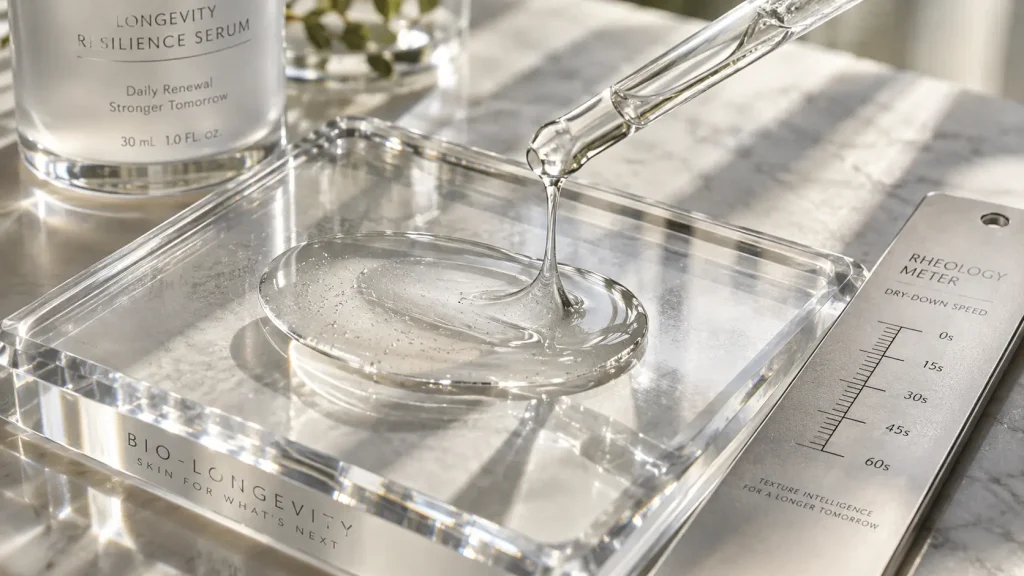
If a product is meant to be used every day for months or years, sensory experience becomes strategically important.
A formula that is:
- Sticky
- Greasy
- Difficult to spread
- Heavy
- Slow to absorb
- Difficult to layer under SPF
may struggle to become a consistent habit.
Different longevity concepts may therefore need different sensory targets.
Daily Serum
May target:
Lightweight + Silky + Low Tack + Easy Layering
Gel-Cream
May target:
Hydrating + Fresh + Comfortable + Routine-Friendly
Rich Cream
May target:
Cushioning + Nourishing + Evening-Oriented Comfort
Treatment Capsule
May target:
Precision + Premium Ritual + Defined Dose
There is no universal “longevity texture.”
The correct sensory profile depends on:
Consumer + Climate + Product Role + Usage Occasion
The principle is simple:
A long-term skincare strategy only works if the product is enjoyable enough to keep using.
7. Skin Longevity Needs More Evidence — Not More Scientific-Sounding Words
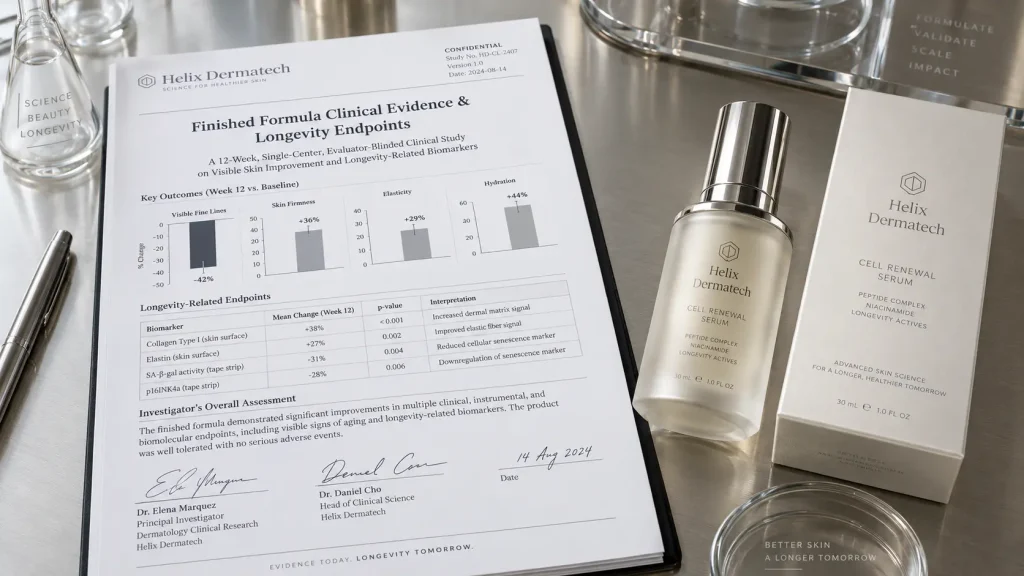
This is where longevity positioning becomes more difficult.
Scientific language can easily become stronger than the evidence supporting the finished cosmetic.
Examples that deserve particular caution include:
“Reverses biological aging.”
“Extends skin lifespan.”
“Rejuvenates skin cells.”
“Repairs DNA.”
“Resets cellular age.”
“Makes skin biologically younger.”
These statements can imply much more than a conventional cosmetic product has demonstrated.
A stronger development pathway is:
Scientific Concept
↓
Ingredient Evidence
↓
Finished Formula
↓
Testing & Evaluation
↓
Supporting Evidence
↓
Target-Market Review
↓
Commercial Claim
Research on longevity cosmeceuticals has proposed scientific frameworks involving biological aging hallmarks, biomarkers, clinical evaluation, and concepts such as skinspan.
This research is useful because it demonstrates how demanding a true biological longevity claim would need to be.
It should not be interpreted as automatic proof that a cosmetic using a longevity-associated ingredient has demonstrated those outcomes.
In other words:
A proposed scientific framework is a standard to investigate — not proof that the finished cosmetic already meets it.
For more on finished-product evaluation, see:
Cosmetic Product Testing Before Mass Production
The more biological the longevity claim sounds, the stronger the evidence question becomes.
8. Ingredient Evidence Is Not Finished-Product Evidence
This point deserves its own section because longevity concepts frequently begin with sophisticated supplier research.
An ingredient supplier may provide data relating to:
- Oxidative-stress pathways
- Senescence-associated markers
- Cellular communication
- Inflammation-related pathways
- Barrier markers
- Other biological mechanisms
That research can help build scientific rationale.
But once the ingredient enters a commercial cosmetic, the evidence question changes.
The finished product also contains:
- Vehicle
- Supporting ingredients
- Preservation system
- pH system
- Defined ingredient levels
- Packaging
- Consumer instructions
So brands should avoid moving directly from:
“Ingredient X influenced marker Y in a laboratory study.”
to:
“Our serum reverses skin aging.”
The evidence chain still needs to pass through the actual finished product and the claim being communicated.
The ingredient can start the longevity story. The finished product has to carry the commercial claim.
9. Product Format Can Make the Concept Easier to Understand
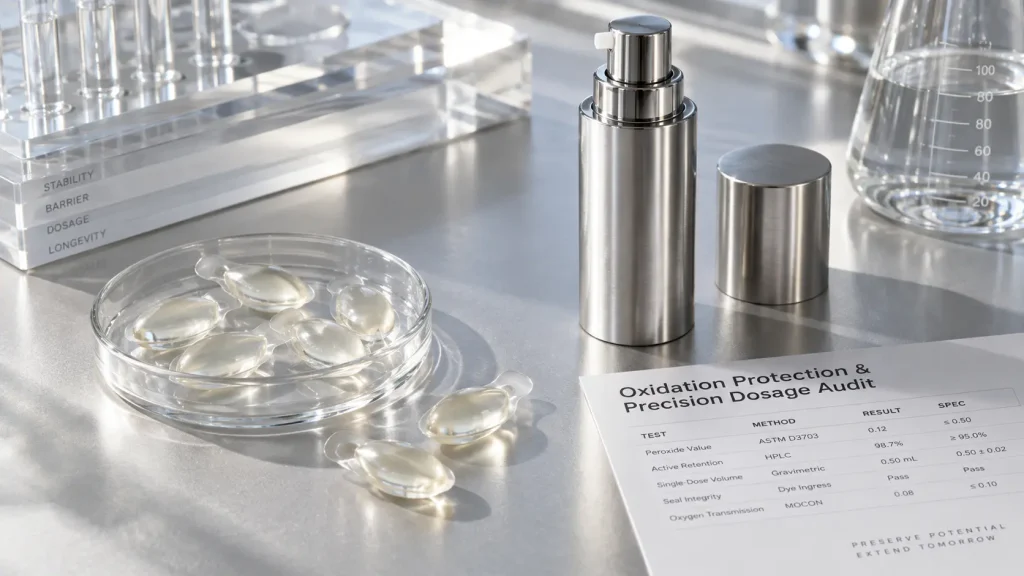
Longevity is an abstract idea.
Product format can make that positioning easier for consumers to understand.
Standard Serum
May communicate:
Daily Consistency + Familiar Treatment
Single-Dose Capsule
May communicate:
Precision + Defined Dose + Premium Ritual
For example:
AgeReset Bakuchiol Serum Capsules
illustrate one possible single-dose treatment format.
Freeze-Dried System
May communicate:
Technology + Activation + Specialized Treatment
Hydrogel Treatment
May communicate:
Intensive Use + Sensory Experience + Targeted Ritual
The format should still have a reason to exist.
A technically unusual package or dosage form does not automatically make the formula more “longevity.”
The better question is:
Does this format improve use, stability, precision, differentiation, or product experience?
Format should clarify the concept — not simply make it look more scientific.
10. Packaging Should Support the Formula and the Long-Term Routine
Longevity skincare does not automatically require:
Airless packaging.
Different products may use:
- Pump
- Airless system
- Dropper
- Capsule
- Tube
- Dual-chamber package
The correct choice depends on:
- Formula viscosity
- Ingredient sensitivity
- Dose
- Product exposure
- Consumer routine
- Compatibility
- Filling
- Price positioning
If the product is expected to be used daily over a long period, packaging usability also matters.
Can the consumer dispense the right amount?
Is the package easy to use repeatedly?
Does the system create unnecessary mess?
Does it protect the intended formula?
Can it be filled consistently?
Packaging should follow the finished formula and usage scenario — not the longevity buzzword.
11. Stability Matters — Especially When the Formula Becomes More Complex
Longevity products do not have to be multi-active.
But many concepts are.
When a formula combines several active systems, development may need to pay particular attention to:
- Color
- Odor
- pH where relevant
- Viscosity
- Precipitation
- Separation
- Sensory changes
- Formula-package compatibility
- Ingredient interactions
A sophisticated ingredient story has limited commercial value if the finished product cannot maintain its intended characteristics over time.
Stability strategy should still be product-specific.
There is no universal “longevity stability protocol.”
For more on this stage, see:
Cosmetic Stability Testing Explained
Long-term positioning still requires ordinary formulation discipline.
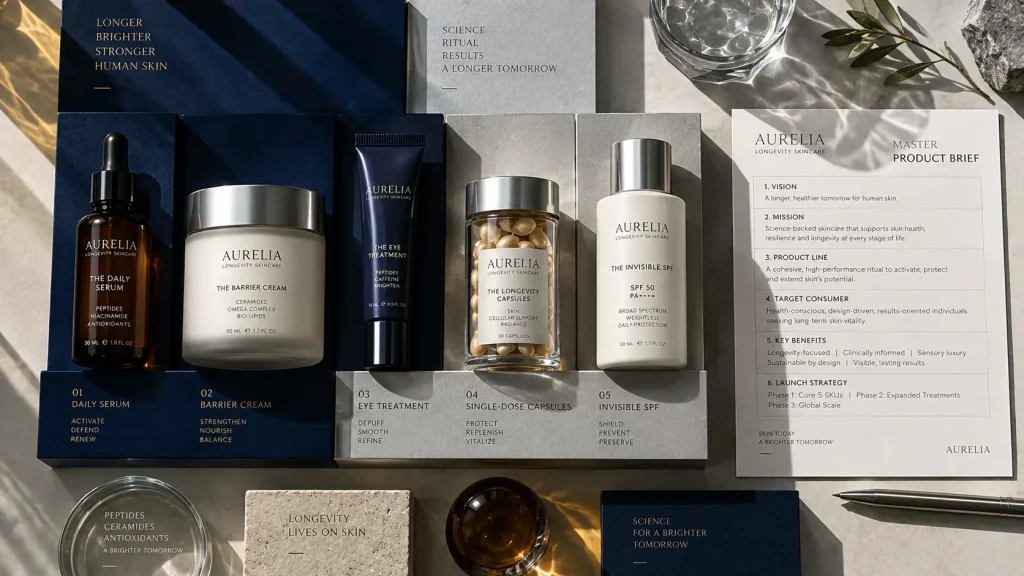
12. Build a Longevity Portfolio — Not Five Similar Serums
Longevity becomes more useful when the brand thinks beyond one hero SKU.
But that does not mean launching several products with exactly the same:
Anti-Aging + Firming + Repair + Longevity
story.
A stronger portfolio gives each SKU a different role.
Daily
Resilience-Oriented Serum
Support
Barrier Cream
Target
Eye Treatment
Intensive
Single-Dose / Hydrogel / Specialized Treatment
Protect
Daily SPF
Now every product has a reason to exist.
The line shares one broader philosophy.
The SKUs do not repeat the same job.
This creates a useful portfolio principle:
Longevity should connect the routine — not flatten every product into the same claim.
13. Skin Longevity and Traditional Anti-Aging Can Coexist
It is useful to compare the two approaches without pretending that one replaces the other.
These are not mutually exclusive systems.
A brand may use:
Traditional cosmetic efficacy claims
inside:
A broader longevity-oriented product philosophy.
That can be clearer and more defensible than trying to invent a new biological longevity claim for every SKU.
14. What Does a Better Skin Longevity Product Brief Look Like?
Compare:
Weak Brief
“We want a longevity serum with PDRN, peptides, and exosomes.”
This gives R&D:
Trend + Ingredient List
but little product strategy.
Now consider:
Stronger Brief
“We want a lightweight daily serum for consumers beginning to focus on long-term skin quality and early visible signs of aging.
The product should support hydration, barrier comfort, and a firmer-looking appearance, with a silky, low-tack texture suitable for consistent daytime or evening use.
The ingredient system should support one coherent product story, while finished-product claims should remain tied to appropriate evidence rather than implying extension of skin lifespan or reversal of biological aging.”
Now the development team understands:
Target Consumer
↓
Longevity Positioning
↓
Product Role
↓
Primary Cosmetic Benefits
↓
Ingredient Strategy
↓
Texture
↓
Routine
↓
Claim Boundary
That is a development-ready brief.
15. What Should a Skin Longevity Product Brief Include?
A useful development sequence may include:
- Target Consumer
- Primary Longevity Positioning
- Product Role
- Primary Cosmetic Benefit
- Ingredient System
- Barrier / Support Strategy
- Texture & Sensory Target
- Product Format
- Packaging
- Claims & Evidence
- Stability & Product Evaluation
- Target Market
- Scale-Up & OEM/ODM Manufacturing
- Portfolio Role
The sequence matters.
It keeps the brand from beginning with:
“Which longevity ingredient is trending?”
before deciding:
“What product are we actually trying to build?”
Frequently Asked Questions
What is skin longevity skincare?
Skin longevity skincare is a product-development approach focused on supporting the appearance, comfort, resilience, and overall condition of healthy-looking skin over time.
For beauty brands, it is more useful as a broader development framework than as one standardized ingredient category.
Is skin longevity the same as anti-aging?
Not exactly.
Traditional anti-aging often begins with visible concerns such as wrinkles, firmness, tone, and texture.
Skin longevity can place more emphasis on maintenance, resilience, consistency, barrier support, and long-term skin quality.
The two approaches can overlap significantly.
Can a cosmetic claim to extend skin lifespan?
Brands should be very cautious with this type of claim.
Claims such as extending skin lifespan, reversing biological aging, repairing DNA, or changing fundamental cellular aging processes may go beyond conventional cosmetic positioning depending on the wording, evidence, intended effect, and target market.
Finished-product claims should be reviewed for the relevant jurisdiction.
Does a longevity product need advanced biotech actives?
No.
A longevity-oriented product can be built around:
- Hydration
- Barrier support
- Antioxidant-oriented care
- Comfortable daily use
- Photoprotection within the wider routine
as well as more advanced active systems.
The product role should determine the ingredient strategy.
Does a longevity product need to be a serum?
No.
Longevity-oriented concepts can be developed as:
- Serums
- Creams
- Gel-creams
- Capsules
- Eye treatments
- Hydrogel products
- Sun-care products
- Other suitable formats
The format should support the intended consumer need and routine.
Does skin longevity require special packaging?
Not automatically.
The package should follow the actual formula, viscosity, ingredient sensitivity, dose, compatibility, filling requirements, and consumer use.
What ingredients can be used in skin longevity skincare?
There is no single required longevity ingredient.
Depending on the product brief, brands may explore barrier lipids, humectants, antioxidants, peptides, copper peptides, retinoid or retinoid-alternative systems, ectoin, microbiome-oriented ingredients, or other appropriately supported actives.
The ingredient system should support one coherent product role rather than simply maximize the number of trending ingredients.
Is sunscreen part of a skin longevity routine?
Photoprotection can play an important role in a long-term skincare strategy.
A longevity serum should not be treated as a replacement for sunscreen, and sun-care products should be developed and evaluated according to the requirements of their intended market.
Do skin longevity products need clinical testing?
The appropriate testing depends on the claims being made.
General cosmetic positioning and stronger biological longevity claims do not create the same evidence burden. The more specific or biological the claim, the more important it becomes to define suitable finished-product testing and substantiation.
Can skin longevity products be developed through OEM/ODM manufacturing?
Yes.
The appropriate development route depends on the brand’s desired level of customization, timeline, budget, formula ownership requirements, product format, claims strategy, and differentiation goals.
Terminology and service models vary between manufacturers, so brands should clarify exactly which parts of formulation, testing, packaging, scale-up, and production are included.
Developing a Skin Longevity Skincare Concept?
Skin longevity should not begin with:
“How many advanced anti-aging ingredients can we put into one formula?”
A stronger development sequence is:
Consumer Need
↓
Longevity Positioning
↓
Product Role
↓
Ingredient System
↓
Barrier & Support Strategy
↓
Texture
↓
Format
↓
Packaging
↓
Claims & Evidence
↓
Stability & Testing
↓
Target Market
↓
Manufacturing
↓
Portfolio Role
At NEXO Beauty Labs, longevity-oriented skincare development can connect product positioning, ingredient strategy, custom formulation, sensory design, packaging, product evaluation, scale-up, and OEM/ODM manufacturing.
The opportunity is not simply to attach the word “longevity” to another anti-aging formula.
It is to build a product system designed around:
long-term consumer use
credible evidence
and:
a clear reason for every SKU to exist.
Further Reading
Longevity Skin Care Takes a New Approach to Aging — Vogue, June 18, 2026
Longevity Cosmeceuticals as the Next Frontier in Cosmetic Innovation: A Scientific Framework for Substantiating Product Claims — Frontiers in Aging, 2025