
Cosmetic Stability Testing Explained: What Beauty Brands Should Know Before Production
Learn what cosmetic stability testing evaluates, why formulas can change over time, and what beauty brands should consider before commercial manufacturing.
A cosmetic formula can look perfect when the first laboratory sample is approved.
The color is right. The texture feels right. The fragrance is right. The formula appears completely uniform.
But what happens after weeks or months of storage?
That is where cosmetic stability testing becomes important.
Stability evaluation helps determine whether a cosmetic product can continue to maintain its intended physical, chemical, sensory, and functional characteristics under defined conditions over time.
Depending on the formula and product format, development teams may monitor:
- Appearance
- Color
- Odor
- Viscosity
- pH where relevant
- Separation
- Precipitation or crystallization
- Texture
- Particle distribution
- Capsule or bead integrity
- Dispensing performance
- Other product-specific characteristics
Stability is therefore about much more than whether a cream separates.
The real question is:
Will the product continue to behave the way it was designed to behave throughout its intended commercial life?
Quick Answer: What Is Cosmetic Stability Testing?
Cosmetic stability testing evaluates how a finished formulation changes over time under defined storage or stress conditions.
The exact protocol should be designed according to the product rather than applied identically to every cosmetic.
Why Cosmetic Stability Testing Matters Before Production
A freshly prepared laboratory sample represents only one moment in the life of a cosmetic product.
After commercial production, the finished product may experience:
- Scale-up and manufacturing
- Filling
- Packaging
- Warehouse storage
- Transportation
- Temperature changes
- Light exposure
- Retail storage
- Consumer handling and use
A formula that looks perfect immediately after production can gradually change.
For example:
- A serum may become darker
- A cream may become thinner
- An emulsion may begin separating
- A suspension may develop uneven particle distribution
- A gel may lose viscosity
- A fragrance profile may shift
- A pump may become more difficult to use
Stability testing helps identify these issues while formulation, processing, or packaging changes can still be made — instead of after commercial inventory has already reached the market.
Why Can a Cosmetic Formula Change Over Time?
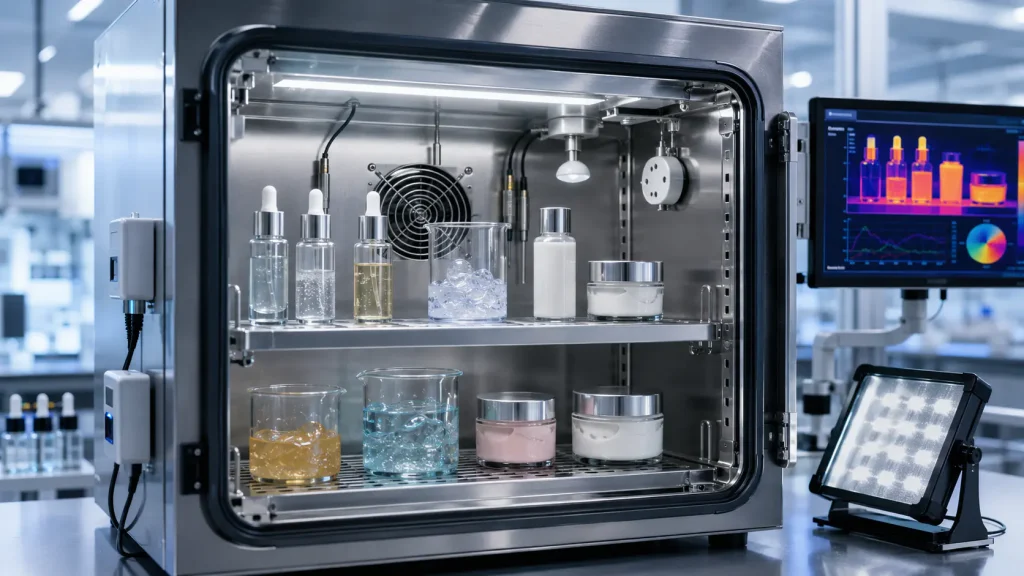
Cosmetic formulas are complex systems.
An ingredient can appear stable on its own while behaving differently once it is combined with other ingredients, processed into a finished formula, filled into packaging, and stored under different conditions.
Temperature
Temperature can influence:
- Viscosity
- Emulsion structure
- Ingredient solubility
- Crystallization
- Texture
- Appearance
Some changes become more visible under warmer or colder conditions than at ordinary room temperature.
Light
Certain ingredients, pigments, botanical extracts, fragrances, or complete formulas may be sensitive to light.
This means packaging opacity and product storage can sometimes become part of the stability strategy.
Oxygen & Environmental Exposure
Exposure to air can also influence some formulations or ingredients.
The significance depends on the formula and packaging system.
This is one reason bottle type, closure, airless systems, headspace, and consumer-use pattern can matter during product development.
Ingredient Interactions
A formula should be treated as one interconnected system rather than a collection of hero ingredients.
Interactions can occur among:
- Active ingredients
- Botanical extracts
- Oils
- Fragrance
- Surfactants
- Emulsifiers
- Thickeners
- Preservative systems
- Antioxidants
- Colorants
Changing one component or concentration can affect the behavior of the complete formulation.
Processing Conditions
Mixing, homogenization, heating, cooling, processing time, and ingredient-addition sequence can all influence the structure of a cosmetic product.
This becomes especially important when the formula moves from a small laboratory batch into commercial manufacturing.
Packaging
A formula ultimately needs to remain acceptable in the package consumers will actually receive.
Bottles, jars, tubes, pumps, droppers, spray systems, capsules, dual chambers, and other packaging formats create different storage and dispensing environments.
Time
Some problems simply do not appear immediately.
A sample remaining visually unchanged for several days does not demonstrate how it will behave throughout its intended commercial life.
What Does Cosmetic Stability Testing Usually Evaluate?
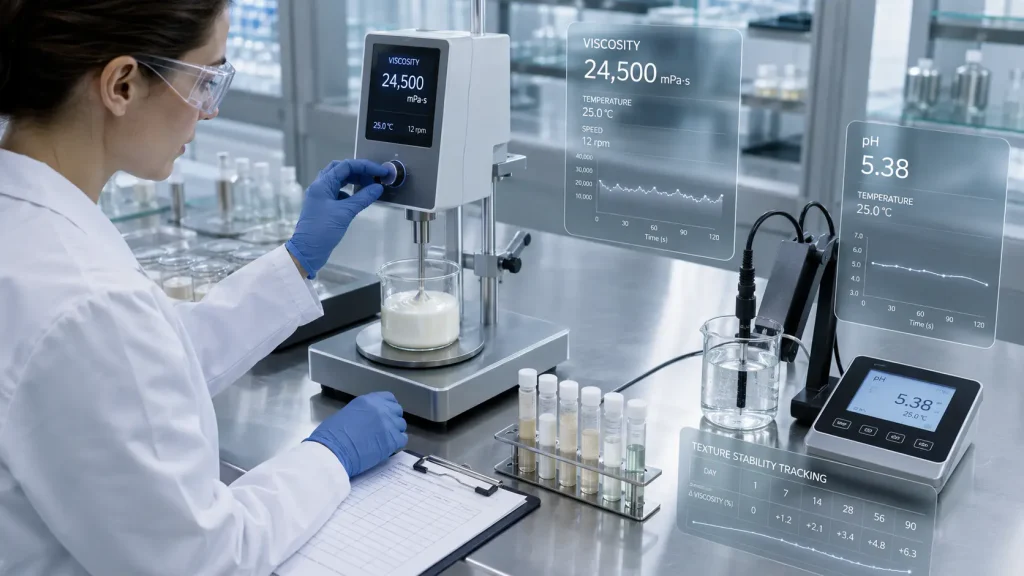
There is no universal set of evaluation parameters for every cosmetic product.
The appropriate characteristics depend on the formulation, product format, package, intended use, and development objectives.
Appearance
The product may be monitored for:
- Separation
- Sedimentation
- Precipitation
- Crystallization
- Cloudiness
- Surface changes
- Uneven particle distribution
- Loss of visual uniformity
Color
Color changes can be commercially significant and may indicate changes within the formulation, ingredients, or packaging environment.
Odor
Fragrance or raw-material odor may change over time.
An unexpected odor shift can require investigation of ingredients, oxidation, storage, packaging, or other formulation factors.
Viscosity
Viscosity can be particularly important for:
- Serums
- Lotions
- Creams
- Gels
- Cleansers
- Masks
A product becoming significantly thicker or thinner can affect:
- Texture
- Spreadability
- Filling
- Pump or dropper performance
- Dose consistency
- Consumer perception
pH
Where pH is a relevant specification, it can be monitored to determine whether the formula remains within its defined range.
Unexpected movement may indicate that further investigation is appropriate.
Texture & Sensory Characteristics
A product can remain visually acceptable while its consumer experience changes.
It may become:
- Stickier
- Oilier
- Less smooth
- Slower to absorb
- More difficult to spread
- More prone to residue
For beauty products, sensory stability can therefore be commercially important alongside measurable physical characteristics.
What Conditions Are Used in Cosmetic Stability Testing?
Stability programs may use several defined environments to understand how the formula behaves.
Depending on the project, these may include:
- Normal or expected storage conditions
- Elevated temperatures
- Lower temperatures
- Temperature cycling
- Light exposure
- Other stress conditions appropriate to the product
The exact temperatures, duration, pull points, specifications, and acceptance criteria should be selected according to the actual product and purpose of the study.
One universal temperature-and-time recipe should not be assumed to prove stability for every cosmetic formula.
Accelerated Stability Testing vs. Real-Time Stability
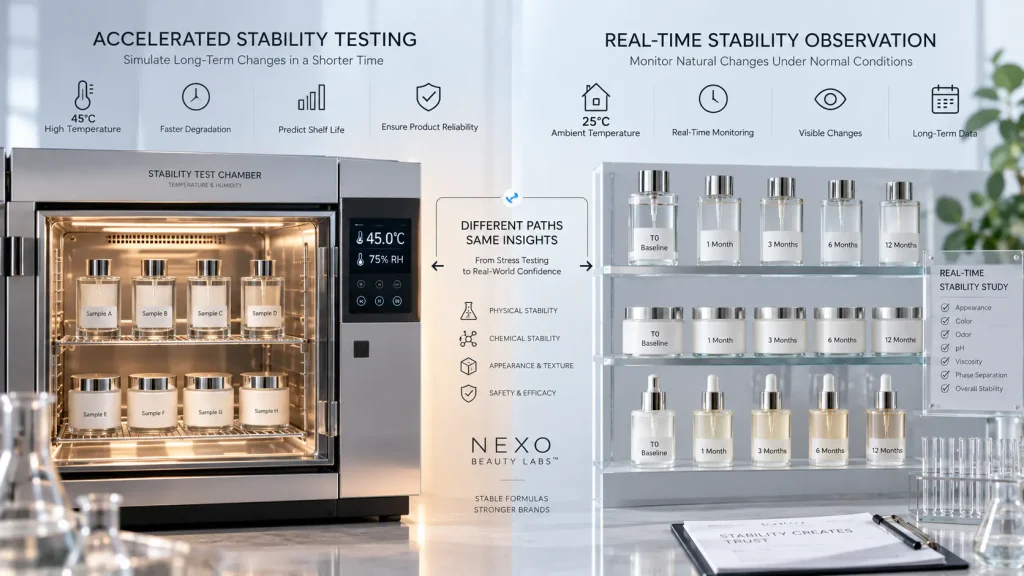
Accelerated Stability Evaluation
Accelerated testing uses defined storage or stress conditions intended to make certain potential changes easier to identify within a shorter development period.
It can help formulation teams identify:
- Physical instability
- Viscosity changes
- Color changes
- Precipitation
- Packaging interactions
- Other product-specific weaknesses
Real-Time Stability Observation
Real-time observation follows the finished product for a longer period under defined or expected conditions.
This provides evidence about how the actual product behaves as time passes.
Accelerated Testing Is Not a Simple Shelf-Life Calculator
A common mistake is assuming:
X weeks at an elevated temperature = exactly Y years of cosmetic shelf life.
That is too simplistic for the wide variety of cosmetic formulation systems.
Accelerated testing can help identify risk and provide useful supporting evidence, but conclusions should be limited to what the actual protocol and data can reasonably support.
Cosmetic Stability Testing vs. Packaging Compatibility Testing
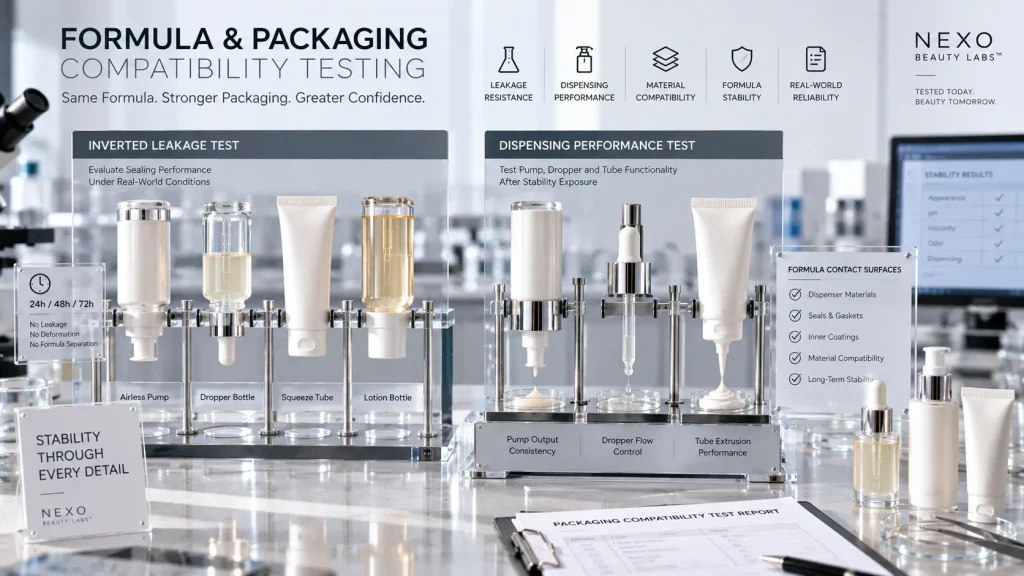
A formula may appear stable in an inert laboratory container while behaving differently in the package selected for commercial sale.
That is why formula stability and packaging compatibility should be treated as connected but distinct development areas.
Packaging can influence:
- Air exposure
- Light exposure
- Product-contact surfaces
- Loss of volatile components
- Leakage
- Dispensing
- Pump or applicator function
- Formula appearance
- Component integrity
Whenever possible, commercial development should evaluate a formula in packaging representative of what will actually be sold.
Related Guide: If compatibility testing shows that packaging may affect formula protection, dispensing, leakage, light or air exposure, the next step is choosing a package that works with the complete product system. See our Guide to Choosing Cosmetic Packaging → for a deeper look at packaging formats, materials, dispensing, compatibility, filling, MOQ, cost, and brand positioning.
Different Cosmetic Formats Have Different Stability Challenges
The characteristics that matter most depend strongly on the product format.
This is why one identical stability protocol should not automatically be applied to every cosmetic product.
Stability Testing Is Not the Same as Microbiological or Challenge Testing
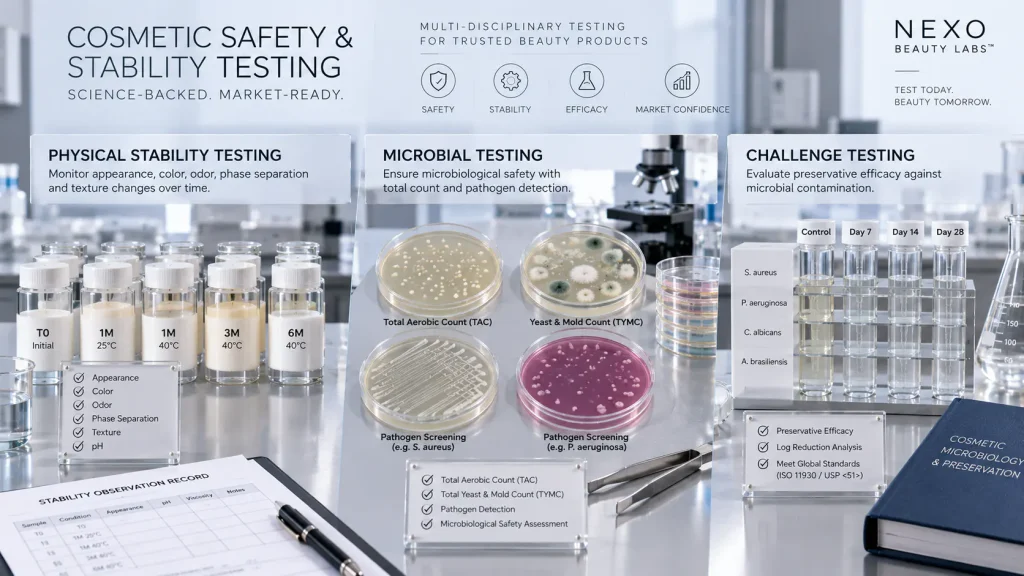
These areas are complementary, but they should not be treated as interchangeable.
Stability Testing
Primarily evaluates whether the formula maintains its intended physical, chemical, sensory, and relevant functional characteristics.
Microbiological Evaluation
Evaluates microbiological quality and the presence or control of microorganisms according to the appropriate product-testing strategy.
Preservative Efficacy / Challenge Testing
Where appropriate, evaluates how the preservation system performs when exposed to defined microbial challenge conditions.
A formula can look physically stable while still requiring appropriate microbiological evaluation.
Likewise, acceptable microbiological results do not prove that the product will maintain its viscosity, texture, color, or appearance over time.
Product testing should therefore be viewed as a system of complementary evaluations.
Related Guide: Stability is only one part of product evaluation before commercial production. To understand how stability, microbiological quality, preservative efficacy, packaging compatibility, sensory evaluation, claims support, and scale-up work together, read our Cosmetic Product Testing Before Mass Production →
When Should Cosmetic Stability Testing Begin?
Stability should not be treated as a final test added only after formulation development is completely finished.
It can begin much earlier.
A practical development cycle may look like:
Initial Formula
↓
Early Stability Screening
↓
Formula Optimization
↓
Final Formula Candidate
↓
Packaging Selection
↓
Formula + Packaging Evaluation
↓
Scale-Up
↓
Continued Stability Observation
↓
Commercial Production
The exact sequence varies according to the project, but the important principle is:
build stability into development rather than treating it as a last-minute production checkpoint.
What Happens If a Formula Fails Stability Evaluation?
A stability problem does not necessarily mean the complete product concept needs to be abandoned.
The first step is to understand what changed and why.
If Viscosity Changes
The formulation team may investigate the rheology system, emulsification, ingredient interactions, pH, processing, or storage conditions.
If Color Changes
Potential areas to review can include ingredients, oxidation, light exposure, formulation interactions, storage, or packaging.
If Separation Occurs
The emulsification system, processing parameters, phase balance, or ingredient compatibility may need further investigation.
If Particles Settle
The team may review suspension structure, viscosity, particle characteristics, dispersion, or processing.
If Odor Changes
Raw materials, fragrance, oxidation, packaging, or storage conditions may need investigation.
If the Package Stops Working Correctly
The issue may involve formula viscosity, component compatibility, pump mechanism, closure, leakage, filling, or other formula-package interactions.
The objective is not simply to make a product “pass.”
It is to understand why the product changed and determine whether the change is acceptable or requires formulation, process, or packaging optimization.
Stability Testing & Scale-Up Are Connected
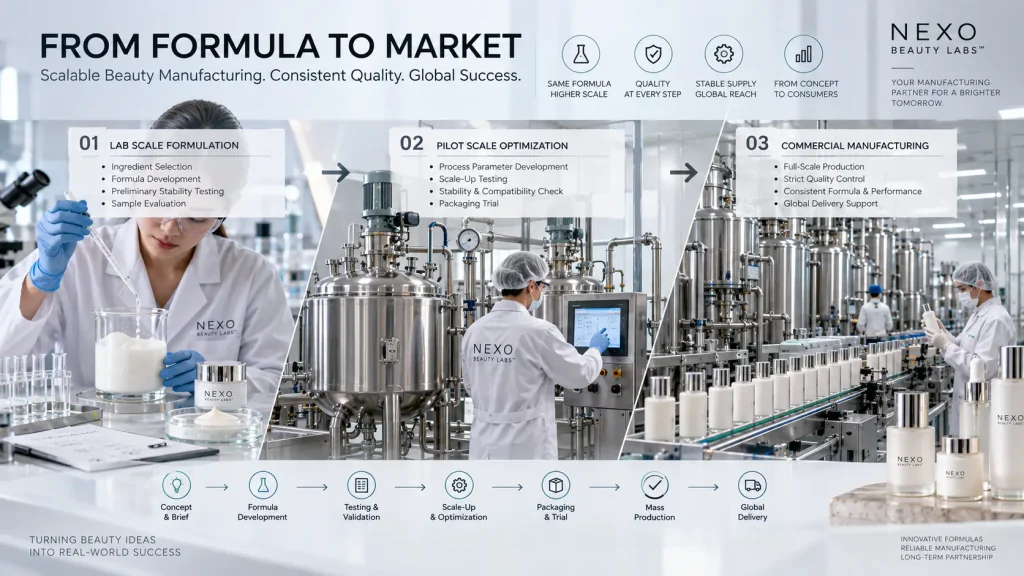
A formula can show good stability during early laboratory work and still require continued evaluation when manufacturing conditions change.
Moving from a small laboratory batch to production equipment can change:
- Batch size
- Mixing
- Shear
- Homogenization
- Heating rate
- Cooling rate
- Processing time
- Ingredient-addition sequence
These variables can influence the physical structure and sensory characteristics of the finished product.
That is why:
Lab Stability ≠ Automatic Manufacturing Stability
The commercial process still needs to reproduce the characteristics established during development.
Related Guide: Once a stable laboratory formula moves toward commercial scale, manufacturing parameters such as mixing, homogenization, heating, cooling, filling, and in-process quality control become part of maintaining product consistency. See how these stages connect in our Complete Cosmetic Manufacturing Process Guide →
Does Stability Testing Determine Cosmetic Shelf Life?
Stability data is an important part of building a shelf-life rationale, but shelf life should not be reduced to one accelerated test or one observation period.
Depending on the product and market, shelf-life decisions can involve:
- Formula characteristics
- Packaging
- Accelerated stability data
- Real-time observations
- Microbiological considerations
- Preservation strategy
- Storage conditions
- Product format
- Target market
- Other relevant supporting data
Brands should therefore avoid asking only:
“How many days is your stability test?”
A better question is:
“How was the stability program designed for this specific product, and what evidence supports the proposed shelf-life approach?”
When Should a Cosmetic Product Be Re-Evaluated?
Stability work should also be reconsidered when important aspects of the finished product change.
Examples can include:
- Significant formula changes
- Changes to important raw materials
- Changes in supplier or material grade where technically relevant
- A new preservation strategy
- A major processing change
- Scale-up to significantly different manufacturing equipment
- Changes to primary packaging
- A new dispensing system
- An intended shelf-life extension
- Unexpected quality complaints or stability observations
The appropriate amount of additional work depends on the significance of the change and the product itself.
The key principle is that stability evidence should remain relevant to the commercial product actually being manufactured and sold.
Questions Beauty Brands Should Ask Their Manufacturer
Before moving toward commercial production, ask:
- How is stability evaluated for this product?
- Which characteristics are monitored?
- Which storage or stress conditions are being used?
- Why was this protocol selected?
- What are the evaluation time points?
- What specifications or acceptance criteria are being used?
- Is the intended commercial packaging included?
- How is formula-packaging compatibility evaluated?
- How are results documented?
- What happens if a characteristic changes?
- Does this product require different evaluation from another format?
- When did stability work begin?
- Will the product be re-evaluated after scale-up?
- What data is being used to support shelf-life decisions?
- What changes would trigger additional stability evaluation?
These questions provide much more useful information than simply asking whether a manufacturer “does stability testing.”
Frequently Asked Questions
What is cosmetic stability testing?
Cosmetic stability testing evaluates how a formulation’s relevant physical, chemical, sensory, and functional characteristics behave under defined conditions over time.
Why is stability testing important for skincare products?
It can identify changes such as separation, discoloration, viscosity changes, precipitation, texture changes, or packaging-related problems before large-scale commercial distribution.
How long does cosmetic stability testing take?
There is no universal duration that applies to every cosmetic. The program depends on the formula, product type, packaging, test conditions, study objectives, and intended market.
What is accelerated cosmetic stability testing?
Accelerated stability testing uses defined stress or storage conditions to help identify potential product changes earlier than relying only on longer-term real-time observation.
Does accelerated stability testing equal a specific number of years of shelf life?
Not automatically. Cosmetic formulation systems vary significantly, so accelerated results should not be treated as a universal mathematical conversion to shelf life.
What is real-time stability testing?
Real-time stability observation follows the product over a longer period under defined or expected storage conditions to understand how it behaves as time passes.
Can packaging affect cosmetic stability?
Yes. Packaging can influence light and air exposure, formula contact surfaces, leakage, dispensing, evaporation or loss of volatile components, and the overall behavior of the commercial product.
Is stability testing the same as packaging compatibility testing?
No. Formula stability asks whether the formulation maintains its intended characteristics. Packaging compatibility asks whether the formula and intended commercial package continue functioning appropriately together.
Is stability testing the same as preservative challenge testing?
No. Stability testing primarily evaluates the physical, chemical, sensory, and relevant functional characteristics of the formula. Preservative efficacy or challenge testing evaluates the performance of an appropriate preservation system under defined microbial challenge conditions.
Does every cosmetic product need the same stability test?
No. Stability protocols should reflect the actual formula, product format, packaging, intended storage and use conditions, and development objectives.
Does stability testing determine cosmetic shelf life?
Stability data contributes important supporting evidence, but shelf-life decisions should consider the complete product, packaging, stability program, microbiological factors, storage conditions, and applicable market requirements.
What happens if a cosmetic formula fails stability evaluation?
The formulation, manufacturing process, packaging, or relevant raw materials can be investigated to determine why the product changed. The product may then be optimized and re-evaluated before commercial production.
Do I need to repeat stability testing after changing packaging?
A significant primary-packaging change can affect the formula-package system, so the available stability and compatibility evidence should be reviewed to determine what additional evaluation is appropriate.
Build Stability Into Cosmetic Product Development
A formula that looks beautiful on the day it is created is only the beginning.
A commercially viable cosmetic product needs to remain consistent beyond the first laboratory sample.
That means stability should be considered alongside:
Formulation → Packaging → Testing → Scale-Up → Manufacturing
At NEXO Beauty Labs, product stability is considered as part of the wider private label, ODM, and custom OEM development process together with formulation, packaging compatibility, product evaluation, and manufacturing requirements.
Different skincare, haircare, body care, scalp care, and personal care products can require different evaluation strategies according to their formula, format, packaging, manufacturing process, and intended market.
Request a Cosmetic Stability Testing & OEM/ODM Consultation with NEXO Beauty Labs to discuss your formulation, packaging, testing strategy, scale-up, and manufacturing requirements.