Retinol vs Bakuchiol vs Peptides: Which Anti-Aging Serum Direction Should Your Skincare Brand Develop?
Compare retinol, bakuchiol and peptides to find the right anti-aging serum direction for your brand, from positioning and formulation to texture, packaging and stability.
A retinol night serum, botanical-inspired bakuchiol treatment, and peptide firming serum may all sit within the broader anti-aging skincare category.
But from a product-development perspective, they can become three very different products.
They create different expectations around:
- Consumer recognition
- Product positioning
- Evidence
- Formula architecture
- Sensory experience
- Packaging
- Stability
- Claims
- Target market
So the better question isn’t:
“Which anti-aging ingredient is strongest?”
It is:
“Which active direction best supports the consumer, product promise, evidence strategy, and brand positioning we are trying to build?”
Anti-aging serum development should begin with positioning — not with the longest possible list of active ingredients.
Quick Answer: Retinol vs Bakuchiol vs Peptides
This is a product-development framework — not an efficacy ranking.
If established evidence and recognizable active-led night care are central, retinol may fit naturally.
If a retinol-free botanical story is important, bakuchiol creates a different direction.
If technology-led firming and formulation differentiation matter, a specific peptide system may be appropriate.
The finished formulation still determines the commercial product.
1. Define the Anti-Aging Product Before Choosing the Hero Active
Before discussing retinol, bakuchiol, or peptides, define what the product is actually intended to do cosmetically.
Is the primary concept:
- Visible fine-line care?
- Smoother-looking texture?
- Firmer-looking skin?
- Daily age-care?
- Botanical-inspired anti-aging?
- Night treatment?
- Retinol-free age care?
- Barrier support + firming?
- Premium single-dose treatment?
Then define:
- Target consumer
- Application area
- Morning or evening use
- Desired texture
- Product format
- Price positioning
- Packaging
- Claims
- Target market
A facial night serum and an under-eye treatment should not share the same development brief simply because both contain retinol.
A useful rule is:
Product Story First → Hero Active Second
2. Retinol: The Most Evidence-Established Direction of the Three
Retinol is a form of vitamin A and has a well-established place in topical age-care skincare.
One randomized, double-blind, vehicle-controlled study evaluated a specific 0.4% retinol lotion on naturally aged skin for 24 weeks.
Importantly, this was not a generic commercial face-serum study: 36 elderly participants were enrolled, and the retinol lotion was applied to arm skin up to three times per week under the study protocol.
The study reported a statistically significant improvement in fine wrinkling in retinol-treated skin compared with the vehicle.
View the retinol clinical study on PubMed
For beauty brands, retinol can therefore support product concepts around:
- Nighttime skincare
- Visible fine-line care
- Smoothing
- Active-led treatment
- Premium age-care routines
But evidence for retinol as an ingredient does not mean every retinol serum will perform identically.
Retinol Formulation Considerations
- Retinol concentration
- Raw-material form
- Encapsulation or delivery system where applicable
- Formula base
- Consumer tolerance
- Light exposure
- Oxygen exposure
- Processing conditions
- Storage
- Packaging
- Stability
- Target-market restrictions
Retinol use can also be associated with dryness, scaling, stinging, or other tolerance issues in some users.
That means:
Higher concentration does not automatically mean a better commercial product.
The goal is to balance efficacy-oriented positioning, stability, consumer experience, regulatory requirements, and appropriate claims.
3. Retinol Evidence Is Stronger — But Still Formula-Specific
One of the most important distinctions in this comparison is the strength and depth of evidence.
Retinol has been studied in topical skincare for much longer than bakuchiol and many individual cosmetic peptides.
However, brands should still avoid turning that into:
“Retinol is proven, therefore every retinol product is proven.”
A clinical result belongs to:
- The specific ingredient
- The concentration tested
- The finished formulation
- The application frequency
- The study population
- The study duration
- The measured endpoints
This distinction becomes essential when developing finished-product claims.
For a related eye-care format, see Retinol & Collagen Firming Hydrogel Eye Patches.
4. Bakuchiol: A Different Botanical-Inspired Age-Care Direction

Bakuchiol is frequently discussed alongside retinol.
But:
Bakuchiol is not retinol and is not a vitamin A derivative.
Its value for a beauty brand is not simply that it can be marketed as a copy of retinol.
It creates a different product and consumer story.
A randomized, double-blind 12-week study involving 44 participants directly compared 0.5% bakuchiol cream used twice daily with 0.5% retinol cream used once daily.
Both groups showed improvements in measured wrinkle surface area and hyperpigmentation in that study, while retinol users reported more scaling and stinging.
View the bakuchiol vs retinol study on PubMed
But the result needs to be interpreted carefully.
The study:
- Included only 44 participants
- Lasted 12 weeks
- Used specific finished creams
- Used different application frequencies
- Does not establish universal equivalence between all bakuchiol and retinol products
The tested concentrations are also study conditions — not automatic formulation recommendations.
Bakuchiol Development Considerations
- Raw-material identity
- Purity
- Ingredient concentration
- Supplier specifications
- Formula base
- Solubility
- Color
- Odor
- Stability
- Packaging
- Sensory profile
- Supporting evidence
Botanical positioning should not automatically become claims such as:
“Zero irritation”
or:
“Exactly the same results as retinol without side effects.”
Those statements are much broader than the evidence from one small comparative trial.
For a single-dose format direction, see AgeReset Bakuchiol Serum Capsules.
5. Is Bakuchiol Really a “Natural Retinol”?
This phrase is common in consumer marketing, but technically it can be misleading.
Bakuchiol and retinol are different molecules.
Bakuchiol is not converted into retinoic acid simply because some research has reported overlapping biological or cosmetic outcomes.
A stronger product-development description is:
Bakuchiol = A Distinct Botanical-Inspired Age-Care Active
rather than:
Bakuchiol = Retinol in Plant Form
This distinction allows brands to build a credible retinol-free product without overclaiming equivalence.
6. Peptides: Start by Asking “Which Peptide?”
“Peptide serum” sounds specific.
From a formulation perspective, it is not.
Peptides are a category — not one interchangeable active ingredient.
Different peptide systems can differ in:
- Chemical structure
- Raw-material form
- Supplier concentration
- Recommended use level
- Solubility
- Processing conditions
- pH requirements
- Stability
- Skin-delivery considerations
- Supporting evidence
A controlled 12-week study involving 93 women evaluated a moisturizer containing a specific palmitoyl pentapeptide, pal-KTTKS.
The study used a split-face design comparing a control moisturizer with the same moisturizer containing 3 ppm pal-KTTKS and reported improvement in fine lines and wrinkles for the peptide-containing product.
View the palmitoyl pentapeptide study on PubMed
That result supports the specific peptide system and finished formulation tested.
It does not prove that every serum labeled “multi-peptide” will produce the same result.
Questions to Ask About a Peptide System
- Which exact peptide is being proposed?
- What INCI or supplier trade material contains it?
- What evidence supports that peptide?
- What is the supplied raw-material concentration?
- Does a quoted percentage refer to pure peptide or the complete supplier blend?
- What is the recommended use level?
- What processing temperature is recommended?
- What pH range is appropriate?
- How should it be incorporated?
- What stability data are available?
- Which finished-product claims can reasonably be supported?
For one technology-oriented example, see Copper Peptide & Ectoin Barrier Repair Serum.
7. “10% Peptide Complex” May Not Mean 10% Pure Peptide
This is an important B2B formulation detail.
Peptide raw materials are often supplied as complex solutions or blends containing components such as:
- Water
- Humectants
- Solvents
- Stabilizers
- Preservatives
- The peptide itself
Therefore, a formula containing:
10% of a peptide supplier solution
does not necessarily contain:
10% pure peptide.
Brands comparing peptide formulas should request technical documentation and understand the difference between:
Supplier Blend Level
and:
Actual Active Peptide Level.
8. Evidence Strength Is Not Equal Across the Three Directions
A useful brand-development framework is to separate:
Consumer Popularity
from:
Evidence Depth.
Retinol has a longer and broader topical research history.
Bakuchiol has promising clinical data, including a direct comparison with retinol, but the overall evidence base is much smaller.
“Peptides” cannot be assigned one evidence level because different peptides have different studies, formulations, concentrations, and biological targets.
This means peptide development should begin with:
Exact Peptide → Exact Evidence → Exact Formula
rather than:
Peptides → Anti-Aging Claim
9. Can Retinol, Bakuchiol & Peptides Be Combined?
Potentially — when there is a clear formulation and positioning reason.
Possible development directions can include:
Retinol + Selected Peptide System
or:
Bakuchiol + Selected Peptide System
depending on the product concept.
Some commercial products also combine retinol and bakuchiol.
But this does not mean more actives automatically create a better anti-aging product.
Combination development may need to evaluate:
- Exact raw materials
- Concentrations
- Solubility
- Formula pH
- Processing conditions
- Stability
- Texture
- Packaging
- Consumer tolerance
- Claims
Evidence for Ingredient A + evidence for Ingredient B does not automatically prove superior performance for Product A+B.
10. Build a Hero Active & Supporting System
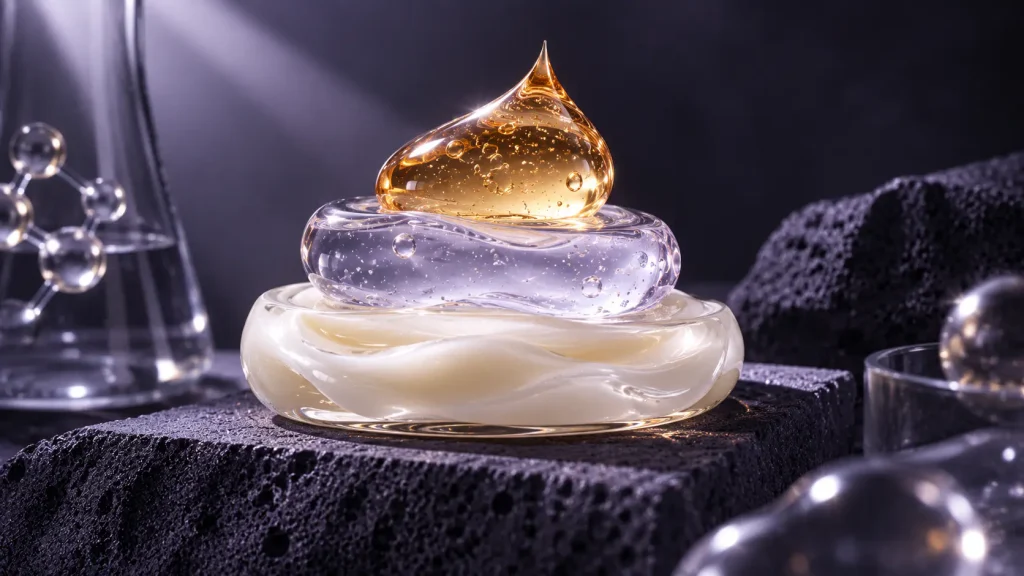
A more coherent development strategy is to give different ingredients different jobs.
Hero Active
The ingredient that anchors the main consumer story.
For example:
Retinol
Supporting Active System
Ingredients that reinforce the concept without competing with the hero ingredient.
For example:
Selected Peptide + Barrier-Support System
Formula Architecture
The base responsible for:
- Texture
- Solubility
- Spreadability
- Stability
- After-feel
- Compatibility
- Consumer experience
This creates a more understandable finished product.
A sophisticated formula does not need every active ingredient printed equally prominently on the front label.
11. More Anti-Aging Actives Can Make the Product Weaker
Ingredient accumulation is a common formulation problem.
The brief begins with retinol.
Then bakuchiol is added.
Then six peptides.
Then PDRN.
Then ceramides.
Then collagen.
Then botanical extracts.
Eventually, the brand has a long ingredient list but no clear answer to:
“What is the hero product story?”
Every additional active can also add:
- Compatibility questions
- Solubility challenges
- Stability risk
- Processing restrictions
- Sensory complexity
- Raw-material cost
- Claims complexity
- Manufacturing complexity
A long active list is not the same as a well-designed anti-aging serum.
12. Match Texture & Format to the Consumer Routine
Active-Led Night Serum
May aim for:
Silky + Controlled Richness + Low Tack + Comfortable Finish
Daily Age-Care Serum
May emphasize:
Lightweight + Fast-Spreading + Easy Layering
Botanical Oil Serum
May emphasize:
Silky + Nourishing + Premium Ritual
Single-Dose Capsule
Can create:
Pre-Measured Dose + Individual Opening Ritual + Premium Format
Dual-Chamber / Activation Format
Can create:
Separate Components + Mixing Ritual + Technology-Led Experience
Choose the format because it solves a product-development need or strengthens the consumer experience — not simply because it looks more innovative.
For more on serum formats, see Serum Capsules vs Bottled Serums: Which Format Is Right for Your Brand?.
13. Packaging & Stability Need to Be Developed Together
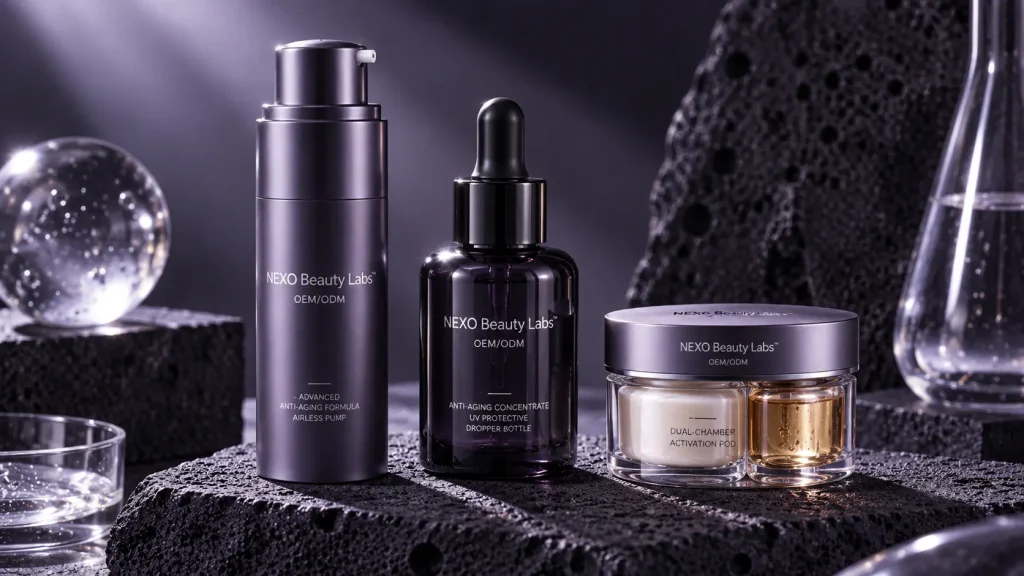
Packaging can be particularly important for active-led age-care products.
Development should consider:
- Formula viscosity
- Dispensing
- Light exposure
- Air exposure
- Product-contact materials
- Dose
- Consumer use
- Formula-package compatibility
- Commercial filling
An airless pump may be useful for certain formulations.
But:
Airless Packaging ≠ Automatic Stability
Opaque Bottle ≠ Automatic Active Protection
Encapsulation ≠ Automatic Superior Efficacy
The actual formula still needs to be evaluated in the selected package.
For more on packaging development, see How to Choose Cosmetic Packaging for Skincare & Beauty Products.
14. Retinol Stability Requires More Than Checking Color & Texture
Active stability is not always visible to the eye.
Research evaluating retinoids in commercial cosmetic products has shown substantial differences in retinoid degradation according to formulation and storage conditions.
View the retinoid stability study on PubMed
This means a product can maintain an acceptable:
- Color
- Odor
- Texture
- Viscosity
while the level of a sensitive active may still be changing.
Depending on the development objective, evaluation may therefore include:
- Appearance
- Color
- Odor
- pH where relevant
- Viscosity
- Separation
- Precipitation
- Packaging performance
- Relevant active-content testing where appropriate
For more detail, see Cosmetic Stability Testing: What Beauty Brands Need to Know.
15. Scale-Up Matters for Active Anti-Aging Serums
A successful laboratory sample still needs to be translated into repeatable commercial production.
Scale-up can change:
- Mixing conditions
- Shear
- Heating and cooling
- Ingredient-addition sequence
- Exposure time
- Light and air exposure
- Deaeration
- Filling conditions
These variables can be especially important for:
- Retinol systems
- Temperature-sensitive peptide raw materials
- Encapsulated systems
- Multi-active formulas
- Dual-chamber products
The commercial question is:
Can the approved formula be reproduced consistently at production scale?
16. Ingredient Evidence Is Not Automatically Finished-Product Evidence
This principle is especially important in anti-aging skincare.
A study on a specific retinol lotion is evidence for the tested retinol product and conditions.
A study on a specific bakuchiol cream supports that tested formulation.
A study on pal-KTTKS supports the specific peptide system used.
None of them automatically proves identical performance for every commercial product containing the ingredient.
A good claims strategy separates:
Ingredient Evidence
from:
Finished-Product Evidence.
Possible cosmetic claim directions may include:
- Helps improve the appearance of fine lines
- Supports firmer-looking skin
- Helps improve skin smoothness
- Supports a more refined-looking complexion
The exact claim and supporting evidence should be determined for the finished product and target market.
17. EU Cosmetic Claims Require Adequate Evidence
For products intended for the European Union, cosmetic claims should follow the common criteria established under Commission Regulation (EU) No 655/2013.
One especially relevant principle for active-led skincare is:
Properties associated with an ingredient should not automatically be presented as properties of the finished cosmetic product without adequate support.
This is particularly relevant when a brand uses:
- Retinol clinical literature
- Bakuchiol ingredient studies
- Peptide supplier data
- In-vitro active data
to build finished-product marketing.
The evidence should be relevant to the actual claim being made.
18. EU Retinol Rules Must Now Be Considered Early in Development
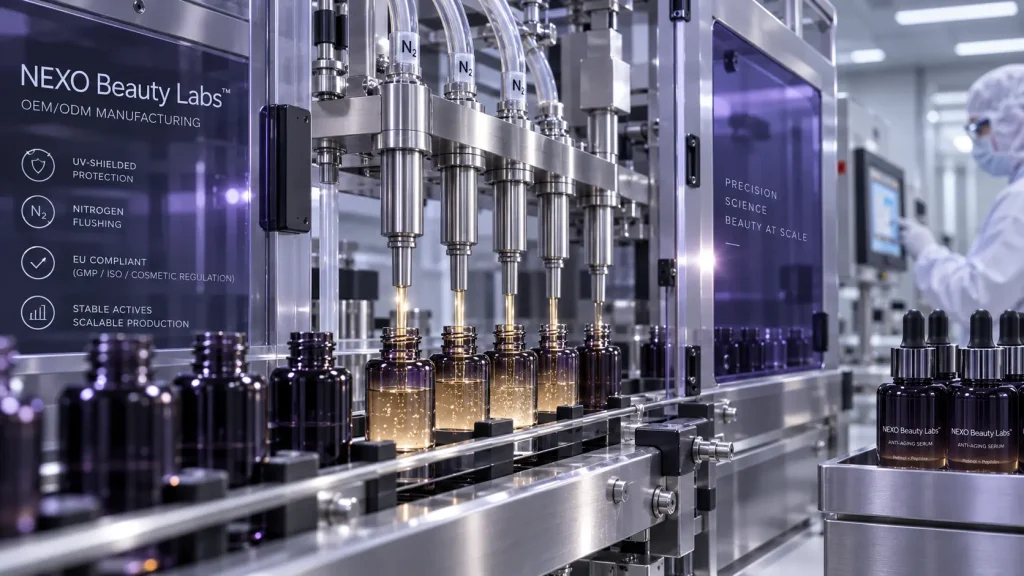
Target market is especially important when developing retinol-containing cosmetics.
Under Regulation (EU) 2024/996, the covered Vitamin A ingredients — Retinol, Retinyl Acetate, and Retinyl Palmitate — are restricted to:
- 0.05% Retinol Equivalent (RE) in body lotion
- 0.3% Retinol Equivalent (RE) in other leave-on and rinse-off cosmetic products
Cosmetics containing these covered Vitamin A ingredients also require the specified warning:
“Contains Vitamin A. Consider your daily intake before use.”
For these Vitamin A restrictions, non-compliant products have not been permitted to be newly placed on the EU market since 1 November 2025.
Products that had already been placed on the market under the transitional conditions may continue to be made available until 1 May 2027.
For a new product being developed now, the practical approach is therefore to formulate to the current requirements rather than rely on the remaining sell-through transition period.
This is a clear example of why every formulation brief should answer:
Where will this product actually be sold?
19. Which Anti-Aging Direction Fits Your Brand?
Consider Retinol When:
- Fine-line and smoothing positioning is central
- Recognizable evidence-led age care fits the brand
- A night-treatment story makes sense
- The project can support appropriate stability work
- Consumer tolerance is considered
- Target-market Vitamin A requirements have been reviewed
Consider Bakuchiol When:
- A retinol-free product story is important
- Botanical-inspired age care fits the brand
- A premium serum, oil-serum, or capsule concept is desired
- The positioning does not depend on claiming universal equivalence with retinol
Consider Peptides When:
- Technology-led firming is central
- You can identify the exact peptide system
- Supplier documentation is available
- The evidence matches the selected peptide
- A premium active story fits the brand
The stronger development sequence is:
Target Consumer
↓
Primary Product Promise
↓
Evidence Strategy
↓
Hero Active
↓
Supporting Active System
↓
Formula Architecture
↓
Texture & Format
↓
Packaging
↓
Stability & Scale-Up
↓
Claims
↓
Target Market
Frequently Asked Questions
Is retinol better than bakuchiol for anti-aging skincare?
Retinol has a deeper and longer-established topical evidence base, but that does not mean it is automatically the right choice for every product. Bakuchiol creates a different retinol-free and botanical-inspired product direction. The decision should consider evidence, target consumer, tolerance goals, formula architecture, packaging and positioning.
Is bakuchiol the same as retinol?
No. Bakuchiol is not retinol and is not a vitamin A derivative. Although one small clinical study directly compared specific bakuchiol and retinol creams, the result does not establish universal equivalence between all products containing the two ingredients.
Is bakuchiol a natural retinol?
Not technically. “Natural retinol” is a marketing shorthand that can cause confusion. Bakuchiol is a distinct molecule with its own evidence, formulation requirements and product-positioning opportunities.
Are peptides better than retinol?
There is no useful universal comparison because “peptides” describes a broad category. Retinol has a more established overall evidence base, while peptide performance depends strongly on the exact peptide system, concentration, delivery and finished formulation.
Are all peptide serums similar?
No. Different peptide raw materials can have different structures, concentrations, supplier vehicles, recommended use levels, stability requirements and supporting evidence.
What does 10% peptide complex mean?
It may refer to 10% of a supplier’s peptide-containing raw-material blend rather than 10% pure peptide. Brands should review technical documentation to understand the actual active composition.
Can retinol and peptides be formulated together?
Potentially. Feasibility depends on the specific retinol system, peptide raw material, concentrations, pH, processing conditions, formula architecture and stability requirements.
Can bakuchiol and peptides be used together?
They can be considered within the same formula when the ingredient systems are compatible and the combination supports a clear product concept.
Can retinol and bakuchiol be used in the same formula?
Potentially. Commercial combination products exist, but combining the ingredients does not automatically make the finished formula superior. Compatibility, use levels, stability, consumer tolerance and claims still need to be evaluated.
Is higher retinol concentration always better?
No. Higher concentration can also affect tolerance, stability, regulatory compliance and consumer usability. The appropriate concentration should be determined for the actual finished product and target market.
Does encapsulated retinol automatically work better?
No. Encapsulation can be used as a formulation or delivery strategy, but the presence of an encapsulated system alone does not prove superior stability, tolerance or efficacy. Those characteristics should be demonstrated for the finished product.
Is bakuchiol irritation-free?
That should not be assumed. The small direct comparison study reported better tolerability for the tested bakuchiol cream than the tested retinol cream, but this does not establish that every bakuchiol cosmetic causes zero irritation.
What packaging is suitable for retinol serum?
Possible options include pumps, airless systems, protective bottles, capsules and other formats selected according to the formulation’s exposure, dispensing and compatibility requirements. Packaging alone does not guarantee stability.
Do anti-aging serums need stability testing?
Yes. The finished formula should be evaluated in its intended packaging using relevant physical, chemical and other product-specific parameters. Sensitive active content may also need appropriate analytical evaluation depending on the development objective.
What is the EU retinol limit for face serum?
Under the current EU restriction covering Retinol, Retinyl Acetate and Retinyl Palmitate, cosmetic products other than body lotion are limited to a maximum of 0.3% Retinol Equivalent (RE). The exact formulation still needs to be reviewed for compliance with applicable EU requirements.
Can ingredient clinical studies be used directly as finished-product claims?
Not automatically. Ingredient studies can support ingredient selection, but finished-product claims need evidence relevant to the actual product and benefit being communicated.
Build the Anti-Aging Product Before Building the Active List
The strongest anti-aging serum does not begin with:
“How many trending actives can we fit into one formula?”
It begins with:
Who is the consumer?
What is the primary cosmetic product promise?
How strong is the evidence for the selected active system?
How should the product feel?
Can the formula remain stable?
Can it be manufactured consistently?
Can the intended claims be supported in the target market?
Once those questions are clear, choosing between retinol, bakuchiol, peptides — or a justified combination — becomes much easier.
At NEXO Beauty Labs, anti-aging skincare development can be approached across private label, ODM, and custom OEM pathways together with active-ingredient strategy, formulation, sensory design, packaging, stability evaluation, product testing, scale-up, and commercial manufacturing.
Whether your brand is developing an evidence-led retinol treatment, botanical-inspired bakuchiol serum, specific peptide firming system, or an advanced capsule or activation format, the active ingredients should support the product strategy — not replace it.
Explore NEXO Beauty Labs’ OEM/ODM Skincare Development Solutions