How to Develop Microbiome-Friendly Skincare: Formulation, Preservation, Claims & Packaging
Learn how brands develop microbiome-friendly skincare through ingredient strategy, preservation, claims, packaging, testing, and OEM/ODM manufacturing.
The skin microbiome has moved from research language into mainstream beauty positioning.
Prebiotic serums, ferment-based moisturizers, postbiotic concepts, microbiome cleansers, and scalp microbiome products are increasingly appearing across the market.
But for beauty brands, “microbiome-friendly” is not simply an ingredient story.
A finished product still requires decisions around:
- Consumer need
- Ingredient identity
- Barrier strategy
- Cleansing intensity
- Preservation
- Texture
- Packaging
- Stability
- Testing
- Claims
- Manufacturing
That creates a more useful development question:
What does a microbiome-conscious cosmetic formula actually need to get right?
Because:
A microbiome-related ingredient does not automatically create a microbiome-friendly finished product.
1. Define the Product Role Before the Microbiome Positioning
“We want a microbiome serum.”
That is not yet a complete product brief.
The development team still needs to understand what problem the product is supposed to solve.
For example:
Barrier-Support Serum
May focus on:
Hydration + Comfort + Lightweight Barrier-Oriented Care
Sensitive-Skin Moisturizer
May focus on:
Comfort + Gentle Sensory Profile + Barrier Support
Mild Cleanser
May focus on:
Effective Cleansing + Appropriate Surfactant System + Comfortable Post-Wash Feel
Scalp Microbiome Serum
May focus on:
Scalp Comfort + Lightweight Root Feel + Oil-Balance Positioning
These products may all use a microbiome-inspired formulation strategy.
They should not automatically share the same:
- Base formula
- Texture
- Ingredients
- Packaging
- Application
- Claims
The microbiome can provide a scientific and product-development framework.
The consumer still needs a clear reason to use the product.
2. Define the Microbiome Ingredient Before Choosing the Marketing Term
This is one of the most important distinctions in microbiome skincare.
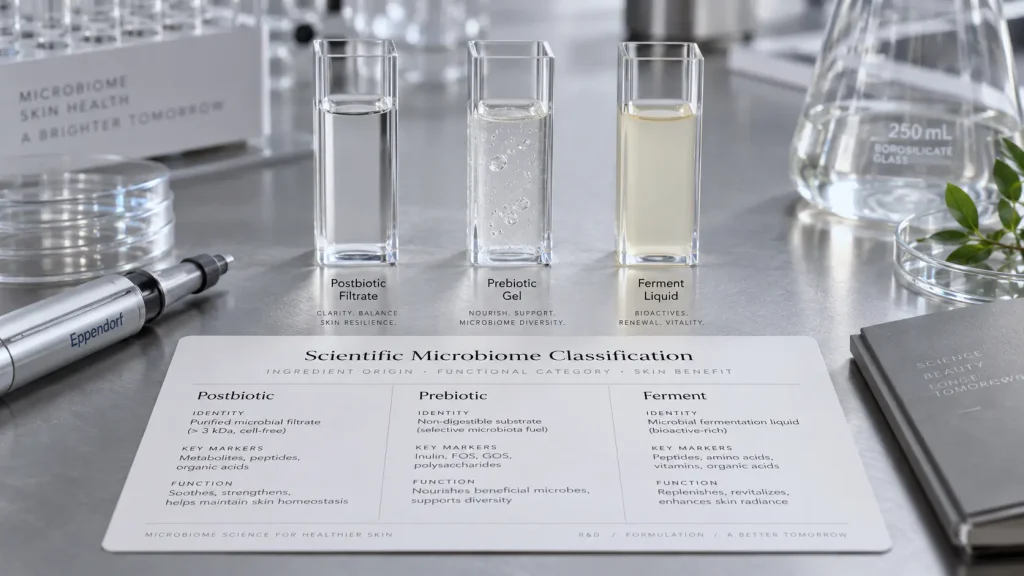
Beauty marketing often places terms such as prebiotic, probiotic, postbiotic, ferment, lysate, and filtrate together.
Scientifically, they should not automatically be treated as interchangeable.
Prebiotic
A prebiotic is more specific than simply:
“Food for good bacteria.”
In the scientific definition, a prebiotic is a substrate that is selectively utilized by host microorganisms and confers a health benefit.
That means not every sugar, botanical extract, fiber, or microbiome-associated ingredient should automatically be described as a prebiotic.
For product development, brands should confirm:
- Exact ingredient identity
- Supplier documentation
- Relevant supporting evidence
- Recommended use level
- Intended microbiome rationale
- Finished-product positioning
Probiotic
In the scientific definition, probiotics are live microorganisms that, when administered in adequate amounts, confer a health benefit on the host.
This creates a much more demanding formulation problem than simply adding a microbial-derived ingredient to a conventional cosmetic.
If a cosmetic genuinely contains live microorganisms intended to remain viable until use, the development team may need to consider:
- Microorganism and strain identity
- Viability
- Effective quantity
- Water activity
- Preservation compatibility
- Temperature
- Oxygen exposure
- Packaging
- Storage
- Filling
- Shelf life
- Activation at use where relevant
This is very different from putting a microbial lysate into a conventional serum.
Postbiotic
The term postbiotic should also be used carefully.
Under the scientific definition, a postbiotic is a preparation of inanimate microorganisms and/or their components associated with a demonstrated benefit.
This means a purified microbial metabolite does not automatically become a postbiotic simply because microorganisms produced it.
Ferment / Lysate / Filtrate
Ferments, lysates, filtrates, and other microbial-derived cosmetic ingredients can still be highly relevant to microbiome-inspired skincare.
But they should be described according to:
what the material actually is
and:
what its evidence actually supports.
They should not automatically be relabeled as:
“postbiotic”
simply because the terminology is commercially attractive.
Define the ingredient first. Build the marketing terminology second.
The ingredient route changes the formulation problem.
3. Define the “Microbiome-Friendly” Claim Before Designing the Test
The term:
“Microbiome-friendly”
can sound like one universally standardized technical classification.
In practice, there is no single universal criterion that automatically makes every cosmetic product microbiome-friendly simply because it contains a microbiome-associated ingredient.
The development and evaluation approach should follow the specific product and the specific claim.
Depending on the intended positioning, evaluation might consider areas such as:
- Defined microbial populations
- Relative abundance of selected microorganisms
- Changes before and after product use
- Microbial diversity where relevant
- Barrier-related outcomes
- Consumer tolerance
- Other clearly defined microbiome endpoints
Brands should therefore avoid assuming:
Contains microbiome ingredient = microbiome-friendly finished product
The correct evaluation strategy depends on the actual claim being made.
This becomes especially important with broad language such as:
“Balances the microbiome.”
What exactly does “balance” mean?
Does it refer to:
- Microbial diversity?
- Selected microorganisms?
- Recovery after cleansing?
- A barrier-related outcome?
- Another defined and measurable endpoint?
If the endpoint is unclear, the claim becomes difficult to evaluate and substantiate.
Microbiome-friendly can be a positioning direction. The finished-product evidence still needs a clearly defined question.
4. Design Preservation Around the Formula and Microbiological Risk
A common misconception is:
“Microbiome-friendly means preservative-free.”
That is not a sound product-development principle.
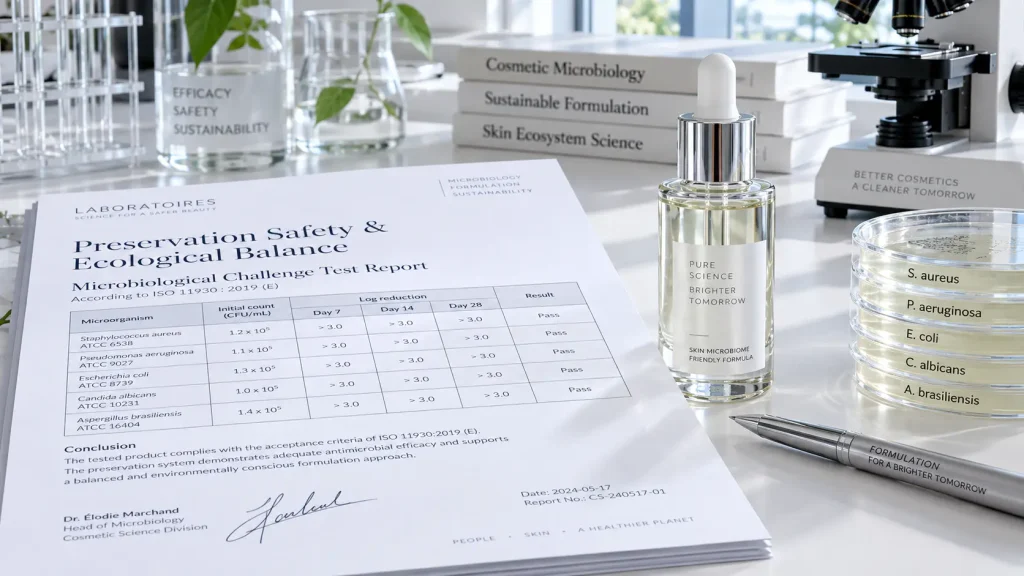
A commercial cosmetic still needs appropriate protection against unwanted microbial contamination and growth.
Depending on the formula, its microbiological protection strategy may involve:
- Preservation system
- pH
- Water activity
- Multifunctional ingredients
- Packaging
- Manufacturing hygiene
- Filling conditions
- Product-specific microbiological risk assessment
The appropriate strategy depends on the actual formula, package, intended use, and microbiological risk.
This is particularly important for water-containing cosmetics.
The product may be designed with the skin ecosystem in mind.
The formula inside the package still needs to remain microbiologically safe.
Those are two different questions.
Question 1
Is the commercial cosmetic adequately protected against unwanted microbial contamination?
Question 2
Does the finished product support the microbiome-related positioning being communicated?
Both matter.
Microbiome-conscious formulation does not mean preservation-free formulation.
5. Treat Live-Probiotic Skincare as a Separate Technical Project
Many commercial products positioned within the microbiome category rely on:
- Ferments
- Lysates
- Inactivated microbial preparations
- Microbial derivatives
- Prebiotic strategies
rather than viable microorganisms that need to remain alive throughout the commercial product’s shelf life.
There is a practical reason.
A conventional cosmetic preservation strategy is generally intended to control unwanted microbial growth.
A genuine probiotic concept requires selected microorganisms to remain viable in an appropriate quantity until use while still meeting the product’s safety and quality requirements.
That creates a very different technical problem.
A live-microorganism project may therefore require a product architecture that considers:
Microorganism Identity
↓
Viability
↓
Preservation Compatibility
↓
Temperature
↓
Moisture
↓
Oxygen
↓
Packaging
↓
Filling
↓
Storage
↓
Activation Where Relevant
↓
Shelf Life
This does not mean live-probiotic cosmetic development is impossible.
It means:
a genuine live-probiotic product should not be treated as a conventional serum with one unusual ingredient added.
For brands, this distinction needs to happen very early in the product brief.
6. Connect Microbiome Strategy With Barrier Care
Microbiome beauty is sometimes presented as if microorganisms are the only thing that matters.
A more useful formulation view is broader.
Skin ecosystem considerations can sit alongside:
- Barrier condition
- Hydration
- Lipid systems
- pH
- Cleansing
- Skin comfort
- Product frequency
- Overall formula mildness
This creates an important strategic question:
Is this primarily a microbiome product?
or:
Is this a barrier-support product designed with microbiome considerations?
For many consumer concepts, the second framing may actually be clearer.
A moisturizer could be built primarily around:
Hydration + Barrier Support + Comfort
while microbiome thinking influences ingredient selection, formula architecture, cleansing compatibility, preservation strategy, and product evaluation.
Supporting the skin ecosystem can begin with designing the complete formula carefully — not simply adding one microbiome ingredient.
Related Guide: If barrier support is the primary product role, texture becomes another important development decision. Compare how creams, lotions, and gels differ in richness, sensory profile, packaging, and positioning in our Barrier Repair Cream, Lotion & Gel Guide →
7. Design Cleansing Around the Skin Ecosystem
Microbiome skincare often focuses on:
Serums
Essences
Creams
But cleansing deserves equal attention.
A cleanser directly interacts with the skin surface and is used repeatedly.
That makes areas such as these important:
- Surfactant system
- Cleansing intensity
- pH
- Foam profile
- Rinse behavior
- Tightness perception
- Residual feel
- Usage frequency
- Post-cleansing comfort
This does not mean:
“Microbiome cleanser = cleanser that barely cleans.”
A cleanser still needs to perform its primary function.
The objective is to create an appropriate balance for the intended consumer and use case.
Sometimes the most important ecosystem-oriented decision is not:
What microbiome ingredient should we add?
It is:
How should this product cleanse?
Product Example: Explore one microbiome-inspired cleansing direction with our Rose Microbiome No-Rinse Makeup Remover →
8. Build an Ecosystem-Based Formula — Not an Ingredient Stack
Microbiome formulas can easily turn into ingredient collections.
A brief begins with:
Prebiotic Ingredient
Then adds:
Ferment
Then:
Lysate
Then:
Postbiotic
Then:
Eight Botanical Extracts
The INCI list becomes longer.
The product does not automatically become more microbiome-oriented.
Every ingredient addition can introduce questions around:
- Compatibility
- Preservation
- Stability
- Color
- Odor
- Texture
- Cost
- Claims
- Manufacturing
A stronger architecture might look like:
Primary Consumer Need
Barrier Comfort
Microbiome Strategy
One clearly defined microbiome-related ingredient or formulation approach.
Supporting Formula System
Hydration + Barrier Support + Sensory Comfort
Now each part of the formulation has a reason to exist.
Microbiome formulation should not become another ingredient arms race.
9. Build the Texture and Sensory Brief Around Daily Use
Advanced microbiome science does not remove everyday sensory expectations.
Consumers still experience:
Spreadability
Stickiness
Oiliness
Absorption
Residue
Fragrance
Comfort
After-Feel
Different microbiome concepts therefore require different sensory briefs.
Barrier-Oriented Facial Serum
Might target:
Silky + Hydrating + Low Tack + Comfortable
Lightweight Lotion
Might target:
Milky + Soft + Fast-Spreading + Low Residue
Scalp Microbiome Serum
Might target:
Lightweight + Fresh + Fast-Spreading + Root-Friendly
A compelling scientific story cannot compensate for a product consumers dislike applying every day.
Microbiome science can shape the formulation philosophy. Sensory design still shapes the daily experience.
10. Choose Packaging Based on the Actual Formula
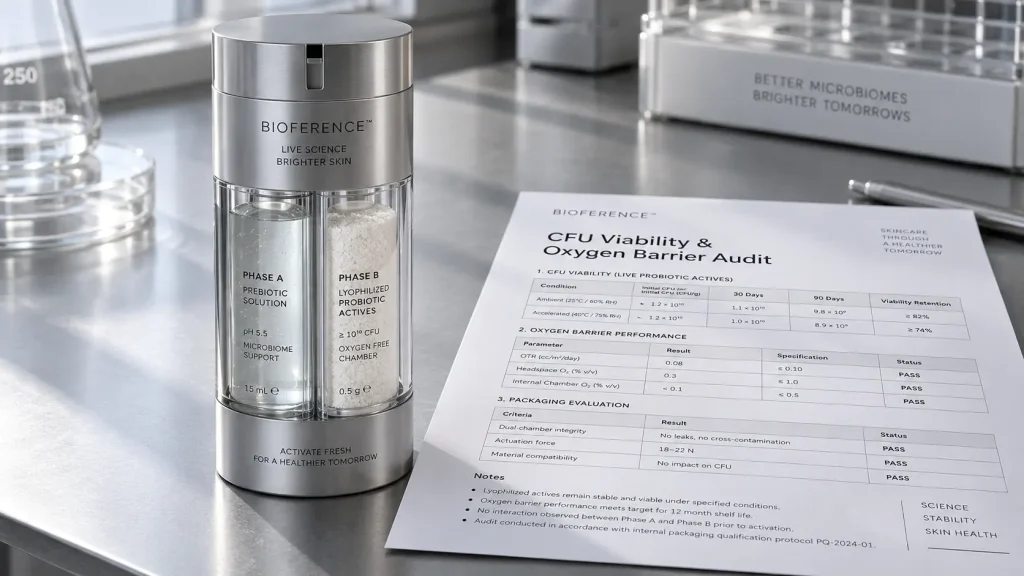
There is no universal rule such as:
“Microbiome skincare should always use airless packaging.”
Packaging should follow the actual formula and product system.
A conventional serum might use:
Pump / Airless / Dropper
A lotion might use:
Pump / Airless
A cleanser might use:
Bottle / Pump
A scalp treatment might use:
Targeted Nozzle / Dropper / Spray
A genuine live-microorganism concept may create completely different storage, exposure, dispensing, viability, and activation requirements.
Packaging development may need to consider:
- Formula viscosity
- Dose
- Air exposure
- Moisture exposure
- Product-contact materials
- Pump performance
- Nozzle behavior
- Filling
- Consumer handling
- Storage
- Formula-package compatibility
“Microbiome skincare” is too broad to prescribe one packaging solution.
The package needs to follow the actual product system.
Related Guide: Once the formula architecture is clear, packaging should be selected around viscosity, dosing, exposure, dispensing, filling, compatibility, MOQ, and consumer use. See our Guide to Choosing Cosmetic Packaging →
11. Plan Stability and Microbiological Evaluation Early
Microbiome positioning does not remove normal cosmetic development requirements.
The formula still needs to be evaluated as a commercial product.
Depending on the product, that can include:
- Appearance
- Color
- Odor
- pH where relevant
- Viscosity
- Separation
- Ingredient compatibility
- Packaging compatibility
- Microbiological quality
- Preservation performance where appropriate
Live-organism concepts introduce additional viability questions.
Ferment-, lysate-, postbiotic-, or prebiotic-based conventional cosmetics create different stability and formulation considerations.
They should not be assumed to behave identically simply because all of them appear under the broad microbiome category.
The product story may be ecosystem-oriented.
The finished cosmetic still needs to remain stable, microbiologically appropriate, fillable, and reproducible.
Related Guide: For a deeper look at how appearance, viscosity, pH, separation, packaging compatibility, accelerated conditions, and real-time observation can be evaluated during cosmetic development, read Cosmetic Stability Testing Explained →
12. Build Microbiome Claims Around Finished-Product Evidence
Microbiome language can quickly become stronger than the evidence.
Examples that deserve particular caution include:
“Restores a healthy microbiome.”
“Rebalances good and bad bacteria.”
“Repairs dysbiosis.”
“Treats microbiome imbalance.”
“Eliminates harmful bacteria while protecting good bacteria.”
The issue is not simply that these statements sound scientific.
Depending on the wording and market, they may imply:
- A defined biological state
- A measurable microbial change
- A disease-related condition
- A structure/function effect
- A level of microbial selectivity the finished product may not have demonstrated
A stronger development pathway is:
Ingredient Evidence
↓
Finished Formula
↓
Defined Evaluation Method
↓
Supporting Evidence
↓
Target-Market Review
↓
Commercial Claim
General moisturizing data should not automatically become microbiome evidence.
Supplier data for one raw material should not automatically become finished-product proof.
And “microbiome balance” should not be used as an undefined scientific shortcut.
The microbiome story may begin with an ingredient. The claim belongs to the finished product.
Related Guide: Microbiome claims are only one part of finished-product evaluation. To see how stability, microbiological quality, preservation, packaging compatibility, sensory evaluation, claims support, and scale-up can fit into pre-production testing, read Cosmetic Product Testing Before Mass Production →
13. Extend the Microbiome Strategy Into Scalp Care
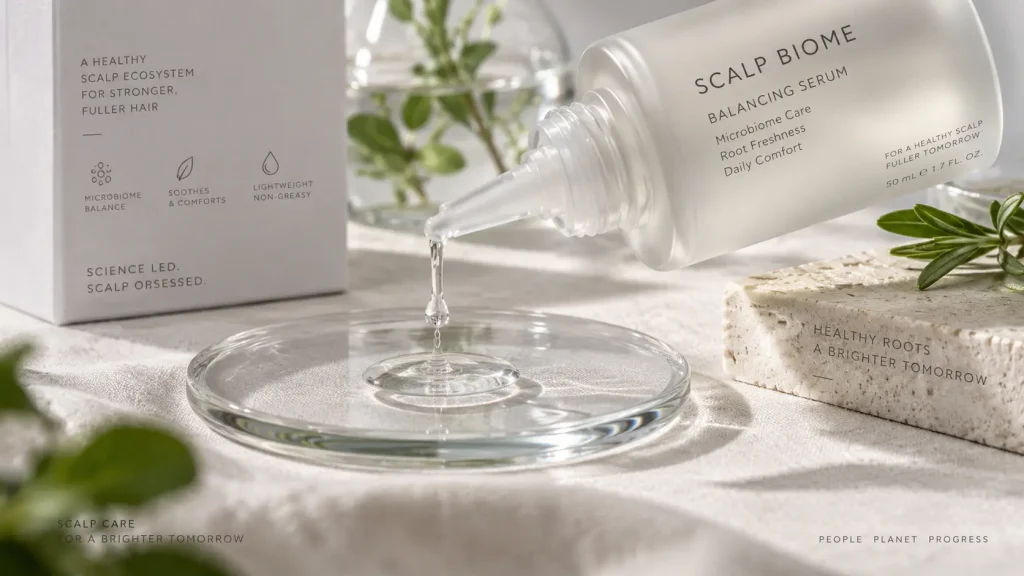
Microbiome product development is not limited to facial skincare.
The scalp has its own environment shaped by:
- Sebum
- Sweat
- Cleansing frequency
- Styling products
- Hair coverage
- Barrier condition
- Comfort
- Microbial communities
That creates an interesting space for:
Lightweight Scalp Serums
Targeted Tonics
Scalp Sprays
Scalp-Focused Cleansing
But again, the consumer need should come first.
A scalp microbiome product might focus on:
Freshness
Scalp Comfort
Oil-Balance Positioning
Low-Residue Root Care
rather than using microbiome language as the only reason the product exists.
Product Example: Explore one lightweight scalp microbiome product direction with our Green Tea Microbiome Scalp Care Serum →
The microbiome may provide the formulation framework. The scalp concern still defines the product job.
Related Guide: If scalp care is part of the microbiome portfolio, the next step is defining the formula, texture, applicator, packaging, testing, claims, and manufacturing route. See our How to Develop a Scalp Serum →
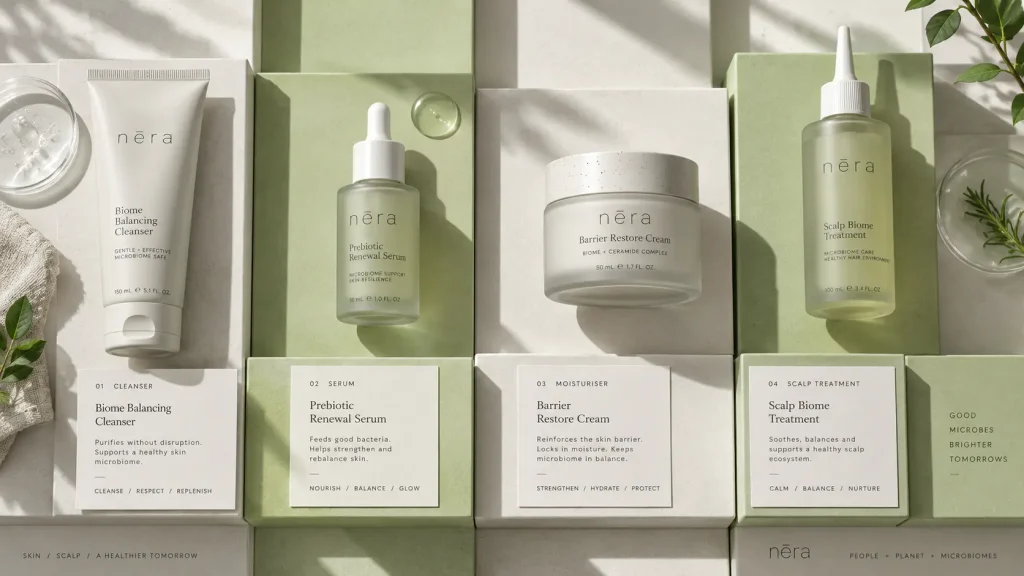
14. Build a Microbiome Product Line Around Different Jobs
A microbiome-conscious range does not need four products that all say:
“Balances the microbiome.”
A stronger architecture can give every SKU a different role.
Cleanse
Microbiome-Conscious Cleanser / No-Rinse Remover
→ Cleansing + Comfortable Post-Wash Experience
Hydrate
Prebiotic- or Ferment-Oriented Serum
→ Hydration + Lightweight Daily Care
Support
Barrier Lotion or Cream
→ Comfort + Moisturization + Barrier-Oriented Care
Target
Scalp Microbiome Serum
→ Scalp Comfort + Low-Residue Root Care
Now the products share an ecosystem philosophy without repeating the same claim.
A stronger microbiome line gives every SKU a clear job within the routine.
15. Turn the Microbiome Concept Into a Development-Ready Brief
Compare:
Weak Brief
“We want a probiotic microbiome serum.”
The formulation team receives:
Trend + Ingredient Language + Product Format
but little actual product strategy.
Now consider:
Stronger Brief
“We want a lightweight daily facial serum for consumers concerned with dryness, sensitivity, and barrier comfort.
The formula should use a clearly defined microbiome-related ingredient strategy, provide hydration with low tack, and fit comfortably beneath moisturizer and sunscreen.
The preservation system, packaging, and claims should be developed around the final formula rather than assuming that the presence of a ferment or prebiotic ingredient automatically makes the finished product microbiome-friendly.”
Now R&D understands:
Consumer
↓
Primary Need
↓
Product Role
↓
Microbiome Strategy
↓
Exact Ingredient Identity
↓
Texture
↓
Routine
↓
Preservation
↓
Packaging
↓
Claim Boundary
That is much closer to a development-ready brief.
16. Connect the Microbiome Strategy to Manufacturing Feasibility
A strong microbiome concept still needs to become a commercially repeatable cosmetic product.
The manufacturing team may need to consider:
- Raw-material specifications
- Ingredient addition sequence
- Temperature exposure
- Mixing and homogenization
- pH control where relevant
- Preservation strategy
- Manufacturing hygiene
- Filling conditions
- Packaging compatibility
- Batch specifications
- Quality control
- Scale-up consistency
A live-microorganism system may create additional viability and handling requirements that do not apply to a conventional ferment-, lysate-, or prebiotic-based cosmetic.
Likewise, a formula that works in a small laboratory batch still needs to remain reproducible when the batch size, equipment, filling process, and commercial packaging change.
The objective is not simply to develop a microbiome story.
It is to build a microbiome-conscious product system that can be manufactured, filled, evaluated, released, and reordered consistently.
Frequently Asked Questions
Does microbiome-friendly skincare need to contain live probiotics?
No.
A microbiome-inspired product may use prebiotic strategies, ferments, lysates, inactivated microbial preparations, or other appropriately supported approaches.
A genuine probiotic concept involving viable microorganisms creates substantially different formulation, preservation, viability, packaging, storage, and evidence requirements.
Are prebiotic, probiotic, postbiotic, ferment, and lysate the same thing?
No.
They describe different materials or scientific concepts.
Brands should confirm the exact identity of the ingredient and the evidence supporting the terminology rather than using these words interchangeably.
Does microbiome-friendly skincare need to be preservative-free?
No.
Microbiome positioning and microbiological protection of the cosmetic itself are different issues.
A commercial formula needs an appropriate microbiological safety and preservation strategy based on its actual formula, package, use conditions, and risk profile.
Can a product containing a ferment claim to be microbiome-friendly?
Not automatically.
Ingredient presence alone does not establish a finished-product microbiome claim.
The appropriate evidence depends on what the brand actually wants to say about the finished product.
Is microbiome skincare only for the face?
No.
Microbiome-inspired development can extend into:
- Scalp care
- Cleansing
- Body care
- Personal care
Each category still requires its own consumer need, formula architecture, sensory brief, packaging, testing, and claims strategy.
Is “balances the microbiome” a safe generic cosmetic claim?
It should not be treated as a generic claim that any microbiome-associated formula can automatically use.
“Balance” needs to be defined, the relevant endpoint needs to be evaluated, and the wording needs to reflect the finished product, supporting evidence, intended use, and target-market requirements.
What packaging is best for microbiome skincare?
There is no single best package.
The appropriate solution depends on the actual formula, viscosity, ingredient system, stability requirements, dosing needs, exposure conditions, filling process, consumer use, and whether viable microorganisms are involved.
Build the Ecosystem Strategy Before Building the Marketing Story
A useful microbiome skincare development sequence is:
Target Consumer
↓
Primary Product Need
↓
Product Role
↓
Microbiome Strategy
↓
Exact Ingredient Identity
↓
Barrier / Cleansing Strategy
↓
Formula Architecture
↓
Preservation & Microbiological Safety
↓
Texture & Sensory
↓
Packaging
↓
Stability & Evaluation
↓
Claims & Evidence
↓
Target Market
↓
Scale-Up & Manufacturing
↓
Market-Ready Microbiome Product
Microbiome skincare becomes more useful when brands move beyond:
“Which probiotic ingredient should we add?”
and start asking:
“How should the complete product system support the ecosystem story we want to tell?”
At NEXO Beauty Labs, microbiome-inspired skincare development can connect consumer positioning, ingredient strategy, custom formulation, barrier and cleansing considerations, sensory design, preservation, packaging, stability evaluation, product testing, scale-up, and OEM/ODM manufacturing.
The opportunity is not simply to put:
“Microbiome”
or:
“Probiotic”
on the front of a bottle.
It is to build a finished cosmetic whose formulation logic, consumer experience, and evidence genuinely support the story behind it.
Talk to NEXO Beauty Labs about your microbiome-inspired skincare, cleansing, scalp-care, or OEM/ODM product-development project.
Further Reading
Probiotics and Postbiotics for Skin Care Cosmetics
— Journal of Tropical Medicine, 2026
A Microbial Formulation Perspective on Probiotic Skincare: Viability, Challenges, and Current Approaches to Maintain Probiotic Viability
— Biotechnology and Bioengineering, 2026