Building a Copper Peptide Skincare Line: From Hero Serum to a Complete Product Strategy
Learn how beauty brands can build a copper peptide skincare line through clear product positioning, hero SKU planning, formulation, texture, packaging, claims and stability strategy.
Copper peptides have become increasingly visible across premium age-care, barrier-focused, and technology-led skincare.
For beauty brands, that creates an obvious product-development opportunity.
But:
“We want a GHK-Cu product.”
is still not a complete development brief.
The first question should not be:
“How much copper peptide should we add?”
It should be:
“What role should copper peptide play in our brand and product line?”
A copper-peptide concept might become:
- A firming-oriented hero serum
- A barrier-support treatment
- A premium eye-care product
- A hydrogel treatment
- A richer night cream
- A scalp-care extension
The ingredient can create recognition and a technology-led story.
The product strategy still needs to define what consumers are actually buying.
1. Define the Copper Peptide Raw Material Before Formulation Begins
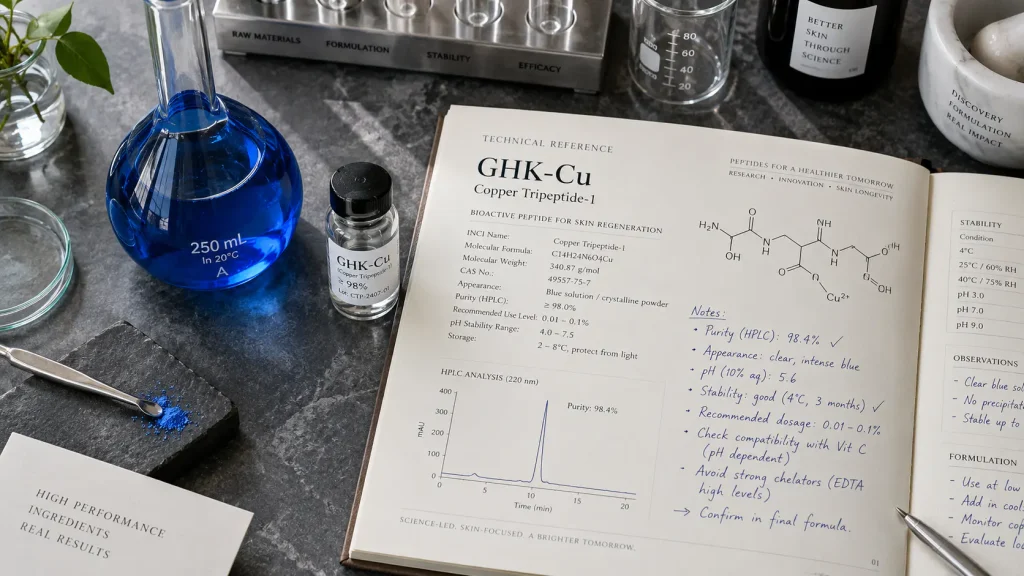
Copper peptide should not be treated only as a marketing phrase.
GHK-Cu is a copper-binding tripeptide complex commonly associated with Copper Tripeptide-1 in cosmetic ingredient discussions. For commercial formulation, however, brands should confirm the exact INCI name, supplied raw-material composition, active content, specifications, and recommended use conditions with the ingredient supplier.
For product development, brands should therefore look beyond the ingredient name and understand the material actually being proposed.
Relevant questions may include:
- What is the raw-material identity?
- Which supplier provides it?
- What documentation is available?
- What is the supplied ingredient form?
- What active content does the supplied material contain?
- What use level or conditions does the supplier recommend?
- What formula conditions does it require?
- What processing limitations apply?
- What stability information is available?
- What evidence supports the ingredient?
- Which claims are relevant to the intended market?
This is particularly important with peptide ingredients because a quoted percentage does not always mean the same thing.
For example, a supplier may provide a prepared peptide solution or blend rather than 100% pure peptide material.
So brands should clarify:
Does the percentage refer to the supplied raw material or the actual peptide content?
A strong product starts by understanding the material that is actually going into the formula.
2. Start With One Hero Copper Peptide Product
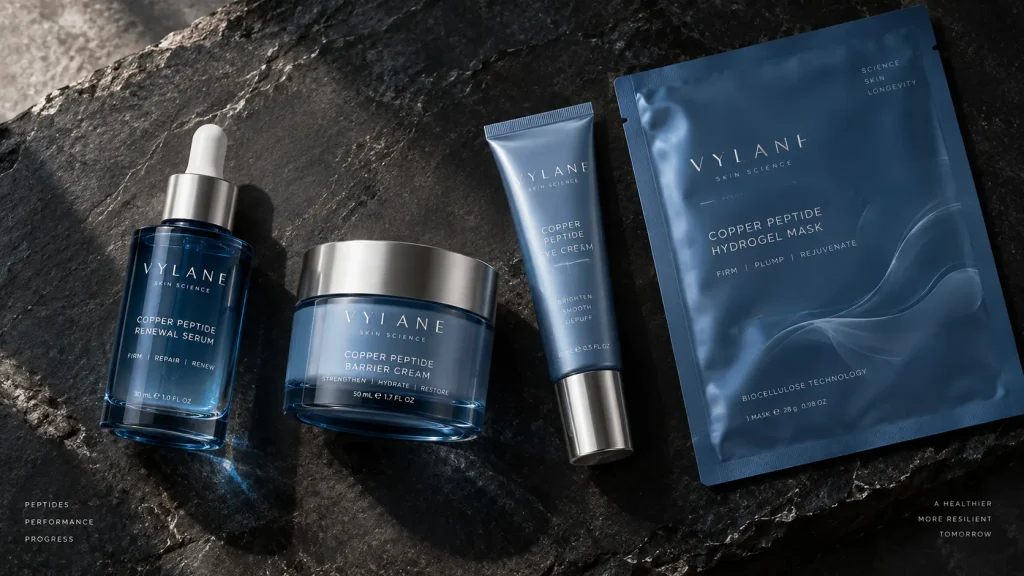
Copper peptide can support a complete product line.
That does not mean a brand needs to launch five SKUs at once.
A clearer strategy often begins with one hero product.
Hero Copper Peptide Serum
A serum can naturally support:
- Technology-led positioning
- Premium treatment
- Daily or nighttime use
- Firming-oriented skincare
- Lightweight layering
- Active ingredient storytelling
The objective is to create a product consumers can easily associate with the brand.
From there, a line can expand logically:
Hero Serum
↓
Barrier Cream / Treatment
↓
Hydrogel Mask
↓
Eye Care
↓
Scalp-Care Extension
The key is not how many copper-peptide products can be created.
It is:
Does each new SKU solve a different consumer need?
A recognizable hero ingredient is useful.
A clear product architecture is more useful.
3. Define the Hero Product Role Before Choosing Supporting Actives
A copper peptide serum can support several different positioning directions.
Firming-Oriented Serum
May emphasize:
Technology + Premium Age Care + Smoother / Firmer-Looking Skin
Barrier-Focused Serum
May emphasize:
Comfort + Hydration + Skin-Barrier Support + Daily Use
Premium Treatment Serum
May emphasize:
Advanced Active Story + Refined Texture + Treatment Ritual
Eye-Care Treatment
May emphasize:
Targeted Application + Lightweight Texture + Premium Treatment
These concepts should not automatically use identical supporting ingredients.
The first decision is:
What should consumers remember this product for?
Once that answer is clear, the supporting formula becomes easier to design.
4. Build a Supporting Ingredient System Around Copper Peptide
Copper-peptide formulas can easily become overloaded.
The brief starts with GHK-Cu.
Then PDRN is added.
Then retinol.
Then vitamin C.
Then collagen.
Then ceramides.
Then multiple peptides.
Eventually the ingredient list looks highly advanced, but the product strategy becomes harder to understand.
Every additional active may introduce questions around:
- Compatibility
- Solubility
- pH
- Stability
- Color
- Texture
- Sensory performance
- Packaging
- Cost
- Claims
- Manufacturing
A stronger approach gives ingredients different roles.
Hero Active Story
Copper Peptide
Supporting Ingredient System
Chosen according to the primary product positioning.
For example:
Barrier-Oriented Direction
Copper peptide + hydration + barrier-support architecture
or:
Firming-Oriented Direction
Copper peptide + selected complementary peptide or age-care system
Formula Architecture
Responsible for:
- Texture
- Spreadability
- Absorption
- Richness
- Tack
- Residue
- Stability
The goal is not:
“How many premium ingredients can we add?”
It is:
“Which ingredients help this product tell one coherent story?”
More actives do not automatically create a more premium formula.
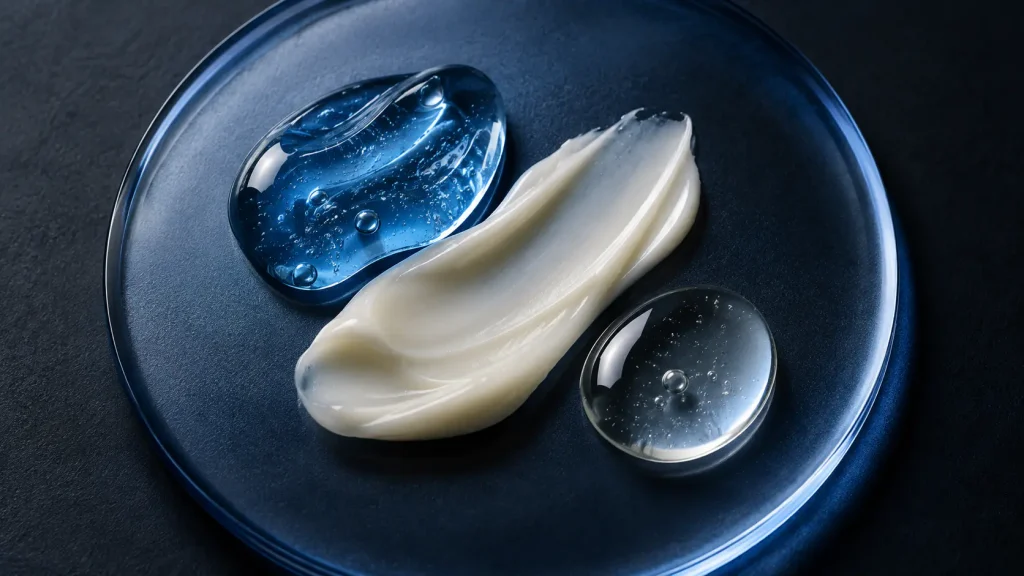
5. Build a Texture Architecture Across the Product Line
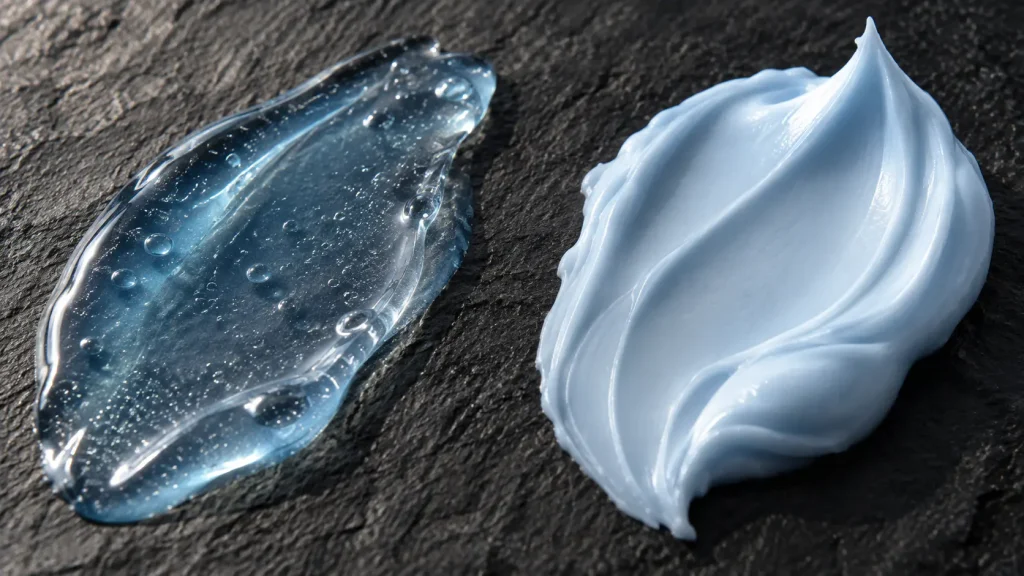
A copper-peptide line can quickly become repetitive if every SKU is:
Blue + Peptide + Firming + Premium
Texture is one way to give each product a clearer role.
Copper Peptide Serum
May target:
Lightweight + Silky + Fast-Spreading + Treatment-Led
Copper Peptide Cream
May target:
Cushioning + Richer + Comfortable + Barrier-Oriented
Copper Peptide Hydrogel Mask
May target:
Cooling + Close-Fitting + Targeted + Ritual-Based
Eye Gel
May target:
Fresh + Lightweight + Low Tack + Easy Layering
Eye Cream
May target:
Smooth + Controlled Richness + Targeted Comfort
These textures communicate different usage occasions even when the hero ingredient story remains related.
A product line becomes easier to understand when every texture has a different job.
6. Develop Packaging Around the Formula
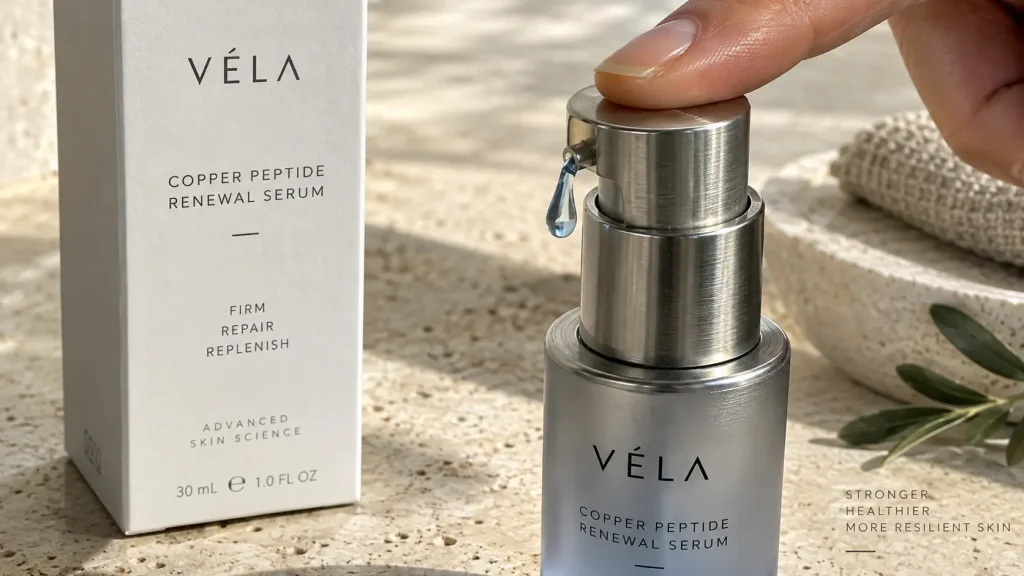
Copper peptide products naturally lend themselves to visual directions such as:
- Blue
- Silver
- White
- Laboratory-inspired graphics
- Airless pumps
- Ampoule-style packaging
- Single-dose systems
- Clinical visual language
That can strengthen premium and technology-led positioning.
But visual language should not replace packaging engineering.
Packaging still needs to work with:
- Formula viscosity
- Dose
- Dispensing
- Exposure conditions
- Product-contact materials
- Filling
- Formula compatibility
- Consumer handling
A serum may work with:
- Pump
- Airless system
- Dropper
- Single-dose format
depending on the actual formula and development requirements.
A cream may use:
- Tube
- Airless system
- Jar
- Pump
depending on viscosity, dispensing needs, compatibility, and positioning.
There is no universal rule that says:
“Copper peptide = airless.”
The correct package is the one that supports the actual formula and consumer experience.
Formula + Dose + Packaging + Consumer Use = Product System
Related Guide:If you’re comparing pumps, airless systems, droppers, jars, tubes, or other packaging options, the final choice should reflect formula viscosity, dispensing, compatibility, filling, MOQ, and consumer use. See our Guide to Choosing Cosmetic Packaging →
7. Clinical-Looking Packaging Is Not Scientific Evidence
A copper-peptide serum in a syringe-style applicator can look highly technical.
A freeze-dried format can look laboratory-inspired.
A blue glass bottle may reinforce the ingredient story.
But none of those choices prove product efficacy.
Packaging communicates positioning.
Evidence supports claims.
Brands should keep those two roles separate.
This is especially important when products use words such as:
- Clinical
- Regenerative
- Repair
- Renew
- Rebuild
- Cellular
- Professional
The stronger development question is:
What can the finished product appropriately support?
rather than:
How clinical can we make the product look?
8. Build Copper Peptide Claims Around the Finished Product
Copper peptide has a science-forward reputation and has been studied in a range of biological and skin-related contexts.
That does not mean a topical cosmetic automatically inherits medical, therapeutic, or structure-function claims associated with other research contexts.
Brands should therefore be cautious with claims such as:
- “Heals wounds”
- “Regenerates tissue”
- “Repairs damaged tissue”
- “Rebuilds collagen”
- “Stimulates cellular regeneration”
when those statements are not appropriately supported for the finished cosmetic product and intended target market.
A cosmetic concept may instead be developed around appropriately supported appearance and skincare positioning such as:
- Firmer-looking skin
- Smoother-looking texture
- Hydration
- Comfort
- Barrier-support positioning
- Healthy-looking skin
- Age-care positioning
The exact language should still reflect the finished formula, available evidence, intended use, and target-market requirements.
A useful principle is:
Ingredient science can inspire the story. Finished-product evidence should support the claim.
9. Plan Copper Peptide Stability Testing Early
A copper-peptide formula may look excellent immediately after development.
That does not automatically mean it is commercially ready.
Depending on the formulation, stability evaluation may consider:
- Appearance
- Color
- Odor
- pH where relevant
- Viscosity
- Precipitation
- Separation
- Texture
- Packaging compatibility
Color deserves particular attention in any visually recognizable ingredient-led product because consumers may associate color directly with product quality or ingredient identity.
But visible appearance alone should not be treated as proof that the active system or complete formula has remained unchanged.
The appropriate evaluation plan should follow the actual formula, packaging, product format, storage conditions, and development requirements.
A premium ingredient story becomes commercially useful only when the finished product remains technically practical.
Related Guide: For a deeper look at how appearance, color, viscosity, pH, separation, packaging compatibility, accelerated conditions, and real-time observation can be evaluated during development, read Cosmetic Stability Testing Explained →
10. Build a Finished-Product Testing and Evidence Strategy
Copper peptide is another good example of why brands need to separate:
Ingredient Evidence
from:
Finished-Product Evidence
A stronger development path is:
Ingredient Story
↓
Finished Formula
↓
Evaluation Strategy
↓
Supporting Evidence
↓
Market-Appropriate Claim
Supplier documentation relating to Copper Tripeptide-1 can help explain why an ingredient was selected and support the ingredient rationale.
It does not automatically prove every firming, barrier, age-care, or regenerative statement a brand may want to make about the finished serum, cream, mask, or eye product.
Claims need to reflect:
- The finished formula
- The actual ingredient level and supplied material
- The product format
- Directions for use
- Finished-product evaluation
- Relevant supporting evidence
- The target market
Related Guide: Claims support is only one part of finished-product evaluation. To understand how stability, microbiological quality, packaging compatibility, sensory evaluation, claims support, and scale-up can fit together before commercial production, read Cosmetic Product Testing Before Mass Production →
11. Consider Hydrogel as a Distinct Copper Peptide Treatment Format
Copper peptide does not need to live only in a serum.
Hydrogel treatments can create a very different product experience.
They may support:
- Cooling sensation
- Close skin contact
- Premium treatment ritual
- Barrier-oriented care
- Technology-led positioning
- Strong visual differentiation
Product Example: Explore one hydrogel-based copper peptide development direction with our Copper Peptide Barrier Repair Hydrogel Mask →
But hydrogel should not be treated as:
“serum ingredients placed inside a premium mask.”
The gel system itself creates additional development considerations around:
- Matrix integrity
- Flexibility
- Adhesion
- Moisture
- Ingredient compatibility
- Deformation
- Packaging
- Storage
Related Guide: Hydrogel is only one possible treatment format. If you’re deciding between hydrogel masks, sheet masks, and eye patches, compare how their structure, sensory experience, packaging, manufacturing, and positioning differ in Hydrogel Mask vs Sheet Mask vs Eye Patches →
12. Eye Care Can Become a Targeted Line Extension
Copper peptide can also support targeted eye-care concepts.
Possible formats include:
- Lightweight eye gel
- Eye serum
- Richer eye cream
- Hydrogel eye patches
But an eye product should not simply reuse the face-serum brief.
Eye-area development needs to consider:
- Application area
- Dose
- Texture
- Migration
- Consumer comfort
- Applicator
- Packaging
- Claims
- Target-market requirements
A targeted eye-care SKU should have a clear routine role rather than simply becoming:
“the same copper peptide serum in a smaller bottle.”
Related Guide: If eye care is part of the product-line strategy, the next step is defining the product format, texture, applicator, packaging, positioning, and role within the routine. See our Eye Care Product Development Guide →
13. Plan the Line Around Different Consumer Moments
A stronger copper-peptide portfolio gives every SKU a different job.
For example:
Hero Serum
Daily Treatment + Technology-Led Positioning
↓
Barrier Cream
Comfort + Richer Daily / Night Care
↓
Hydrogel Mask
Periodic Treatment + Cooling Ritual
↓
Eye Product
Targeted Care
Now the product line has a clear architecture.
Compare that with:
Serum → Ampoule → Essence → Gel Serum
where all four products communicate nearly identical benefits and occupy similar consumer moments.
The better portfolio question is:
What does the consumer need next?
not:
Which copper-peptide format have we not launched yet?
14. Extend Copper Peptide Beyond Facial Skincare Carefully
Copper-peptide concepts are not automatically limited to facial care.
Depending on the brand direction, finished formula, evidence, and target-market requirements, peptide-led positioning may potentially extend into:
- Scalp care
- Hair treatment
- Eye care
- Masks
- Barrier-focused products
But the ingredient story should not simply be copied from one category to another.
A scalp serum has different requirements around:
- Root feel
- Residue
- Applicator
- Fragrance
- Usage frequency
- Claims
than a facial serum.
Likewise, hydrogel and eye-care formats create different formulation, packaging, testing, and manufacturing questions.
The hero ingredient may travel across the portfolio. The product-development brief still needs to change.
15. Choose the Right Copper Peptide Development Model
Brands also need to decide how much product differentiation they actually require.
Private Label / Mature Formula
Can suit brands prioritizing:
- Faster development
- Existing formula base
- Lower formulation-development complexity
- Branding and packaging differentiation
- Faster category entry
Semi-Custom / ODM Development
Can allow selected changes around:
- Texture
- Viscosity
- Supporting actives
- Ingredient direction
- Sensory profile
- Packaging
Custom Formulation
Can make sense when the brand needs:
- A specific peptide raw-material strategy
- A defined active system
- A distinctive hero texture
- Specialized packaging
- A specific claims direction
- Greater product differentiation
Custom development is not automatically the more advanced option.
The right development path should follow:
Differentiation Need + Budget + MOQ + Timeline + Target Market + Commercial Strategy
Related Guides:
If you’re still deciding how much formulation control and development work your project requires, compare the different models in OEM vs. ODM vs. Private Label Cosmetics →
If formula ownership, exclusivity, documentation, manufacturing portability, or transfer rights are commercially important, also read Who Owns a Custom Cosmetic Formula? →
16. Evaluate Manufacturing Feasibility Before Expanding the Line
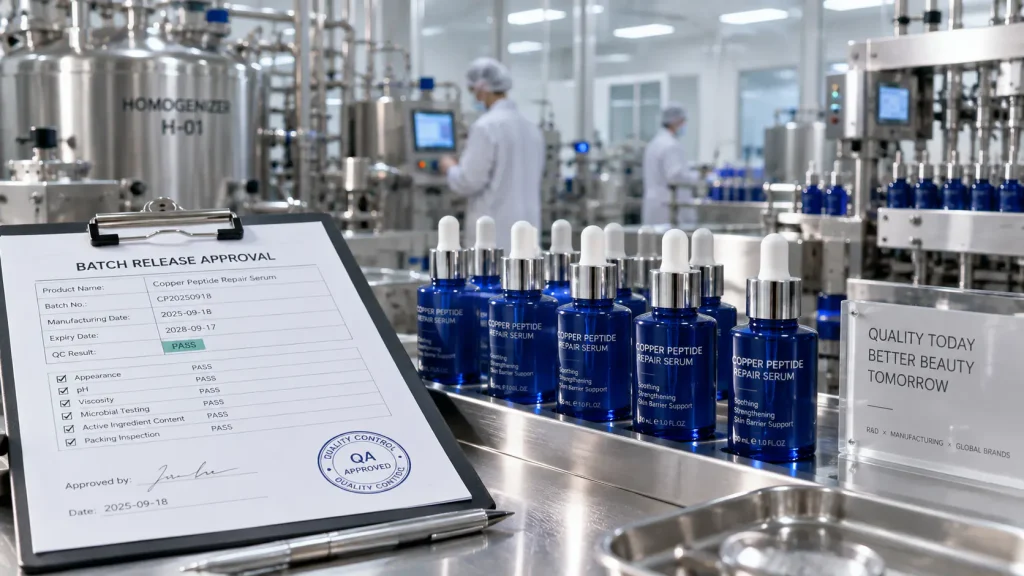
Every additional copper-peptide SKU adds more than another formula.
It may also add:
- Different raw materials
- Different viscosity
- Different equipment requirements
- Different filling
- Different packaging
- Different testing
- Separate MOQ
- Separate production scheduling
- Additional inventory
A four-product line therefore needs a manufacturing plan — not only a product list.
Before expansion, ask:
- Can every formula be manufactured consistently?
- Are the packaging components available?
- Can the products be filled using appropriate equipment?
- What are the MOQ requirements for each SKU?
- Can the hero product be reordered independently?
- Does each SKU justify its inventory commitment?
A strong line needs to work beyond the launch presentation.
It needs to be manufacturable and reorderable.
17. Copper Peptide Product Development Checklist
A useful development sequence is:
Hero Ingredient Direction
↓
Target Consumer
↓
Primary Product Positioning
↓
Hero SKU
↓
Raw-Material Strategy
↓
Supporting Ingredient System
↓
Texture Architecture
↓
Packaging
↓
Claims & Testing
↓
Complementary SKUs
↓
OEM/ODM Development Route
↓
Scale-Up & Manufacturing
↓
Copper Peptide Product Line
This is more useful than beginning with:
“We need four copper peptide products.”
Frequently Asked Questions
What is GHK-Cu in skincare?
GHK-Cu is a copper-binding tripeptide complex commonly discussed in cosmetic and skin-related research.
For cosmetic product development, brands should focus on the exact Copper Tripeptide-1 raw material being supplied, including its composition, active content, supplier documentation, formula compatibility, recommended conditions, and relevance to the intended finished product.
What products can a copper peptide skincare line include?
Possible formats include:
- Hero serum
- Cream
- Eye care
- Hydrogel mask
- Targeted treatment
- Single-dose formats
- Scalp-care extensions
The right line architecture depends on the consumer, positioning, texture strategy, packaging, and manufacturing requirements.
Can copper peptide be used in hydrogel skincare?
Copper-peptide concepts can be explored in hydrogel formats when the ingredient system, gel matrix, stability, packaging, and manufacturing process are compatible.
Can copper peptide be used in eye-care products?
Copper-peptide eye-care concepts can be explored, but the product should be developed specifically around the eye area rather than simply adapting a facial serum.
Should a copper peptide product make regenerative or medical claims?
Medical-style claims should not be assumed simply because copper peptides have a science-forward reputation.
The appropriate claim needs to reflect the finished formula, supporting evidence, intended product use, and target market.
Is retinol or peptide-based positioning better for an anti-aging product?
Neither is automatically better.
They create different formula, sensory, claims, positioning, and product-development strategies. For a broader comparison of these serum directions, see our Retinol, Bakuchiol & Peptide Serum Development Guide.
Should a copper peptide line launch with multiple SKUs?
Not necessarily.
One hero product can establish the ingredient story and brand positioning first.
A wider line makes more sense when each additional SKU serves a clear and complementary consumer need.
Does copper peptide skincare need special packaging?
There is no universal packaging requirement simply because a formula contains copper peptide.
Packaging should follow the finished formula’s viscosity, dose, exposure considerations, dispensing requirements, compatibility, filling process, consumer experience, and product positioning.
Is private label or custom formulation better for a copper peptide line?
Neither is automatically better.
Private label can provide a faster route using an established formula, while custom development can provide greater control over raw-material strategy, supporting actives, texture, packaging, and claims direction.
The correct path depends on the brand’s required level of differentiation, budget, MOQ, timeline, target market, and commercial strategy.
Build the Product Line Around Roles — Not Repeated Ingredient Claims
A strong copper-peptide line should not begin with:
“We need a serum, cream, mask, and eye product containing copper peptide.”
It should begin with:
Who is the consumer?
What does copper peptide mean within our brand?
Which SKU should lead the line?
What role should each additional product play?
How should the textures differ?
What claims can the finished products appropriately support?
Can every SKU be manufactured and reordered realistically?
Once those questions are clear, the ingredient system, textures, packaging, claims, and OEM/ODM development path become much easier to define.
At NEXO Beauty Labs, copper-peptide and peptide-led skincare development can be approached across private label, ODM, and custom OEM pathways covering formulation, active-system strategy, sensory design, packaging, stability evaluation, product testing, scale-up, and commercial manufacturing.
Whether your brand is developing a hero copper peptide serum, barrier-focused cream, hydrogel treatment, targeted eye-care product, or a broader peptide skincare portfolio, the strongest line is the one where every SKU has a clear reason to exist.
Request a consultation with NEXO Beauty Labs to discuss your copper peptide skincare, formulation, packaging, and OEM/ODM development requirements.