
How to Develop an Eye Care Product Line: Formulation, Texture, Packaging & Positioning
Learn how beauty brands can develop an eye care line, from product positioning and texture to ingredients, packaging, testing and manufacturing.
Eye care is a small application area with surprisingly large product-development decisions.
A beauty brand may develop a nourishing eye cream, lightweight morning gel, hydrogel eye patches, or a more specialized treatment format.
But these products should not simply repeat the same claims in different textures.
Each format can serve a different:
- Consumer need
- Usage occasion
- Sensory experience
- Ingredient strategy
- Packaging system
- Price position
- Portfolio role
So before asking:
“Which eye-care ingredients should we use?”
a better question is:
“What role should this product play in the consumer’s eye-care routine?”
A stronger eye-care line starts with product architecture — not with the longest possible active-ingredient list.
Quick Guide: Eye Cream, Eye Gel & Hydrogel Eye Patches
No format is automatically more effective because it is richer, lighter, or more innovative.
The better product is the one whose formula, texture, application method, packaging, claims, and routine role work together.
1. Start With the Role of the Eye-Care Product
Before formulation begins, define what the product is actually supposed to do cosmetically.
Possible product directions include:
- Daily hydration
- Lightweight morning care
- Cooling and refreshing
- Firming-oriented care
- Fine-line appearance care
- Premium age-care positioning
- Overnight nourishment
- Targeted treatment
- Quick-care eye patches
These concepts can all belong to the eye-care category, but they should not automatically use the same formula, texture, ingredients, packaging, or marketing message.
A stronger development sequence is:
Target Consumer
↓
Primary Eye-Care Need
↓
Usage Occasion
↓
Sensory Target
↓
Ingredient Strategy
↓
Packaging / Applicator
↓
Final Format
Define what the product needs to become before deciding what goes into it.
2. Eye Cream, Eye Gel & Patches Should Have Different Jobs
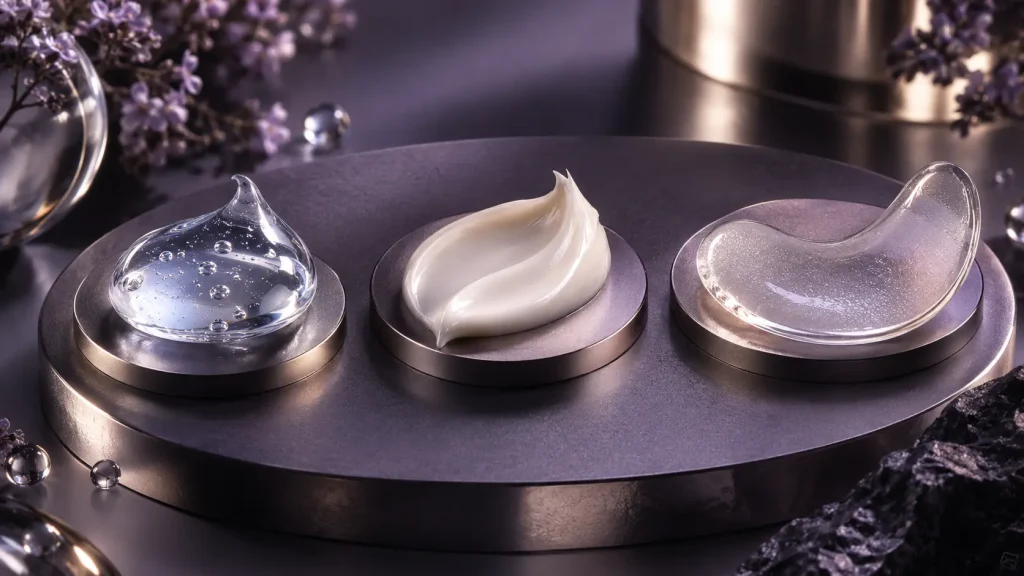
Eye Cream
Eye cream can naturally support concepts around:
- Nourishment
- Comfort
- Richer moisturization
- Night care
- Firming-oriented positioning
- Fine-line appearance care
- Premium age care
A typical sensory direction might be:
Cushioning + Smooth + Nourishing + Comfortable
For one product direction, see Bakuchiol & Ginseng Cryo-Tech Firming Eye Cream.
Eye Gel
Eye gel can support a different product experience:
- Lightweight hydration
- Morning routines
- Cooling concepts
- Low-residue application
- Refreshing positioning
- Easy layering under skincare or makeup
A typical sensory direction might be:
Fresh + Lightweight + Fast-Spreading + Low Tack
For one example, see Yerba Mate Depuffing Eye Gel.
Hydrogel Eye Patches
Hydrogel eye patches create a more ritualized treatment experience.
They can support:
- Targeted application
- Cooling routines
- Premium treatment positioning
- Quick-care occasions
- Visual differentiation
- Travel
- Pre-event skincare
For one product direction, see Retinol & Collagen Firming Hydrogel Eye Patches.
These are different product roles — not simply three delivery systems for the same claim.
3. Choose the Hero SKU Before Building the Full Line
A new eye-care line does not necessarily need three or four products at launch.
One clear hero SKU may be enough to establish the category first.
Start With Eye Cream When:
- Age-care positioning is central
- Night care matters
- Nourishment and comfort fit the brand
- Richer moisturization is part of the experience
- A familiar premium eye-care format is useful
Start With Eye Gel When:
- Lightweight texture is important
- Morning use is central
- Cooling or refreshing positioning fits the concept
- Low residue matters
- Under-makeup use is important
Start With Hydrogel Eye Patches When:
- Strong visual differentiation matters
- The application ritual is part of the product story
- Quick treatment is central
- Travel or pre-event use is relevant
- The brand needs a highly visual supporting or hero SKU
The strongest hero format is the one that expresses the brand idea most clearly and can naturally lead into the next product.
4. Match Texture to the Usage Occasion
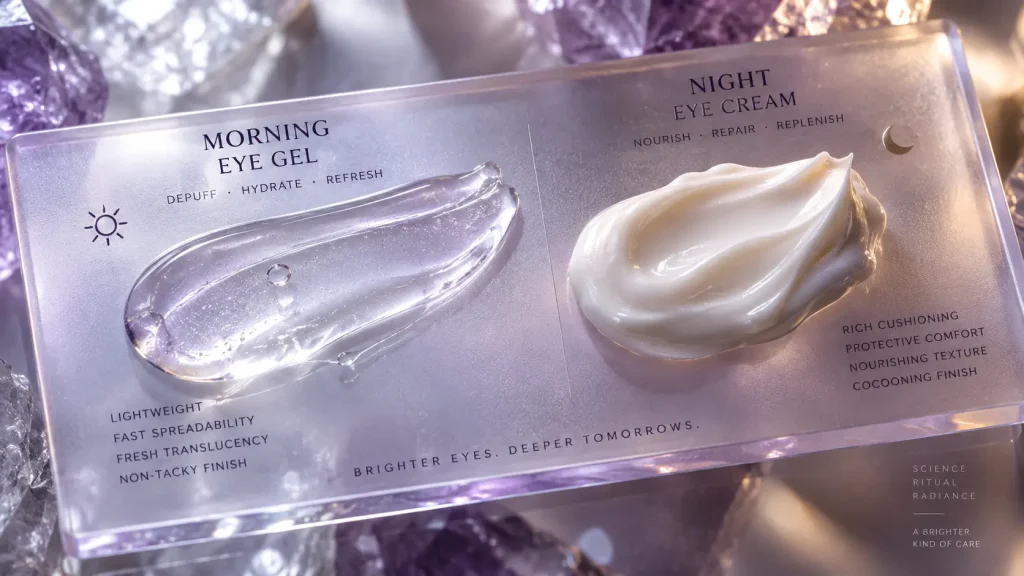
Morning Eye Care
May prioritize:
- Lightweight texture
- Fast spreading
- Low oiliness
- Low tack
- Minimal residue
- Easy layering
- Low pilling under makeup
Night Eye Care
May allow:
- More cushion
- Richer texture
- Longer-lasting comfort
- More substantial after-feel
Quick Treatment / Eye Patches
May emphasize:
- Cooling
- Targeted application
- Patch adhesion
- Treatment ritual
- Comfort during wear
Instead of telling R&D:
“Make the eye gel luxurious.”
a more useful sensory brief is:
“Lightweight and silky, smooth spreading, low tack after several minutes, minimal residue, and compatible with makeup layering.”
Texture is not decoration. It is part of eye-care positioning.
5. Eye Cream vs Eye Gel: The Difference Is Not the Active Ingredient List
Eye cream and eye gel can sometimes use many of the same hero ingredients.
The major difference often comes from:
- Formula architecture
- Oil phase
- Emollient system
- Gel network
- Viscosity
- Spreadability
- After-feel
An eye gel may contain peptides, caffeine, niacinamide, hyaluronic-acid systems, or other actives.
An eye cream can use many of the same ingredient categories.
That means:
Eye Gel ≠ Automatically More Active
and:
Eye Cream ≠ Automatically More Effective
The two formats primarily create different sensory and routine opportunities.
6. Build an Ingredient System — Not an Ingredient Collection

Eye care is highly susceptible to ingredient stacking.
A brief starts with peptides.
Then caffeine is added.
Then retinol.
Then bakuchiol.
Then collagen.
Then several botanical extracts.
Eventually, the ingredient list looks impressive but the product has no clear story.
A stronger formulation architecture gives each ingredient a role.
Hero Active Direction
The ingredient or system that anchors the product concept.
Possible directions may include:
- Retinol-related systems
- Bakuchiol
- Specific peptide systems
- Caffeine-oriented concepts
- Botanical actives
Supporting System
Ingredients can support areas such as:
- Hydration
- Barrier support
- Comfort
- Antioxidant-oriented positioning
- Skin feel
Formula Architecture
The base controls:
- Spreadability
- Richness
- Wateriness
- Tack
- Oiliness
- Residue
- Stability
More actives do not automatically create a stronger eye-care product.
7. Dark Circles Are Not One Single Cosmetic Concern
“Dark circles” is one of the most common eye-care marketing terms.
But the visible under-eye darkness consumers describe can have different contributing factors.
These may include:
- Pigmentation
- Visible vascular coloration
- Puffiness or fluid-related appearance
- Thin-looking skin
- Structural shadowing
- Tear-trough appearance
- Mixed causes
This means one cosmetic formula should not automatically claim to address every form of under-eye darkness.
For example:
Brightening-oriented ingredients
may support a different product story from:
Cooling / puffiness-oriented ingredients and applicators.
Likewise, a topical cosmetic cannot be expected to completely correct structural hollowness caused by facial anatomy.
A stronger claims strategy defines the visible concern the product is actually intended to address.
8. Caffeine Present Does Not Automatically Mean “Eliminates Puffiness”
Caffeine is a highly recognizable eye-care ingredient.
It can support products positioned around:
- Morning refresh
- Tired-looking eyes
- Cooling routines
- Puffiness-related cosmetic care
But ingredient presence alone should not become an absolute finished-product claim.
For example:
Caffeine present
does not automatically prove:
“Eliminates under-eye bags.”
Claims should follow the complete formula and appropriate finished-product evidence.
9. Retinol Eye Care Needs Its Own Development Brief
Retinol-related eye care should not simply reuse a facial retinol serum at a smaller dose.
The development team should consider:
- Application area
- Ingredient form
- Concentration
- Frequency of use
- Formula base
- Consumer tolerance goals
- Directions for use
- Packaging
- Target-market requirements
The eye-area format, formula, and claims need to be developed as one product.
10. Eye-Area Products Need a Clear Comfort & Safety Strategy
Eye-area product development should explicitly consider where and how consumers will apply the product.
Important questions include:
- How close to the eye area will the product be used?
- What is the intended dose?
- Could the texture migrate after application?
- What applicator will contact the skin?
- How will a multi-use container be handled?
- What is the preservation strategy?
- What instructions are needed for safe use?
Consumer handling and packaging hygiene matter especially for products used around the eye area.
A formula intended for the general face should not automatically be assumed to be suitable for eye-area use without product-specific review.
Eye care should be developed as eye care — not simply facial skincare in a smaller package.
11. Packaging & Applicator Design Can Define the Product Experience
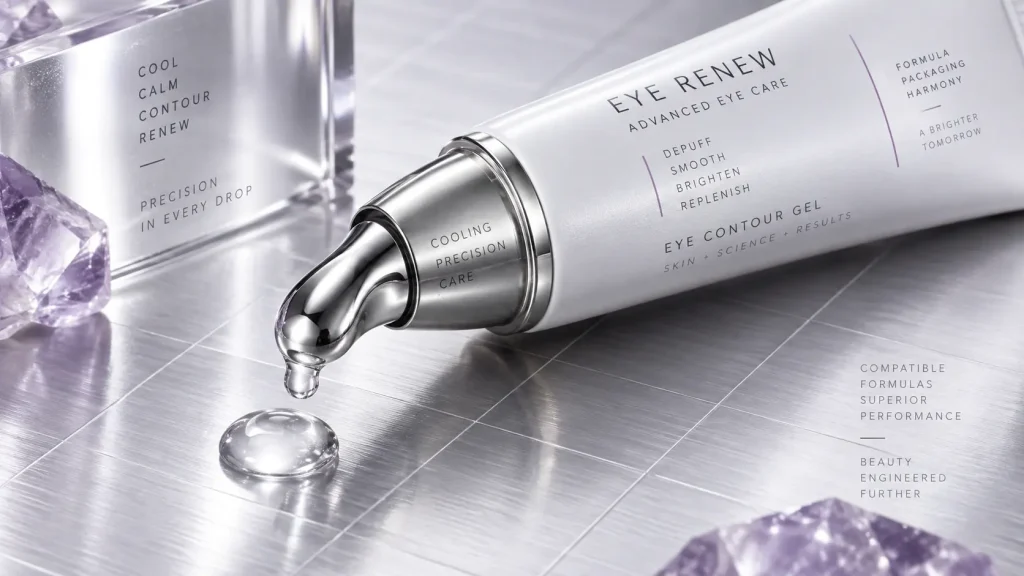
Eye Cream Packaging
Possible options include:
- Tube
- Airless system
- Pump
- Jar
Eye Gel Packaging
Possible options include:
- Pump
- Tube
- Airless system
- Precision applicator
- Cooling-tip applicator
Hydrogel Eye Patch Packaging
Possible formats include:
- Jar
- Individual pouch
- Tray
- Multi-pair container
Development should consider:
- Formula viscosity
- Dose
- Product pickup
- Patch hydration
- Seal integrity
- Consumer handling
- Storage orientation
- Formula-package compatibility
A cooling metal tip can reinforce a morning-refresh concept.
A precision nozzle can support controlled placement.
A pump can support repeatable dosage.
But an applicator should solve a real product need — not simply make the package look expensive.
Formula + Dose + Applicator + Packaging = Product Experience
For more on packaging development, see How to Choose Cosmetic Packaging for Skincare & Beauty Products.
12. Sample Evaluation Should Go Beyond the Ingredient List
Once samples arrive, brands should evaluate the finished experience rather than only checking whether the requested hero ingredients appear on the formula sheet.
For Eye Cream & Eye Gel
Evaluate:
- Spreadability
- Richness
- Wateriness
- Oiliness
- Tackiness
- Absorption perception
- Residue
- Cooling
- Smoothness
- Pilling
- Comfort
- Applicator experience
Do not evaluate the formula only during the first few seconds.
Check again after several minutes.
A gel can initially feel elegant but become too tacky later.
A richer cream can feel heavy initially but settle into a smooth, comfortable finish.
For Hydrogel Eye Patches
Evaluate:
- Patch shape
- Thickness
- Flexibility
- Adhesion
- Sliding
- Cooling sensation
- Hydration during wear
- Ease of removal
- Packaging handling
Sampling should confirm that:
Formula + Texture + Application + Packaging + Positioning
are moving toward the same product target.
13. Hydrogel Eye Patches Need Their Own Development Logic

Hydrogel patches should not be treated as eye serum poured into a different package.
The gel matrix itself introduces additional development questions:
- Matrix integrity
- Formula compatibility
- Thickness
- Flexibility
- Adhesion
- Sliding
- Moisture retention
- Shape
- Packaging protection
- Storage
A patch with an impressive ingredient story can still create a poor product experience if it continuously slides down the face.
For hydrogel patches, physical performance is part of product performance.
14. Cooling Eye Patches Do Not Automatically Prove Long-Term Efficacy
Cooling is one of the strongest sensory benefits of hydrogel eye patches.
It can support products intended to make the under-eye area feel:
- Fresh
- Comfortable
- Hydrated
- Temporarily refreshed in appearance
But the presence of hydrogel or a cooling sensation does not automatically prove:
- Long-term wrinkle reduction
- Permanent removal of under-eye bags
- Deep delivery of every active ingredient
- Correction of structural hollowness
Those claims require evidence relevant to the finished product and intended benefit.
15. Stability Evaluation Should Match the Final Eye-Care Format
Eye Cream
Evaluation may include:
- Appearance
- Color
- Odor
- Viscosity
- Emulsion behavior
- Separation
- Packaging compatibility
Eye Gel
Evaluation may include:
- Gel structure
- Appearance
- Clarity where relevant
- pH where relevant
- Viscosity
- Color
- Packaging performance
Hydrogel Eye Patches
Evaluation may include:
- Patch integrity
- Hydration
- Appearance
- Associated formula compatibility
- Adhesion
- Sliding behavior
- Packaging
- Seal performance
For more detail, see Cosmetic Stability Testing: What Beauty Brands Need to Know.
16. Testing & Claims Should Follow the Finished Product
Eye care is especially vulnerable to turning an ingredient name into a finished-product claim.
For example:
Caffeine present ≠ proven elimination of puffiness
Peptides present ≠ proven firming result
Retinol present ≠ proven wrinkle reduction for the finished eye product
Hydrogel present ≠ proven deeper delivery of active ingredients
The claims strategy should consider:
- Finished formula
- Ingredient level
- Application area
- Usage directions
- Supporting evidence
- Finished-product testing
- Target market
For more on product testing, see Cosmetic Product Testing Before Mass Production.
Ingredient story helps shape the concept. Finished-product evidence supports the claim.
17. Manufacturing Requirements Differ by Eye-Care Format
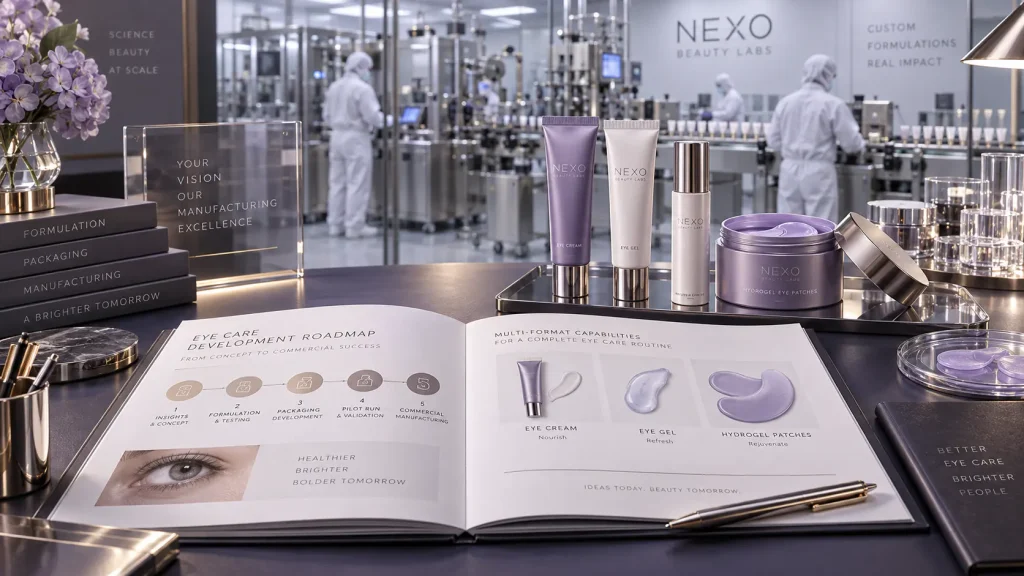
Eye Cream Manufacturing
Depending on the formula, production may involve:
- Water and oil phase preparation
- Emulsification
- Heating and cooling
- Homogenization
- Viscosity control
- Active incorporation
- Small-dose filling
Eye Gel Manufacturing
Production may involve:
- Gel-system preparation
- Active incorporation
- Viscosity control
- Air management
- Controlled filling
Hydrogel Eye Patch Manufacturing
Production can introduce additional requirements around:
- Hydrogel preparation
- Forming or cutting
- Patch dimensions
- Formula loading
- Patch placement
- Container filling
- Sealing
Product format is also a manufacturing decision.
18. MOQ Can Change Significantly by Format
Eye-care MOQ should not be treated as one fixed number for the entire category.
The practical minimum can depend on:
- Formula batch size
- Hero ingredients
- Tube or bottle minimums
- Airless packaging
- Custom applicators
- Metal cooling tips
- Hydrogel molds or shapes
- Patch jars or trays
- Printing and decoration
- Testing
- Manufacturing setup
A conventional eye cream in stock packaging can have a very different commercial structure from a custom hydrogel patch with a dedicated tray.
Likewise, a custom cooling applicator can add packaging supplier minimums even when the formula MOQ itself is relatively manageable.
There is no universal rule that eye gel, cream, or patches always have the lowest MOQ.
For more detail, see Cosmetic MOQ Explained: What Determines Minimum Order Quantity?.
19. Private Label, ODM & Custom Eye-Care Development
Private Label Eye Care
A private label project can begin with an existing manufacturer-developed eye cream, eye gel, patch, or other eye-care formulation.
This can reduce original formulation work while allowing brands to focus on:
- Brand positioning
- Packaging
- Artwork
- Available customization
- Launch strategy
Customized ODM Eye Care
An ODM project can adapt an existing product platform through selected changes such as:
- Hero ingredients
- Supporting active system
- Texture
- Viscosity
- Fragrance-free positioning where appropriate
- Applicator
- Packaging
Custom OEM Formulation
A more customized project can be developed around:
- Target consumer
- Primary eye-area concern
- Morning or night use
- Hero active direction
- Sensory target
- Packaging and applicator
- Claims strategy
- Target market
The right development route depends on how much genuine formula, packaging, and format differentiation the brand needs.
20. Build a Product Line — Not Three Similar SKUs
A common eye-care portfolio mistake is:
Eye Cream: Fine lines + puffiness + dark circles
Eye Gel: Fine lines + puffiness + dark circles
Eye Patches: Fine lines + puffiness + dark circles
The brand now has three SKUs competing for exactly the same role.
A clearer architecture might be:
Morning Eye Gel
Refresh + Lightweight Care + Easy Layering
↓
Daily / Night Eye Cream
Moisturize + Nourish + Age-Care Positioning
↓
Hydrogel Eye Patches
Targeted Treatment + Cooling Ritual
This creates a clearer:
Refresh → Maintain → Treat
system.
A product line becomes stronger when every SKU has a different job.
21. Plan Product Number Two Before Developing Product Number One
Even when launching only one hero eye product, it helps to understand what comes next.
For example:
Hero Morning Eye Gel
↓
Night Eye Cream
↓
Hydrogel Eye Patches
Or:
Hero Firming Eye Cream
↓
Refreshing Eye Gel
↓
Premium Patch Treatment
This does not mean all three need to launch together.
It creates a logical product-development roadmap.
The expansion question should be:
“What does the consumer need next?”
rather than:
“Which eye-care format have we not launched yet?”
Questions to Answer Before Sending an Eye-Care Brief to R&D
- Who is the target consumer?
- What is the primary eye-area concern?
- Which product should become the hero SKU?
- Is the product mainly for morning, night, daily, or occasional treatment use?
- How should the product feel?
- Which ingredient system supports that positioning?
- Does the product need a specialized applicator?
- Which packaging system fits the formula?
- Which claims require finished-product support?
- Which market will the product enter?
- What MOQ range is commercially realistic?
- What product should logically come next?
The clearer these decisions are before sampling, the easier it becomes to evaluate whether each prototype is moving in the right direction.
Frequently Asked Questions
What is the difference between eye cream and eye gel?
Eye creams usually support richer, more cushioning and moisturizing sensory profiles, while eye gels commonly support lighter, fresher and faster-spreading experiences. These are positioning tendencies rather than strict technical definitions.
Is eye gel better for morning use?
Eye gels often fit morning routines well because they can be developed with lightweight texture, low residue, low tack and easier makeup layering. The actual suitability depends on the finished formula.
Is eye cream better for nighttime use?
Richer eye creams can naturally support nighttime or dry-skin-oriented routines because they can provide a more cushioning and nourishing after-feel. However, texture should still reflect the target consumer.
Are eye patches better than eye cream?
No format is universally better. Eye patches create a targeted, often cooling and ritualized treatment experience, while creams are better suited to repeat daily application. They can serve complementary roles.
Can hydrogel eye patches permanently remove eye bags?
That should not be assumed. Cooling and hydration can support a refreshed cosmetic appearance, but structural under-eye bags or hollowness involve factors that topical patches cannot necessarily correct.
Why do hydrogel eye patches slide?
Sliding can be influenced by patch shape, thickness, matrix structure, surface moisture, formula loading, adhesion, storage conditions and consumer movement.
Is caffeine good for eye-care products?
Caffeine is widely used in eye-care concepts, particularly morning-refresh and puffiness-related positioning. However, the presence of caffeine alone does not prove a specific finished-product result.
Can retinol be used in eye-care products?
Retinol-related eye-care concepts can be developed, but the specific active system, formula, concentration, consumer tolerance, directions, packaging, claims and target market need to be evaluated together.
Should eye-care products be fragrance-free?
There is no universal requirement that every cosmetic eye product must be fragrance-free. However, fragrance strategy should be evaluated carefully according to the intended consumer, application area, formula and market positioning.
Are dark circles always caused by pigmentation?
No. Under-eye darkness can involve pigmentation, visible vascular coloration, puffiness, structural shadowing, tear-trough appearance or combinations of several factors. This is why one cosmetic product should not automatically claim to address every type of dark circle.
What packaging is best for eye cream?
There is no universal best package. Tubes, pumps, airless systems and jars can all be appropriate depending on formula viscosity, dose, exposure considerations, hygiene strategy and consumer experience.
Are cooling metal eye applicators necessary?
No. They can reinforce a cooling or massage-oriented product experience, but only when they work correctly with the formula, dose and packaging system.
Do eye patches require different stability testing from eye cream?
Yes. Hydrogel patches introduce additional physical characteristics such as matrix integrity, hydration, adhesion, deformation, sliding and package seal performance.
Can one manufacturer develop eye cream, gel and hydrogel patches?
Potentially. Brands should confirm that the manufacturer has the formulation, processing, filling, hydrogel, packaging and testing capabilities needed for each intended format.
Should a new eye-care brand launch one SKU or a full line?
Either strategy can work. A single hero SKU can establish clear positioning with lower portfolio complexity, while a small line can work when each product serves a distinct and complementary consumer need.
Which eye-care format usually has the lowest MOQ?
There is no universal answer. MOQ depends on formula batch size, raw materials, packaging, applicators, hydrogel components, decoration, manufacturing setup and supplier minimums.
Develop the Eye-Care Routine Before Developing the Product List
A strong eye-care line should not begin with:
“We need an eye cream, eye gel and eye patches.”
It should begin with:
Who is the consumer?
What eye-care need are we addressing?
When should each product be used?
How should each product feel?
Why does each SKU deserve a place in the routine?
Once those questions are clear, the formula architecture, ingredients, texture, packaging, applicator, testing and manufacturing path become much easier to define.
At NEXO Beauty Labs, eye-care development can be approached across private label, ODM and custom OEM pathways covering formulation, active-ingredient systems, sensory design, packaging and applicator selection, stability evaluation, product testing, scale-up and commercial manufacturing.
Whether your brand is developing a nourishing eye cream, lightweight morning gel, or targeted hydrogel eye patch, the strongest product is the one that has a clear role in the consumer routine and a realistic path to commercial production.
Request an Eye Care OEM/ODM Consultation with NEXO Beauty Labs to discuss your eye cream, gel, hydrogel patches, formulation, applicator, packaging, MOQ, testing and manufacturing requirements.