PDRN Skincare Product Development Guide: Formula, Claims, Packaging & OEM/ODM Planning
Learn how beauty brands can develop PDRN skincare products, from positioning and formulation to texture, packaging, claims, testing and OEM/ODM manufacturing.
PDRN has become increasingly visible in consumer skincare.
For beauty brands, that creates an obvious opportunity — but recognizing a trending ingredient is only the beginning.
A market-ready PDRN product still needs decisions around:
- Target consumer
- Product positioning
- Raw-material identity
- Supporting ingredients
- Texture
- Product format
- Packaging
- Claims
- Stability
- Testing
- Target market
- Manufacturing
So the better question is no longer:
“Should we launch a PDRN product?”
It is:
“What kind of PDRN product should our brand actually develop?”
A trending ingredient can create attention.
The finished product still needs a clear reason to exist.
1. Define What PDRN Means for Your Brand
“PDRN skincare” is not yet a complete product concept.
The same ingredient story can lead to very different products.
A brand might develop:
Premium Treatment
Advanced skincare + Refined sensory experience + Premium positioning
Barrier-Focused PDRN Care
Hydration + Comfort + Barrier-support positioning
Radiance-Oriented Care
Healthy-looking skin + Hydration + Radiance
Age-Care Serum
Firming-oriented positioning + Smoother-looking texture + Premium treatment
Targeted Eye Care
Focused application + Treatment ritual + Specialized format
These products may all contain PDRN.
But they should not automatically use the same formula architecture, texture, packaging, or claims.
A stronger development sequence is:
Target Consumer
↓
Primary Product Need
↓
Positioning
↓
Hero Ingredient Story
↓
Supporting Formula System
PDRN can anchor the story.
It should not replace the strategy.
2. Define the PDRN Raw Material Before Building the Marketing Story
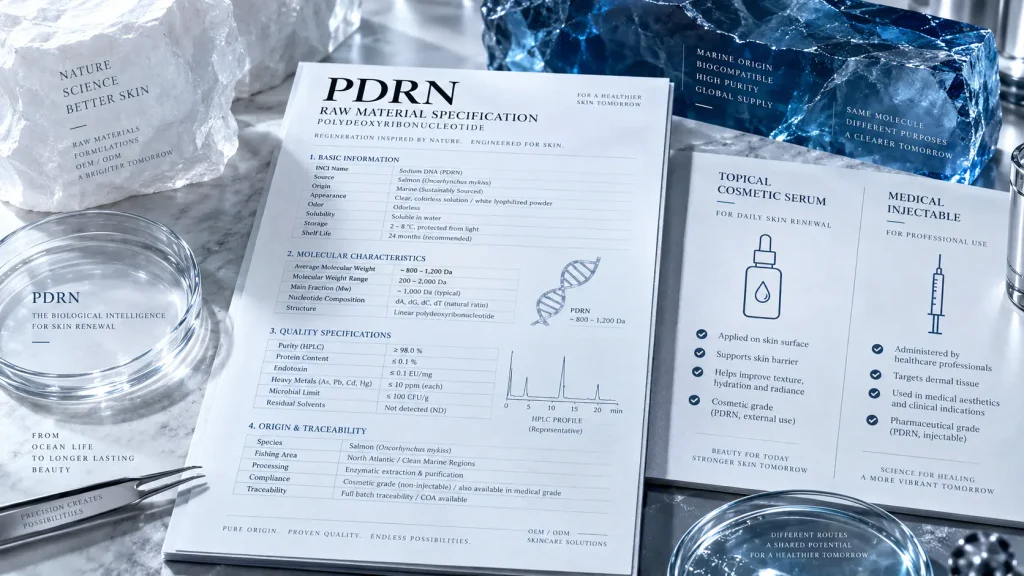
“Contains PDRN” is not enough information for product development.
Before formulation begins, brands should understand what specific raw material is actually being proposed.
Ask the formulation or ingredient supplier for relevant information around:
- Raw-material identity
- Source / origin
- Technical specifications
- Supplier documentation
- Recommended use conditions
- Storage requirements
- Formula compatibility
- Ingredient naming and market documentation
- Supporting evidence
This is especially important because DNA-derived materials may be discussed using different terminology, and similar-sounding materials should not automatically be treated as technically interchangeable.
The development team should know:
What ingredient are we actually formulating with?
before marketing decides:
What do we want to say about it?
This also makes it easier to evaluate whether studies cited in supplier materials are genuinely relevant to the raw material being used.
3. Separate Topical PDRN Skincare From Injectable or Medical Use
PDRN has strong visibility in dermatology, regenerative medicine, and professional aesthetic discussions.
That does not mean a topical cosmetic automatically inherits the claims or performance associated with another route of administration.
This distinction is particularly important in product development.
A topical cosmetic should not simply borrow language such as:
- “Repairs tissue”
- “Regenerates cells”
- “Heals wounds”
- “Rebuilds damaged tissue”
- “Injectable-like regeneration”
without considering the finished product, evidence, intended use, and target-market regulatory requirements.
A cosmetic PDRN concept is generally better developed around consumer-relevant appearance and skincare positioning such as:
- Hydration
- Comfortable skin feel
- Smoother-looking skin
- Radiance
- Firmer-looking appearance
- Barrier-support positioning
- Healthy-looking skin
The exact wording still needs to follow the actual finished formula and appropriate evidence.
This does not mean topical PDRN has no research.
It means evidence generated for one PDRN preparation, concentration, formula, application method, or treatment route should not automatically be generalized to every commercial skincare product.
Ingredient research can inspire the concept. Finished-product evidence should support the commercial claim.
4. Choose the Right PDRN Product Format
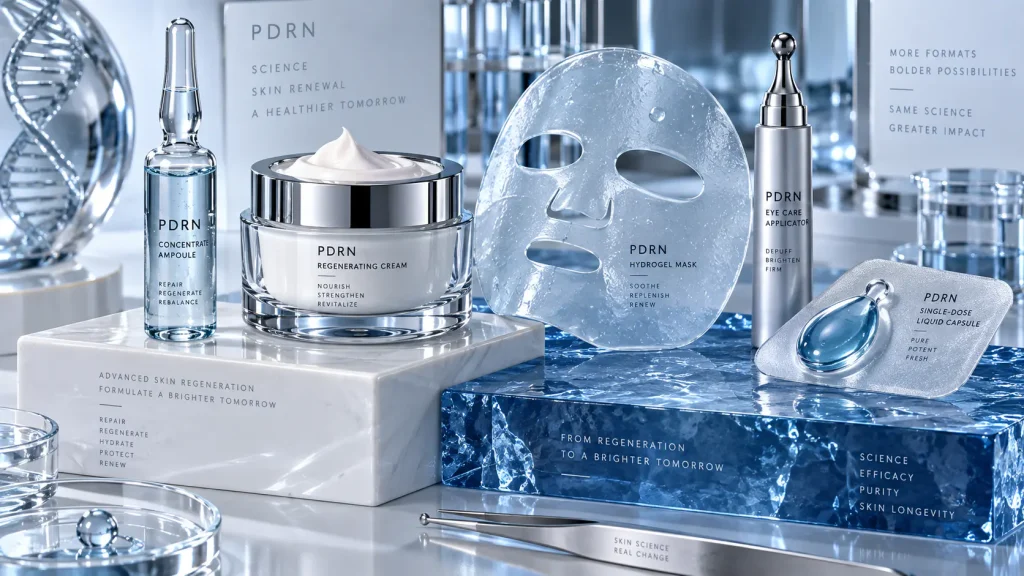
PDRN does not have to become another standard bottled serum.
The product format can play a major role in differentiation.
PDRN Serum or Ampoule
This is one of the most straightforward hero-product directions.
It can support:
- Daily treatment
- Premium skincare
- Layering
- Active-led positioning
- Technology-inspired skincare
Product Example: Explore one serum-based development direction with our Rose PDRN & Collagen Plumping Skin Serum →
PDRN Cream
A cream can support:
- Barrier-focused positioning
- Comfort
- Richer age care
- Night routines
- Nourishing sensory experience
PDRN Hydrogel Mask
A hydrogel format can support:
- Treatment ritual
- Cooling experience
- Premium positioning
- Stronger visual differentiation
- Periodic intensive-care concepts
PDRN Eye Care
Eye-area products can provide a more targeted extension of the PDRN story.
The texture, dosage, applicator, tolerance strategy, and claim direction should still be designed specifically for the eye area.
Single-Dose PDRN Format
Single-dose formats may support:
- Defined portions
- Premium ritual
- Portability
- Strong visual identity
- Treatment-oriented positioning
The right question is not:
“Which PDRN format looks most innovative?”
It is:
“Which format makes the PDRN concept more useful and understandable for our consumer?”
5. Build a Supporting Ingredient System Around PDRN
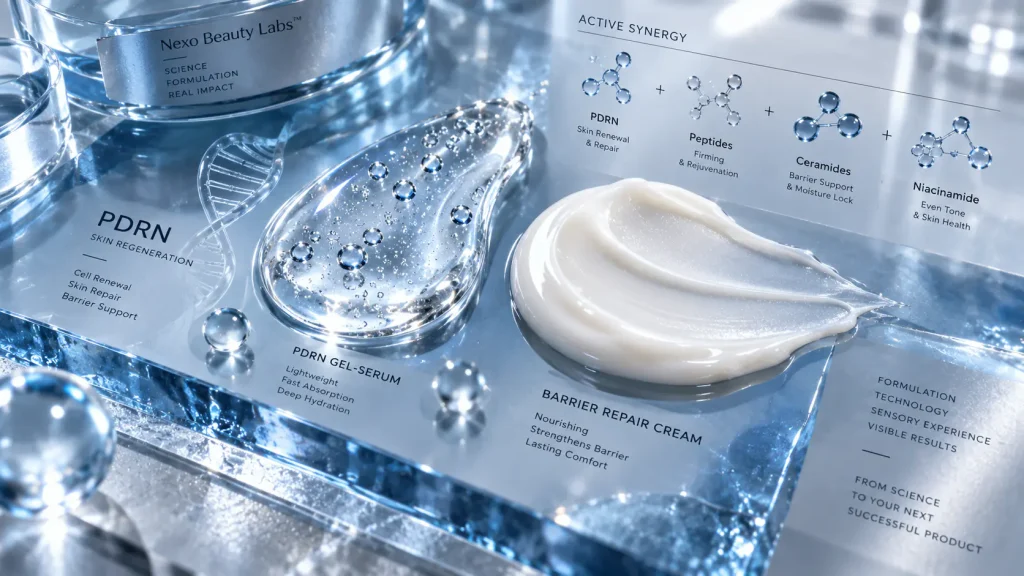
PDRN may be the hero ingredient.
That does not mean it needs to work alone.
Depending on the intended product, supporting systems might explore ingredients associated with:
- Hydration
- Barrier care
- Firming-oriented positioning
- Antioxidant-oriented care
- Comfort
- Radiance
- Sensory performance
Possible supporting directions may involve ingredients such as:
- Niacinamide
- Selected peptide systems
- Ceramides
- Humectants
- Botanical ingredients
- Other formula-supporting systems
But the objective should not be:
PDRN + every trending ingredient currently on the market.
A barrier-focused PDRN serum and a firming-oriented PDRN treatment should not automatically have identical active systems.
A clearer structure is:
Hero Story
PDRN
Supporting Benefit System
Ingredients chosen around the primary product positioning.
Formula Architecture
The system responsible for:
- Texture
- Spreadability
- Absorption
- Stability
- Skin feel
- Consumer experience
A longer ingredient list does not automatically create a stronger PDRN product.
6. Define the Texture and Sensory Experience
Consumers may discover the product because of PDRN.
They experience it through the formula.
Consider several possible directions.
Watery PDRN Serum
Can support:
Lightweight + Layerable + Daily Use + Fresh Feel
Premium Ampoule
Can support:
Treatment-Led + Silky + Refined + Concentrated Positioning
Gel Serum
Can support:
Hydration + Freshness + Cushion + Modern Skincare
Milky Serum
Can support:
Comfort + Barrier-Oriented Care + Richer Sensory Profile
Cream
Can support:
Nourishment + Cushion + Night Care + Premium Age-Care Positioning
None is automatically better.
The texture should follow:
Consumer + Usage Occasion + Brand Positioning
Rather than asking R&D to:
“Make it premium,”
a more useful brief might say:
“Lightweight and silky with fast spreading, low tack after several minutes, and a comfortable hydrated finish.”
That gives the formulation team something that can actually be evaluated during sampling.
7. Develop Packaging With the Formula
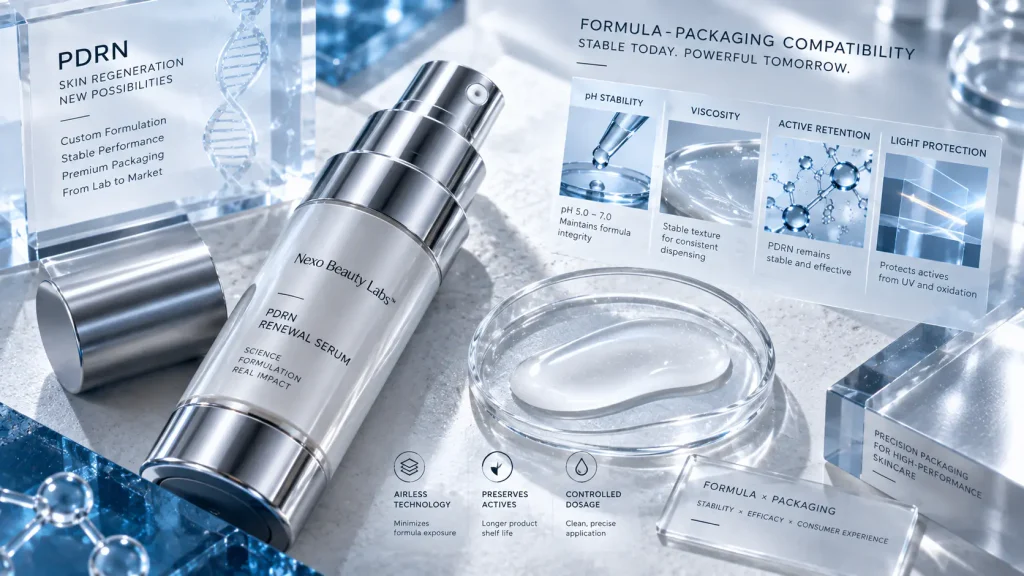
PDRN does not automatically require one specific packaging format.
The right package depends on the entire product system.
Possible formats include:
- Dropper
- Pump
- Airless system
- Tube
- Jar
- Single-dose capsule
- Specialized treatment packaging
Brands should consider:
- Formula viscosity
- Dose
- Product exposure
- Dispensing
- Consumer handling
- Filling
- Product positioning
- Formula-packaging compatibility
An airless package may make sense for one PDRN formula.
That does not mean:
“PDRN = airless packaging.”
Likewise, premium-looking packaging is not automatically technically appropriate.
The actual formula still needs to dispense and remain compatible with the selected system.
The better principle is:
Formula + Dose + Packaging + Consumer Use = Product System
Related Guide: If you’re comparing droppers, pumps, airless systems, jars, tubes, capsules, or other packaging formats, see our Guide to Choosing Cosmetic Packaging → for a deeper look at formula compatibility, dispensing, materials, filling, MOQ, cost, and brand positioning.
8. Plan Stability Testing Early
Ingredient-led products often create ambitious formulation briefs.
This makes stability especially important when PDRN is combined with multiple supporting actives.
Depending on the formula, evaluation may consider:
- Appearance
- Color
- Odor
- pH where relevant
- Viscosity
- Precipitation
- Separation
- Texture
- Packaging compatibility
Brands should not wait until the end of development to ask whether the formula remains stable.
The ingredient strategy, base formula, packaging, and intended storage conditions all need to be considered together.
A strong trend story has limited commercial value if the finished product cannot maintain its intended characteristics over time.
Related Guide: For a deeper explanation of how appearance, viscosity, pH, separation, temperature exposure, packaging, and other variables may be evaluated over time, read Cosmetic Stability Testing Explained →
9. Build a Claims and Evidence Strategy
PDRN is a good example of why ingredient marketing and finished-product claims need to be separated.
A useful evidence sequence is:
Ingredient Evidence
↓
Finished Formula
↓
Evaluation Strategy
↓
Supporting Evidence
↓
Market-Appropriate Claim
For example, supplier documentation may help explain why PDRN was selected.
But that does not automatically establish every claim a brand may want to make about the finished serum.
Likewise, evidence from:
- Injectable use
- Medical treatment
- Another cosmetic formula
- Another concentration
- Another PDRN raw material
should not automatically become proof for the product being sold.
Claims need to reflect:
- The actual formula
- The actual ingredient system
- The intended directions
- Relevant supporting evidence
- The target market
PDRN may create the ingredient story. The finished product has to carry the claim.
Related Guide: To see how stability, microbiological quality, packaging compatibility, sensory evaluation, claims support, and scale-up can fit into finished-product evaluation before commercial production, read Cosmetic Product Testing Before Mass Production →
10. Define the Target Market Before Finalizing Claims
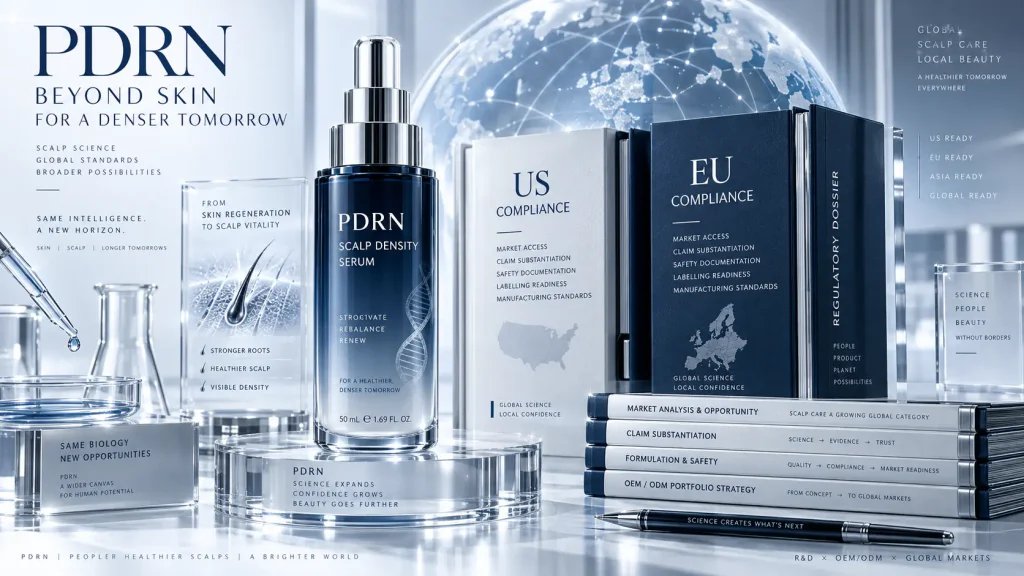
A PDRN product is also being developed for a specific market.
That matters.
Different target markets can have different expectations around:
- Cosmetic claims
- Ingredient documentation
- Labeling
- Product classification
- Supporting evidence
- Required documentation
For example, in the United States, language implying treatment of disease or an effect on the structure or function of the body can move a product outside a conventional cosmetic claim framework.
In the EU, cosmetic claims must be supported appropriately, and claims based on an ingredient should not imply that the finished product possesses the same properties when that is not adequately supported.
That makes one question especially important:
Where will the finished PDRN product actually be sold?
The answer belongs near the beginning of development — not after the formula and packaging are complete.
11. One Hero PDRN Product or a Complete Product Line?
A brand does not need five PDRN products simply because PDRN is trending.
A more focused launch might begin with:
Hero PDRN Serum
Daily / Premium Treatment
and later extend into:
PDRN Cream
Comfort / Barrier / Night Care
PDRN Eye Product
Targeted Care
PDRN Hydrogel Mask
Periodic Treatment Ritual
This creates a portfolio where each product has a distinct role.
A weaker architecture would be:
PDRN Serum → PDRN Ampoule → PDRN Essence → PDRN Gel
with all four products making essentially the same promise.
The question should be:
Why does the consumer need the next SKU?
not:
Which PDRN format have we not launched yet?
12. Extend PDRN Beyond Facial Skincare
PDRN-related positioning is also appearing beyond conventional facial skincare.
For brands developing broader beauty portfolios, the ingredient story may extend into scalp and hair-care concepts when the formula, consumer proposition, claims, and target market support it.
Product Examples:
Rosemary PDRN Scalp Density Serum →
Rosemary & PDRN Hair Thickening Shampoo →
But category extension should not be automatic.
A facial serum, scalp serum, and shampoo create completely different:
- Application areas
- Formula architectures
- Usage conditions
- Sensory targets
- Claims
The ingredient story may travel across categories. The product-development strategy still needs to change with the format.
13. Choose the Right PDRN Development Model
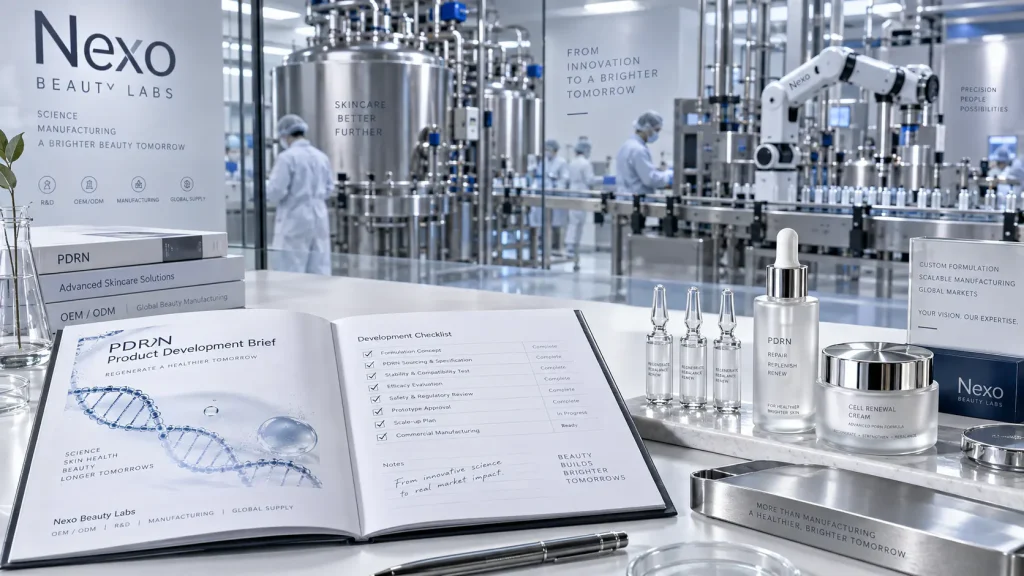
Brands should also define how much formulation differentiation they actually need.
Private Label / Existing Formula
May suit brands prioritizing:
- Faster development
- An established formula base
- Lower development complexity
- Branding and packaging differentiation
Semi-Custom Development
May involve modifying an established direction around areas such as:
- Texture
- Selected supporting actives
- Fragrance where appropriate
- Sensory profile
- Positioning
Custom Formulation / ODM Development
May make more sense when the brand needs:
- A specific PDRN raw-material direction
- A defined active system
- A distinctive texture
- Specialized packaging
- Specific claim objectives
- Greater product differentiation
Custom development is not automatically the “better” option.
The right route should match:
Differentiation Need + Budget + MOQ + Timeline + Target Market + Commercial Strategy
Related Guides:
Choosing between different development routes? OEM vs. ODM vs. Private Label Cosmetics →
If formula ownership or exclusivity matters to your project, see Who Owns a Custom Cosmetic Formula? →
14. Evaluate Manufacturing Feasibility Before Final Approval
A PDRN concept still needs to become a commercially repeatable product.
As development progresses, manufacturers may need to consider:
- Raw-material sourcing
- Ingredient incorporation
- Mixing
- Temperature conditions
- pH where relevant
- Viscosity
- Scale-up
- Filling
- Packaging
- Batch specifications
- Quality control
A sophisticated laboratory formula has limited commercial value if the process cannot reproduce it consistently.
This becomes especially important for:
- Multi-active systems
- Suspended or visually complex formulas
- Capsules
- Hydrogel formats
- Specialized packaging
- High-viscosity products
Market-ready product development means connecting the ingredient story with manufacturing reality.
15. PDRN Product Development Checklist
Before beginning a PDRN skincare project, define:
Target Consumer
↓
Primary Product Positioning
↓
PDRN Raw Material & Documentation
↓
Hero Product Format
↓
Supporting Ingredient System
↓
Sensory Target
↓
Packaging
↓
Claims Strategy
↓
Stability & Product Evaluation
↓
Target Market
↓
Development Route
↓
Scale-Up & Manufacturing Plan
↓
Commercial PDRN Product
This is more useful than beginning with:
“We want a PDRN serum. What can you add to it?”
Frequently Asked Questions
What is PDRN in skincare?
PDRN refers to polydeoxyribonucleotide material used in a range of dermatology, aesthetic, and increasingly topical skincare contexts.
For cosmetic product development, brands should evaluate the exact raw material, supplier documentation, finished formulation, intended claims, and target market rather than treating “PDRN” as one universally interchangeable ingredient specification.
Is PDRN the same as PN?
They should not automatically be treated as interchangeable.
PDRN and polynucleotides (PN) may differ in structural characteristics, so brands should clarify the exact raw material being supplied rather than relying only on broad marketing terminology. Recent dermatology literature also distinguishes the two rather than treating them as identical materials.
What types of PDRN skincare products can a brand develop?
Possible formats include:
- Serums
- Ampoules
- Creams
- Eye-care products
- Hydrogel masks
- Single-dose treatments
The strongest format depends on the target consumer, product positioning, formula, packaging, and intended routine.
Can topical PDRN skincare use evidence from injectable treatments?
Evidence from another route of administration should not automatically be treated as proof of a topical cosmetic product.
Topical PDRN research is developing, including research on specific topical formulations, but results from one preparation or finished product should not automatically be generalized to all commercial PDRN skincare.
Does PDRN need to be the only active ingredient?
No.
A PDRN formula may include supporting ingredients chosen around hydration, barrier care, radiance, firming-oriented positioning, or another clear product objective.
The goal should be a coherent active system rather than the largest possible ingredient list.
Does PDRN skincare need special packaging?
There is no universal package required simply because a product contains PDRN.
Packaging should be selected according to the finished formula’s viscosity, exposure considerations, dose, dispensing requirements, compatibility, filling process, and intended consumer experience.
Is private label or custom formulation better for a PDRN product?
Neither is automatically better.
Private label can offer a faster path using an established formula, while custom development can provide more control over raw-material selection, supporting actives, texture, packaging, and positioning.
The right model depends on the brand’s differentiation and commercial requirements.
Can a brand build a complete PDRN product line?
Yes, but each SKU should have a distinct role.
A serum, cream, eye treatment, and mask can create a logical portfolio when they support different consumer needs and usage occasions.
Turn the PDRN Trend Into a Product System
A strong PDRN development project should not begin and end with:
“PDRN is trending.”
It should ask:
Who is the consumer?
What should PDRN mean within our brand?
Which raw material are we actually using?
What product format communicates the concept best?
How should it feel?
What claims can the finished product support?
Can the formula remain stable and be manufactured consistently?
Once those decisions are clear, PDRN becomes more than a trending ingredient.
It becomes part of a complete product strategy.
At NEXO Beauty Labs, ingredient-led skincare development can connect raw-material strategy, custom formulation, sensory design, packaging, product evaluation, scale-up, and OEM/ODM manufacturing.
Whether your brand is exploring a PDRN serum, cream, hydrogel treatment, eye-care product, or broader PDRN portfolio, the objective is the same:
Turn the ingredient story into a finished product that makes sense for the consumer, the brand, and the target market.
Request a consultation with NEXO Beauty Labs to discuss your PDRN skincare product development project.