How to Choose a Reliable Cosmetic Manufacturer for Your Beauty Brand
Picking a cosmetic manufacturer is one of the biggest decisions you'll make as a beauty brand. Here's what to look for, what to avoid, and how to vet a partner properly.
Your cosmetic manufacturer becomes an extension of your beauty brand. Their formulation capabilities affect your products. Their quality systems affect consistency. Their lead times affect your launch schedule. And their ability to scale can influence how easily your brand grows.
That’s why choosing a cosmetic manufacturer shouldn’t come down to the lowest quote or the smallest MOQ.
The right manufacturing partner needs to fit your product category, formulation strategy, target market, quality expectations, packaging requirements, budget, and long-term growth plans.
This guide explains what to evaluate when comparing cosmetic manufacturers — and the questions worth asking before you commit to production.
1. Define What You Need Before Contacting Manufacturers
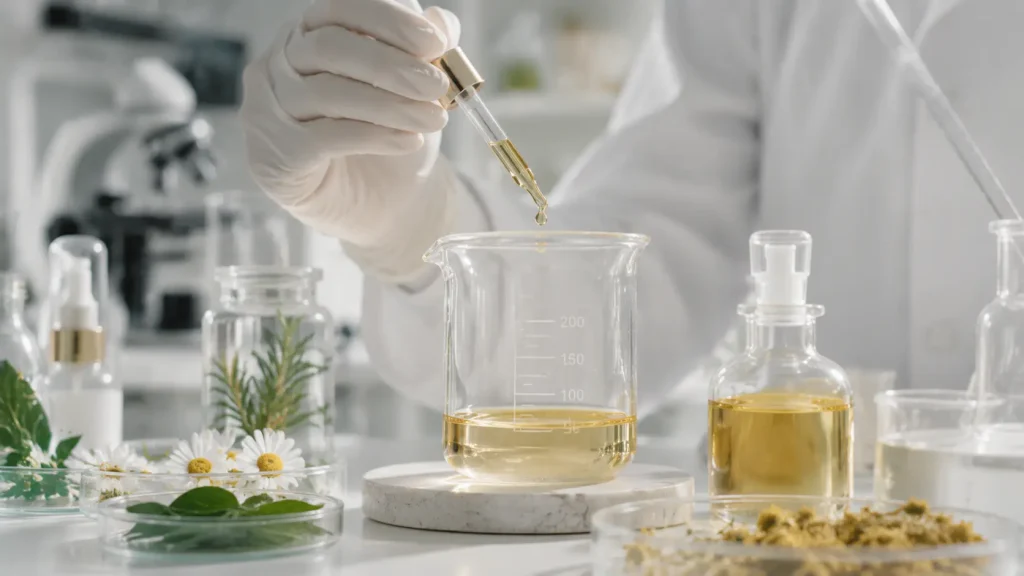
Before comparing factories, get clear about what you’re trying to manufacture.
You don’t need a finished formula or a complete technical specification, but you should be able to explain the basic direction of your project.
Consider:
- What type of product are you developing?
- Who is your target customer?
- What benefits or positioning should the product have?
- Which ingredients, textures, or fragrances matter to you?
- Are there ingredients you want to avoid?
- Do you want an existing formula or custom formulation?
- What is your target retail price?
- What initial order quantity are you considering?
- Which countries or markets do you plan to sell in?
- When do you hope to launch?
A clear product brief makes it much easier to compare manufacturers on the same criteria rather than receiving completely different proposals from every supplier.
Related Guide:If you’re still mapping out how a beauty product moves from initial concept through formulation, testing, packaging, manufacturing, and launch, see From Idea to Shelf: The Beauty Product Development Journey →
2. Choose the Right Manufacturing Model
Not every cosmetic manufacturer offers the same type of product development.
Before comparing suppliers, understand whether you need private label, ODM, or a more customized OEM development route.
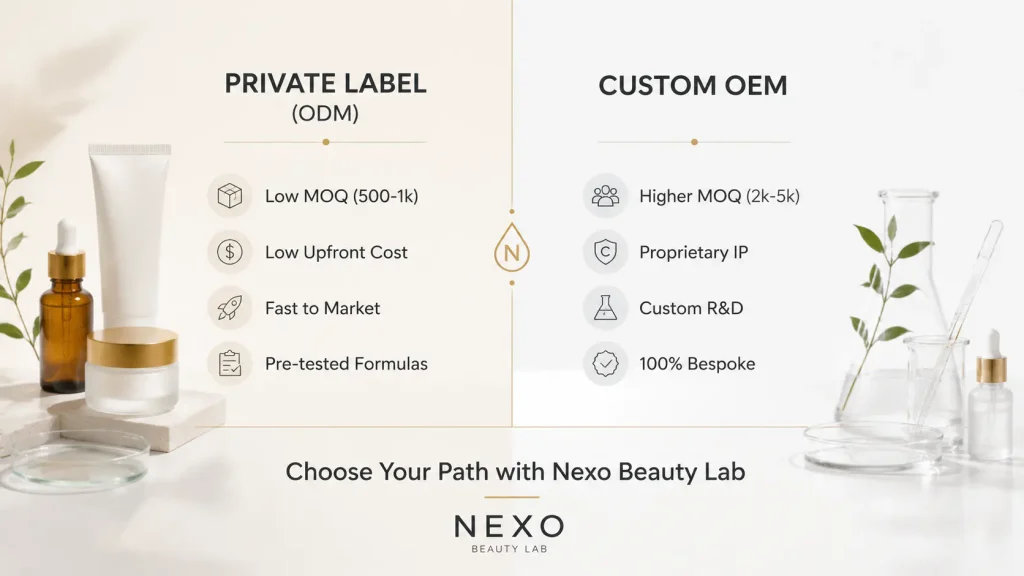
- Private Label: typically starts with an existing product or formula and focuses heavily on branding and packaging.
- ODM: often starts with an existing manufacturer-developed formula or product platform, with selected customization available.
- Custom OEM: generally involves developing a product according to an agreed brief and specifications with a higher level of customization.
These terms are used differently across the cosmetics industry, so don’t rely on the label alone.
Ask each manufacturer exactly what you can customize, what testing is included, what MOQ applies, and what ownership or exclusivity terms are available.
Related Guide: For a deeper comparison of customization, development time, MOQ, cost, formula ownership, and the role of each manufacturing model, read OEM vs. ODM vs. Private Label Cosmetics →
3. Look for Experience in Your Product Category
A manufacturer that produces lipstick successfully isn’t automatically the best partner for active skincare, scalp serums, sunscreens, or sulfate-free shampoos.
Different categories involve different formulation, processing, filling, packaging, testing, and production challenges.
Ask:
- Do you regularly manufacture products like mine?
- Which product categories are your strongest?
- Do you have the required filling and production equipment?
- Have you worked with similar textures or packaging formats?
- Can you support the product as order volume grows?
Relevant category experience can help a manufacturer identify formulation or packaging issues earlier in development.
4. Evaluate Quality Systems, GMP & Compliance Support
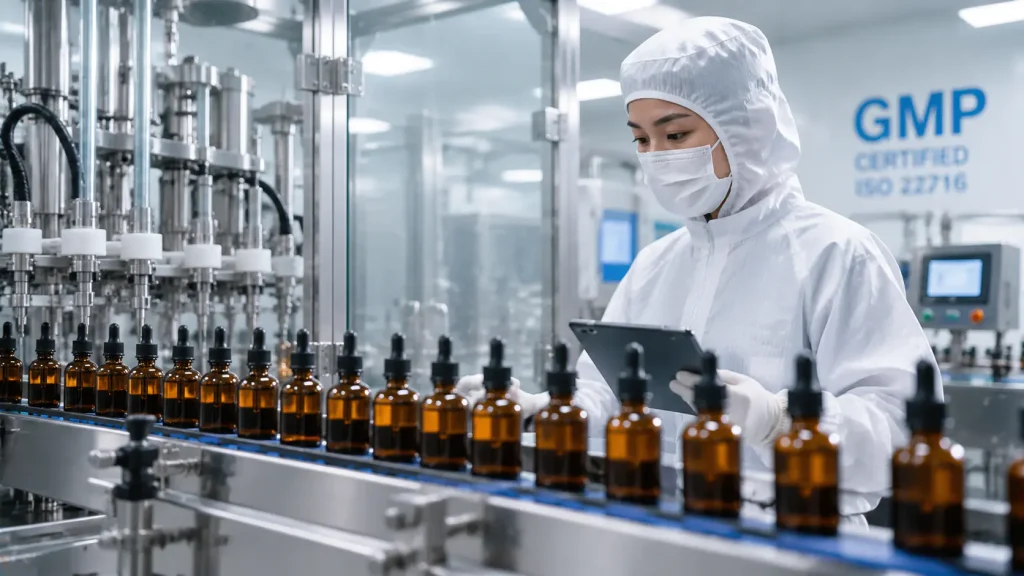
Quality should be one of the first areas you evaluate, not something you check after negotiating the price.
Ask how the manufacturer controls:
- Raw materials
- Supplier qualification
- Production batches
- Equipment and manufacturing areas
- In-process quality checks
- Filling and packaging
- Finished-product release
- Batch documentation and traceability
- Complaints and quality issues
ISO 22716 and documented cosmetic GMP practices are useful areas to discuss when evaluating a manufacturer, alongside any additional standards relevant to your product and intended market.
Don’t simply ask, “Are you GMP?”
Ask what their quality system actually looks like and what documentation they can provide.
Ask About Your Target Market Early
Requirements vary by product category and destination market.
If you’re planning to sell in the United States, EU, UK, Middle East, or multiple markets, tell the manufacturer before formula and packaging decisions are finalized.
A manufacturer experienced with your intended market should be able to explain what support they provide and where additional regulatory specialists or third-party services may be required.
Related Guide: To understand what common cosmetic manufacturing certifications and quality standards actually mean — and what they do and do not tell you about a manufacturer — see our Cosmetic Manufacturing Certifications Guide →
5. Evaluate Their R&D & Formulation Capabilities
R&D capability matters even if you’re beginning with private label or ODM.
A manufacturer with an experienced formulation team can provide more flexibility if you later want to adjust existing products, create new textures, introduce different actives, or develop more differentiated hero products.
Ask:
- Do you have an in-house formulation team?
- Which product categories does the R&D team specialize in?
- How does the sample and revision process work?
- How many development rounds are typically included?
- How do you evaluate formula stability?
- How do you assess formula-packaging compatibility?
- Can you work toward a target cost?
- Can you help translate a product concept into a realistic formulation brief?
Also ask how formula ownership, exclusivity, and intellectual property are handled.
Never assume that “custom formula” automatically means your brand owns every aspect of the formulation. Those terms should be clearly documented in the commercial agreement.
6. Understand MOQ — But Don’t Evaluate MOQ Alone
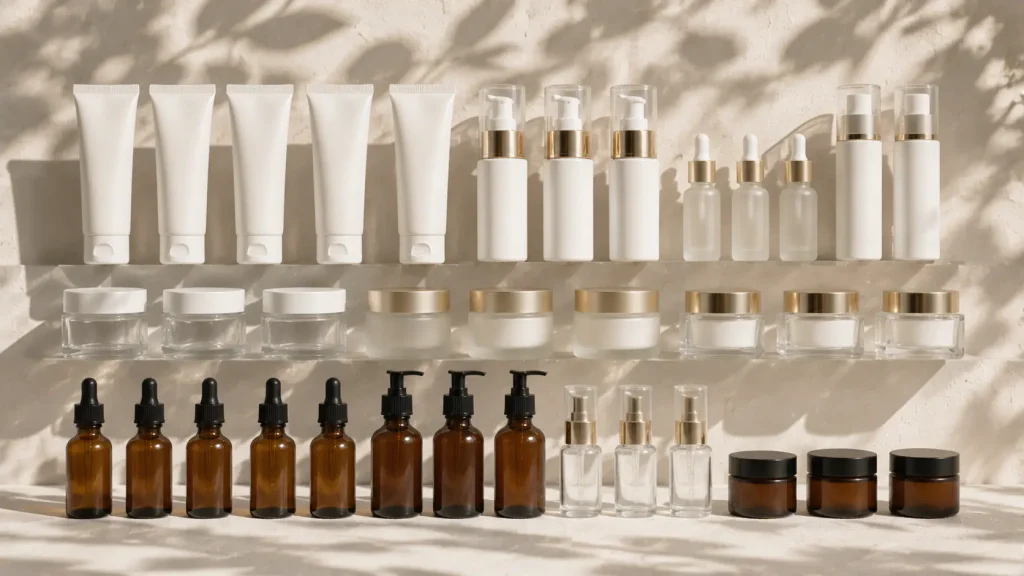
Minimum order quantity directly affects your initial investment and inventory exposure, especially when you’re launching a new brand or testing a new category.
But there is no universal “good” cosmetic MOQ.
MOQ can be influenced by several parts of the project:
A very low MOQ isn’t automatically the best deal.
Compare it with unit cost, formula options, packaging quality, customization, production consistency, and the manufacturer’s ability to support future reorders.
7. Understand the Complete Cost — Not Just Unit Price
Two manufacturers can quote very different unit prices because the quotation may include different things.
Ask for clarity on:
- Formula or development fees
- Sample fees
- Testing
- Bulk product
- Primary packaging
- Labels or printing
- Outer cartons
- Tooling or molds
- Freight
- Any third-party services
A lower unit price can become much less attractive once packaging, development, and other project costs are added.
When comparing quotations, make sure you’re comparing approximately the same specification and scope.
8. Ask About Packaging & Supply Chain Capabilities
Packaging can affect cost, compatibility, MOQ, differentiation, and launch timing.
Ask whether the manufacturer can help with:
- Stock packaging
- Custom bottles, jars, tubes, or other components
- Packaging compatibility
- Printing and decoration
- Labels
- Outer cartons
- Supplier coordination
A full-service manufacturer can simplify the development process by coordinating formula and packaging decisions together.
However, you should still understand which packaging components are produced directly by the manufacturer and which are sourced from external suppliers.
9. Always Request & Approve Samples
Never commit to a commercial production run based only on a catalog, ingredient list, or presentation.
Evaluate physical samples before final approval.
Check:
- Texture — does it match the desired product experience?
- Color and appearance — does it fit your positioning?
- Fragrance — is it appropriate for your customer?
- Application — how easily does it spread or dispense?
- Skin or hair feel — what is the experience during and after use?
- Packaging — does the formula work properly with the selected container?
Use the sample approval process to document what you’re approving before production.
The closer the specification is defined at this stage, the easier it becomes to evaluate whether future production batches meet expectations.
10. Ask How They Handle Testing & Quality Documentation
Testing requirements depend on the product, formula, packaging, claims, and target market.
Ask your manufacturer what testing they conduct internally and what may require an external laboratory.
Relevant areas can include:
- Stability evaluation
- Microbiological testing
- Preservative-system evaluation where applicable
- Packaging compatibility
- Product-specific performance or claim testing
Also ask what documentation is available with production batches and how records are maintained.
11. Evaluate Communication & Project Management
Technical capabilities matter, but poor communication can still turn a good formula into a difficult project.
Pay attention before you sign:
- How quickly do they respond?
- Do they answer questions clearly?
- Do they explain trade-offs?
- Do they document important approvals?
- Are timelines realistic or overly optimistic?
- Do they understand your actual product concept?
A good manufacturing partner shouldn’t simply say yes to every request.
Sometimes the most useful response is explaining why an ingredient, packaging choice, claim, cost target, or launch schedule needs to be reconsidered.
12. Review Lead Times & Supply Chain Risk
Ask for more than a single number such as “production takes six weeks.”
Understand the full project timeline:
- Formula development
- Sampling and revisions
- Testing
- Packaging sourcing
- Printing and artwork
- Raw material procurement
- Production scheduling
- Filling and packaging
- Quality release
- Shipping
Also ask which ingredients or packaging components have long or unpredictable lead times and whether suitable alternatives exist.
13. Check Their Ability to Scale With Your Brand
Your first order isn’t necessarily the best test of whether a manufacturer fits your long-term strategy.
Ask what happens if demand grows.
- Can they support larger production runs?
- What happens to pricing as volume changes?
- Can they support more SKUs?
- Can they move you from private label to more customized development?
- How do they plan raw material and packaging supply for repeat orders?
Changing manufacturers later is possible, but it can involve new sampling, packaging qualification, documentation, and potentially formula changes.
Choosing a partner with room to grow can reduce unnecessary disruption later.
14. Review Formula Ownership, Exclusivity & Commercial Terms
This is one of the most important areas to clarify before signing an agreement.
Ask:
- Who owns the formula?
- Is the formula exclusive?
- Can similar formulas be sold to other brands?
- Who owns custom tooling or molds?
- What happens if you change manufacturers?
- What happens to unused custom packaging?
- How are formula changes approved?
- What are the payment and cancellation terms?
Don’t assume the words OEM, ODM, private label, or custom automatically determine intellectual property ownership.
The contract should make those commercial terms clear.
15. Don’t Choose a Cosmetic Manufacturer Based on Price Alone
Cost matters. But the cheapest quote isn’t automatically the lowest-risk choice.
Your final decision should balance:
- Formula quality
- Manufacturing consistency
- R&D capabilities
- Quality systems
- Packaging support
- MOQ
- Lead times
- Communication
- Scalability
- Commercial terms
- Total project cost
The goal isn’t simply to find the cheapest factory.
It’s to find the manufacturing partner that gives your brand the best combination of product quality, reliability, flexibility, and commercial fit.
Cosmetic Manufacturer Red Flags to Watch For
Pay attention to warning signs before placing a production order.
- Unwilling to provide relevant quality or company documentation
- Vague answers about testing or manufacturing procedures
- Promises that sound unrealistic for the requested timeline or budget
- Pressure to skip samples
- Unclear quotation or unexpected charges
- No clear explanation of formula ownership or exclusivity
- Poor communication during the sales process
- Difficulty explaining where products are actually manufactured
- No clear process for handling quality problems
- Inconsistent information from different contacts
One red flag doesn’t always mean you should immediately walk away, but repeated uncertainty around quality, documentation, production, or commercial terms deserves closer investigation.
Questions to Ask a Cosmetic Manufacturer Before Signing
Use this shortlist when comparing potential partners:
- Which product categories do you specialize in?
- Do you offer private label, ODM, custom OEM, or all three?
- Do you have an in-house R&D team?
- What quality standards and certifications do you follow?
- What testing is included in product development?
- What are the MOQs for my formula and packaging?
- What can I customize?
- Can you source and customize packaging?
- What is the expected development and production timeline?
- What costs are not included in the initial quotation?
- How do you handle formula ownership and exclusivity?
- What support do you provide for my target market?
- How do you manage quality issues or rejected batches?
- Can you support larger orders as my brand grows?
- Who will manage my project and communication?
Frequently Asked Questions
How do I choose a good cosmetic manufacturer?
Look at the complete manufacturing relationship rather than one factor. Important areas include product-category experience, R&D capabilities, quality systems, MOQ, testing, packaging support, communication, lead times, scalability, commercial terms, and total project cost.
What certifications should I look for in a cosmetic manufacturer?
The relevant standards depend on your product and target market. ISO 22716 and documented cosmetic GMP practices are useful areas to evaluate, alongside any product-specific or market-specific requirements that apply to your project.
Should I choose the manufacturer with the lowest MOQ?
Not necessarily. A lower MOQ can reduce initial inventory exposure, but compare it with unit cost, formula quality, packaging options, customization, production consistency, and the manufacturer’s ability to scale with you.
Should a cosmetic manufacturer have an in-house R&D team?
It isn’t required for every manufacturing model, but in-house formulation capabilities can be valuable if you want formula adjustments, custom development, technical support, or greater product differentiation over time.
How many cosmetic manufacturers should I compare?
There isn’t a required number. The goal is to compare enough qualified manufacturers to understand differences in capabilities, MOQ, pricing, timelines, quality systems, and communication before making a commitment.
What should I ask about formula ownership?
Ask who owns the base formula and any custom development, whether the formula is exclusive, whether similar formulas can be offered to other brands, and what happens if the manufacturing relationship ends.
Can a cosmetic manufacturer help with packaging?
Many full-service OEM/ODM manufacturers provide packaging sourcing and customization support. Confirm whether packaging is handled internally or through external suppliers, what MOQ applies, and whether compatibility evaluation is included.
Can I switch cosmetic manufacturers later?
Yes, but the process may involve new samples, packaging qualification, documentation transfer, testing, or reformulation depending on formula ownership and the new manufacturer’s production system. That’s why ownership and exit terms are worth discussing before the first order.
Why Beauty Brands Work with NEXO Beauty Labs
NEXO Beauty Labs supports beauty brands through private label, ODM, and custom OEM product development across skincare, haircare, body care, sun care, and personal care.
Our development capabilities include:
- In-house formulation and R&D
- Private label and ODM product options
- Custom formulation development
- Product sampling and revisions
- Packaging sourcing and customization
- Testing and quality-control support
- Commercial manufacturing and filling
- Support for growing product ranges and repeat production
The goal isn’t simply to manufacture one order. It’s to build a development and production process that can continue working as your brand evolves.
Ready to Find the Right Cosmetic Manufacturing Partner?
Choosing the right cosmetic manufacturer is less about finding the biggest factory or the lowest quotation and more about finding a partner whose capabilities match what you’re trying to build.
Take the time to compare formulation capabilities, quality systems, product experience, MOQ, packaging, testing, communication, scalability, and commercial terms before making your decision.
Request an OEM/ODM Consultation with NEXO Beauty Labs to discuss your product concept, formula direction, packaging, MOQ, target market, and launch requirements.