Cosmetic Manufacturing Certifications & Compliance: What Beauty Brands Should Know
Learn what GMP and ISO 22716 mean, how to verify cosmetic manufacturer certifications, and what brands should check for quality and market compliance.
When beauty brands begin evaluating cosmetic manufacturers, one of the first questions is usually:
“What certifications do you have?”
It is an important question — but it should not be the only one.
A certificate can provide evidence that a manufacturing facility operates within a defined quality framework. But it does not automatically tell you whether that manufacturer is suitable for your formula, product category, packaging system, target market, or commercial requirements.
For beauty brands, manufacturer due diligence should connect:
Certifications + Facility + Quality System + Production Controls + Documentation + Traceability + Product Capability + Target-Market Support
This guide explains what cosmetic GMP and ISO 22716 mean, how they differ from facility registration and finished-product compliance, how to verify a manufacturer’s certification claims, and what beauty brands should check before choosing an OEM/ODM partner.
Quick Answer: What Certifications Should a Cosmetic Manufacturer Have?
There is no single certification checklist that applies to every beauty product or target market.
However, brands evaluating an OEM/ODM cosmetic manufacturer commonly encounter the following:
The most important principle is:
A certification should be relevant, current, verifiable, and connected to the actual facility producing your product.
1. What Does GMP Mean in Cosmetic Manufacturing?
GMP stands for Good Manufacturing Practice.
In cosmetic manufacturing, GMP refers broadly to systems and procedures used to help ensure products are manufactured under controlled, documented, and repeatable conditions.
A cosmetic GMP system can include areas such as:
- Personnel and training
- Premises and production areas
- Equipment
- Raw materials
- Supplier controls
- Manufacturing procedures
- Cleaning and hygiene
- Quality control
- Storage
- Documentation
- Batch records
- Deviation handling
- Traceability
For beauty brands, the important distinction is:
GMP is not simply a logo or certificate displayed on a factory website.
The real value lies in how GMP principles are applied to everyday manufacturing activities and individual production batches.
2. What Is ISO 22716?
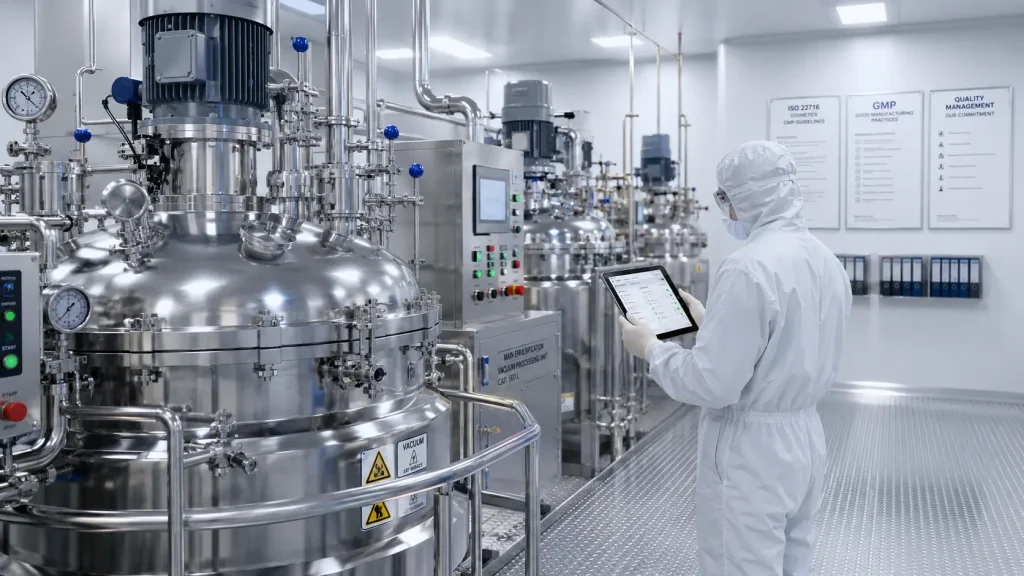
ISO 22716:2007 is an international standard that provides Good Manufacturing Practice guidelines specifically for cosmetic products.
Its scope covers areas relating to:
- Production
- Control
- Storage
- Shipment
For beauty brands evaluating a manufacturer, an ISO 22716 claim should lead to several follow-up questions:
- Which legal company is named on the certificate?
- Which manufacturing address does it cover?
- What is the certification scope?
- Which certification body issued it?
- Is it currently valid?
- Is the certified site the facility that will actually produce my SKU?
This is particularly important when a supplier operates multiple production sites or outsources selected product categories.
A valid certification for one facility should not automatically be assumed to cover every other facility within the same business group.
3. GMP, GMPC & ISO 22716: Are They the Same?
These terms are often placed side by side on cosmetic-manufacturer websites, which can make them appear interchangeable.
They are related, but they do not necessarily describe the exact same thing.
GMP is the broader concept of Good Manufacturing Practice.
ISO 22716 is a specific international standard containing GMP guidelines written for cosmetics.
GMPC is commonly used in the cosmetics industry as shorthand for cosmetic Good Manufacturing Practice, but brands should ask what exact standard, audit program, or certification the supplier means when using the acronym.
Instead of only asking:
“Are you GMP certified?”
ask:
“Which GMP standard or framework does the actual production facility follow, and can you provide current supporting documentation?”
4. Certification, Registration & Product Approval Are Different
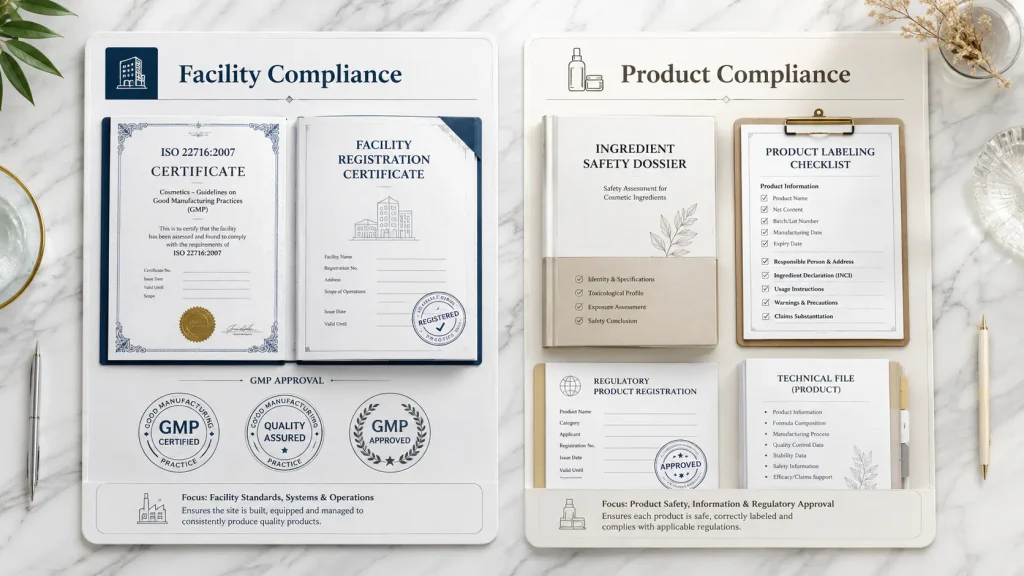
A manufacturing certification, government facility registration, cosmetic product listing or notification, and finished-product market compliance are not interchangeable concepts.
They answer different questions.
5. What Does FDA Registration Mean for Cosmetics?
U.S. cosmetic terminology is particularly important to use accurately.
Under MoCRA, applicable cosmetic manufacturers and processors have facility-registration obligations, while the responsible person has cosmetic product-listing responsibilities.
However:
FDA facility registration and cosmetic product listing are not cosmetic product approval programs.
Brands should therefore be cautious with marketing phrases such as:
“FDA Certified Cosmetic Factory”
or:
“FDA Approved Cosmetic Product”
when referring to ordinary cosmetics and facility registration.
More useful questions include:
- Is the manufacturing facility registered where required?
- Who is responsible for the applicable product listing?
- What product-safety documentation is available?
- What responsibilities remain with the responsible person or brand?
- Does the manufacturer have experience supporting products intended for the U.S. market?
Registration status should be described accurately rather than converted into an approval-style marketing claim.
6. What About EU Cosmetic Compliance?
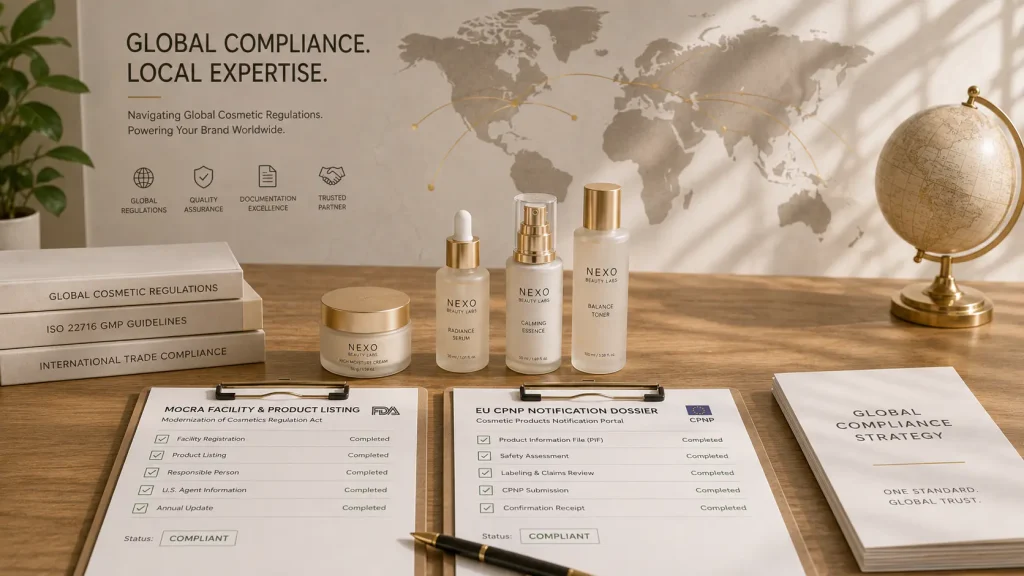
For cosmetics placed on the European Union market, manufacturing certification is only one part of the overall compliance picture.
EU cosmetic requirements can involve areas such as:
- Good Manufacturing Practice
- Responsible Person
- Cosmetic Product Safety Report
- Product Information File
- Ingredient compliance
- Labeling
- Claims
- CPNP notification
The EU Cosmetics Regulation requires cosmetics to be manufactured in accordance with GMP.
But that does not mean that displaying an ISO 22716 certificate automatically completes every other EU product-level obligation.
A manufacturer can support documentation and manufacturing information, while other responsibilities may remain with the EU Responsible Person, importer, brand, or other relevant party depending on the project.
7. Manufacturer Certification Is Not Product Compliance
This distinction deserves particular attention.
Manufacturer-Level Quality & Compliance
This relates mainly to the facility and production system.
It may include:
- Manufacturing licenses
- Cosmetic GMP systems
- ISO 22716 certification where applicable
- Facility registration where applicable
- Quality procedures
- Documentation systems
- Batch traceability
Product-Level Compliance
This relates to the actual formula and finished product being placed on the market.
Depending on the market and product, it can involve:
- Formula and ingredient review
- Product safety
- Testing
- Claims
- Labeling
- Packaging information
- Technical documentation
- Product notification or listing
A qualified manufacturing facility does not automatically make every formula compliant in every country.
Facility qualification and product compliance solve different problems.
8. Target Market Should Be Defined Before Development Is Finished
Where the product will be sold can affect formulation, documentation, labeling, claims, testing, and packaging information.
A product intended only for one market may follow a different preparation route from a product intended for several countries.
Target-market planning can influence:
- Ingredient selection
- Restricted ingredients
- Claims
- Labeling
- Safety documentation
- Product notification or listing
- Responsible-party requirements
- Packaging information
The question:
“Where will this product be sold?”
should therefore be answered early in product development rather than after the formula and packaging are already finalized.
9. Certifications Do Not Replace Daily Quality Control
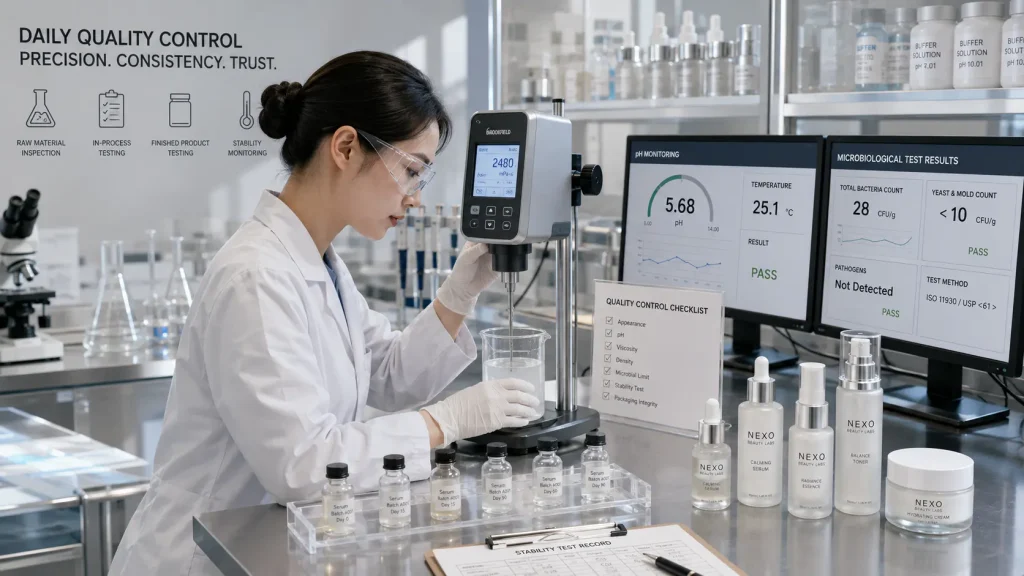
A certificate provides evidence of a quality framework.
Operational quality control shows how that framework is applied to real production.
Raw Material Control
Incoming raw materials can be identified, reviewed, and controlled before use according to the manufacturer’s procedures.
Bulk / Semi-Finished Product Control
Depending on the product, bulk material may be evaluated against defined physical, chemical, sensory, and microbiological specifications.
Packaging Control
Primary and secondary packaging components may be inspected before filling and assembly.
Production Monitoring
Defined manufacturing parameters and production stages can be monitored and documented.
Finished-Product Release
Finished goods should be compared with established specifications before release under the manufacturer’s quality procedures.
Batch Documentation
Production records help connect the finished batch to the materials, processing, packaging, and quality-control activities used during manufacturing.
Retained Samples
Where part of the manufacturer’s quality procedures, retained samples can support future investigation or comparison.
These systems can tell a brand much more about manufacturing reliability than a certificate logo alone.
Related Guide: Daily manufacturing quality control is different from the product evaluation completed before commercial production. To understand how stability, microbiological quality, packaging compatibility, claims support, sensory evaluation, and scale-up can fit into pre-production testing, read Cosmetic Product Testing Before Mass Production →
10. Batch Traceability Matters
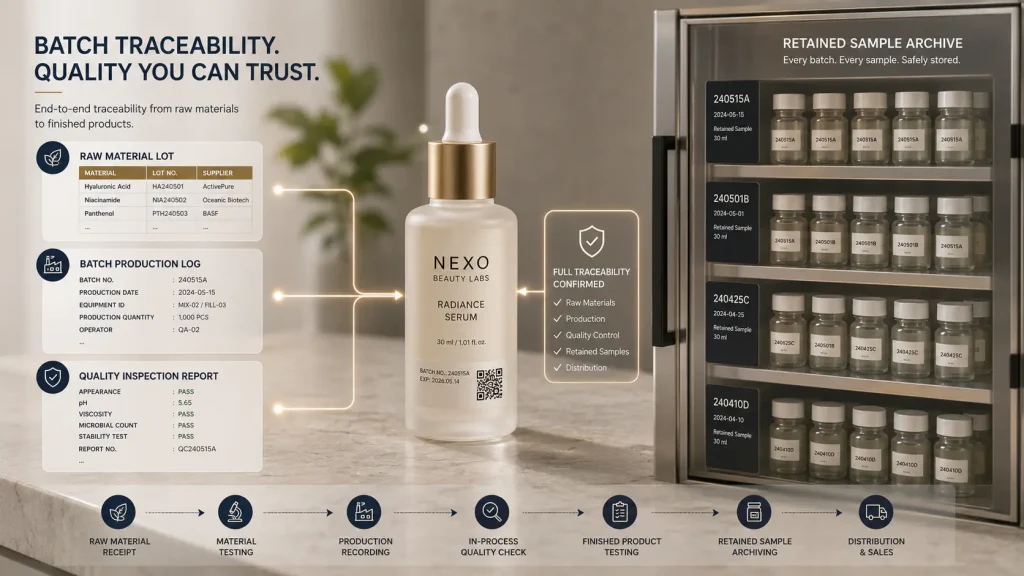
If a quality issue or consumer complaint occurs, the manufacturer needs enough information to investigate the affected batch.
A traceability system may connect a finished product with:
- Raw material lot numbers
- Formula batch
- Production date
- Manufacturing records
- Filling records
- Packaging components
- Quality-control records
- Finished-product batch identification
The important question is not only:
“Was this product manufactured?”
It is:
“Can the manufacturer identify how, when, and with which materials this specific batch was produced?”
This becomes increasingly important as a beauty brand moves into repeat production and larger commercial volumes.
Related Guide: To see where raw material controls, batch manufacturing, in-process checks, filling, packaging, traceability, finished-product inspection, and release fit into commercial production, continue with our Complete Cosmetic Manufacturing Process Guide →
11. What About Halal, Vegan, Organic & Cruelty-Free?
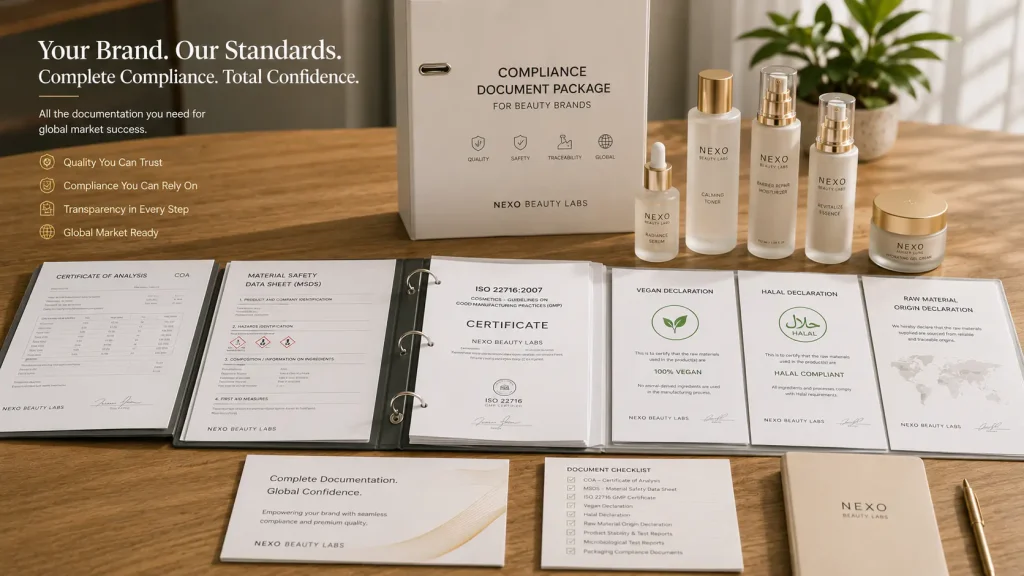
These terms should not all be treated as the same type of certification.
Halal
Halal certification can involve ingredients, processing, cleaning, contamination controls, manufacturing practices, supply-chain requirements, and the rules of the relevant certification scheme.
If Halal positioning matters to your brand, confirm whether the certification body and scope are appropriate for your intended market.
Vegan
Vegan positioning generally requires careful review of ingredient and raw-material origin.
Supplier declarations and other documentation may be needed to support the finished-product claim.
Organic
Organic claims can depend on the certification system, formula composition, qualifying ingredients, manufacturing approach, and target market.
Using one organically sourced ingredient does not automatically make the finished product an organic-certified cosmetic.
Cruelty-Free
Cruelty-free positioning may involve brand policies, supplier information, third-party certification schemes, and market-specific considerations.
The broader principle is:
Do not build a finished-product claim from one ingredient certificate or supplier statement alone.
12. What Documents Should a Beauty Brand Ask For?
The correct document package depends on the product and target market.
However, manufacturer due diligence may include discussion of several categories.
Facility & Quality Documents
- Manufacturing license where applicable
- Relevant GMP documentation
- ISO 22716 certificate where applicable
- Facility registration information where applicable
- Quality-system information
Formula & Raw Material Documents
- Formula specifications
- Ingredient documentation
- Raw material specifications
- Certificates of Analysis where appropriate
- Supplier declarations
- Other supporting ingredient documentation
Product Development Documents
- Product specifications
- Stability-related records
- Microbiological test information
- Preservative-system evaluation where applicable
- Packaging compatibility information
- Other product-specific testing reports
Production & Quality Documents
- Batch information
- Quality-control records
- Traceability records
- Retained-sample procedures
Target-Market Documentation
The required documentation can vary according to:
- Country
- Formula
- Product category
- Claims
- Distribution channel
A good manufacturing partner should clearly distinguish between documents it can provide and responsibilities that remain with the brand, importer, Responsible Person, responsible person, distributor, or another relevant market participant.
13. How to Verify a Cosmetic Manufacturer’s Certification
Do not stop at seeing certification logos on a website or sales presentation.
Request the actual document.
Then verify:
- Legal company name — does it match the manufacturing entity?
- Facility address — is this the site that will produce your SKU?
- Standard — what exact standard or certification is referenced?
- Certificate number — is there a traceable certificate identifier?
- Certification body — who issued the certificate?
- Scope — what facilities, activities, or product categories are covered?
- Issue and validity information — is the certificate current?
- Verification route — can the certificate be checked with the issuing or certification body where a verification system is available?
Most importantly:
Confirm that the documentation applies to the actual factory manufacturing your product.
A genuine certificate connected to a different facility is not evidence that your own production site operates under the same certified scope.
14. Certification Red Flags to Watch For
Certification due diligence can also reveal potential warning signs.
Examples include:
- A company shows certification logos but will not provide the actual certificate
- The certificate lists a different company or manufacturing address
- The certificate is expired or its validity cannot be confirmed
- The scope does not appear relevant to the product being manufactured
- The manufacturer cannot explain which factory will produce your SKU
- The company uses “FDA Approved” or “FDA Certified” loosely for ordinary cosmetic registration
- Quality questions are answered only with marketing statements rather than documentation
- The manufacturer cannot clearly explain batch traceability
- There is no clear distinction between facility certification and product compliance
A professional manufacturer should be able to explain what its certificates mean — and just as importantly, what they do not mean.
15. Questions Beauty Brands Should Ask a Cosmetic Manufacturer
Before choosing an OEM/ODM manufacturing partner, ask:
- Which GMP framework does the production facility follow?
- Does the actual manufacturing site hold ISO 22716 certification?
- Can you provide the current certificate?
- Who issued the certificate?
- What is its scope?
- Which manufacturing facility will produce my SKU?
- How are incoming raw materials inspected and released?
- How are suppliers qualified?
- How are bulk products evaluated?
- How are packaging components controlled?
- How are deviations handled?
- How are production batches identified?
- How does batch traceability work?
- Are retained samples kept according to your quality procedures?
- What finished-product checks are performed before release?
- Which regulatory and product documents can you support?
- Which compliance responsibilities remain with my brand?
- Have you previously supported products intended for my target market?
These questions provide a much clearer picture of manufacturing reliability than simply counting certificate logos.
16. Certifications Should Match the Product & Project
More certification logos do not automatically make one cosmetic manufacturer a better partner than another.
The more useful evaluation is:
Relevant Standards + Actual Facility + Product Capability + Quality Control + Documentation + Traceability + Target-Market Experience
A standard facial cleanser, sunscreen, single-dose capsule, dual-chamber product, scalp treatment, and highly customized active serum can involve different manufacturing and market requirements.
The right manufacturing partner should therefore be evaluated against the product you actually intend to develop.
Related Guide: Certifications are only one part of manufacturer due diligence. If you’re comparing potential production partners, also evaluate R&D capabilities, product-category experience, MOQ, packaging support, testing, communication, scalability, and commercial terms in How to Choose a Reliable Cosmetic Manufacturer →
Frequently Asked Questions
What certifications should a cosmetic manufacturer have?
There is no single universal certificate list for every cosmetic project. ISO 22716 is an important international cosmetic GMP standard, while other facility, quality, social, Halal, or market-specific requirements may also be relevant depending on the product and target market.
What is ISO 22716 for cosmetics?
ISO 22716:2007 provides Good Manufacturing Practice guidelines relating to the production, control, storage, and shipment of cosmetic products.
Is ISO 22716 still current?
Yes. ISO 22716:2007 remains the published international standard for cosmetic GMP guidelines.
What does GMP mean in cosmetic manufacturing?
GMP means Good Manufacturing Practice. It refers to systems and procedures intended to support controlled manufacturing across areas such as personnel, premises, equipment, raw materials, production, hygiene, quality control, documentation, storage, and traceability.
Is GMP the same as ISO 22716?
Not exactly. GMP is the broader Good Manufacturing Practice concept, while ISO 22716 is a specific international standard containing GMP guidelines for cosmetic manufacturing.
Is an FDA-registered cosmetic facility FDA certified?
No. U.S. cosmetic facility registration and cosmetic product listing under MoCRA should not be described as FDA certification or cosmetic product approval. Registration, listing, and product compliance are separate concepts.
Does ISO 22716 certification mean a cosmetic is EU compliant?
Not by itself. EU cosmetic products also need to meet applicable product-level requirements relating to areas such as safety assessment, Responsible Person obligations, Product Information File, labeling, ingredient compliance, claims, and product notification.
Does a certified cosmetic factory mean its products can be sold in every country?
No. Facility certification and finished-product market compliance are separate. The formula, ingredients, labeling, claims, safety documentation, product classification, and other requirements need to be evaluated for the intended market.
How can I verify an ISO 22716 certificate?
Request the complete certificate and review the company name, facility address, standard, certificate number, certification body, scope, and validity information. Confirm that it applies to the actual production facility and use the issuing body’s verification resources where available.
What documents should I ask a cosmetic manufacturer for?
Depending on the project, relevant documents may include facility licenses, GMP or ISO documentation, raw material information, Certificates of Analysis, formula specifications, product testing records, packaging compatibility information, batch records, quality documentation, and target-market supporting documents.
Are Halal, vegan, organic, and cruelty-free the same type of certification?
No. They represent different product, ingredient, supply-chain, ethical, or certification concepts and can involve different evidence and third-party schemes. Each claim should be reviewed separately.
Are more certifications always better?
Not necessarily. Certifications are most valuable when they are relevant to the actual facility, product, production process, customer requirements, and target market.
Choose a Quality System, Not Just a Certificate
Certifications are useful because they provide evidence that a manufacturer operates within a defined framework.
But certification is only one part of evaluating a cosmetic manufacturing partner.
What matters in practice is how the quality system connects:
Formulation → Raw Materials → Production → Packaging → Quality Control → Documentation → Traceability → Target-Market Requirements
At NEXO Beauty Labs, product development is approached as a connected process across formulation, product evaluation, packaging, manufacturing, quality requirements, and international market preparation.
When evaluating an OEM/ODM manufacturing partner, look beyond the logos.
Ask how the system behind those certifications will support your actual product.
Request a Cosmetic Manufacturing & Compliance Consultation with NEXO Beauty Labs to discuss your skincare, haircare, body care, or personal care project, target market, quality requirements, and documentation needs.