Who Owns a Custom Cosmetic Formula? Formula Ownership, Exclusivity & OEM/ODM Development Explained
Learn how cosmetic formula ownership, exclusivity and customization can differ across private label, OEM and ODM projects, and what beauty brands should clarify before development.
A beauty brand may spend months developing a formula, ingredient story, texture, packaging, claims direction, and market positioning.
But one question is sometimes left until much too late:
Who actually owns the cosmetic formula?
There is no universal answer.
Formula rights can depend on:
- How the project started
- Whether an existing formula was used
- Level of customization
- Who performed the development work
- Development fees
- Manufacturer policies
- Confidentiality terms
- Exclusivity arrangements
- Documentation rights
- Manufacturing rights
- Technology-transfer rights
- The written agreement between the parties
The most important point for beauty brands is:
Custom Formula ≠ Formula Ownership ≠ Formula Exclusivity
These concepts can overlap, but they should never be assumed to mean the same thing.
This guide explains the differences between formula ownership, exclusivity, documentation, manufacturing know-how, and transfer rights across private label, ODM, and custom cosmetic development.
This article provides general product-development and commercial information rather than legal advice. Formula, intellectual-property, confidentiality, and contractual rights can vary by jurisdiction and agreement. Brands should seek appropriate legal advice where these rights are commercially important.
Quick Answer: Who Owns a Custom Cosmetic Formula?
A formula being custom-developed does not automatically determine who owns it.
The practical answer depends on how the product was developed and what the written agreement says.
The labels OEM, ODM, private label, or custom formulation are useful descriptions of a development model.
They are not substitutes for an ownership clause.
1. What Does “Formula Ownership” Actually Mean?
When a brand says it wants to “own the formula,” that phrase can refer to several different rights.
For example:
- Who controls the quantitative formula?
- Who owns the underlying base formulation?
- Who controls modifications created during development?
- Who may manufacture the formula?
- Can the manufacturer offer the same formula to another client?
- Can the brand manufacture it somewhere else?
- Can the brand modify or reformulate it?
- Can the formula be transferred or licensed?
- Who controls manufacturing know-how?
- Which technical documents will the brand receive?
These questions are related, but they are not identical.
A brand may receive exclusive use rights without owning the underlying formula.
A brand may also receive formula documentation while certain process knowledge or supplier-specific manufacturing information remains subject to separate rights.
This is why “ownership” should be translated into specific contractual rights rather than left as a general word.
2. Ownership, Exclusivity, License & Confidentiality Are Different
Four terms are especially easy to confuse.
Ownership
Ownership describes who holds the relevant rights in the formula or other defined intellectual property under the applicable agreement.
Exclusivity
Exclusivity limits how a formula or product may be offered or used by other parties.
It can be limited by:
- Territory
- Product category
- Sales channel
- Time period
- Minimum purchase requirements
License / Authorized Use
A license or authorized-use arrangement can allow a brand to use or sell products based on a formula without transferring ownership of the underlying formula.
Confidentiality
Confidentiality determines how defined information may be disclosed or accessed.
A confidentiality agreement can help protect confidential information, but confidentiality alone does not automatically create formula ownership or exclusivity.
In short:
Ownership = Who controls the asset
Exclusivity = Who else may use it
License = What use is permitted
Confidentiality = Who may disclose the information
3. Who Usually Controls a Private Label Formula?
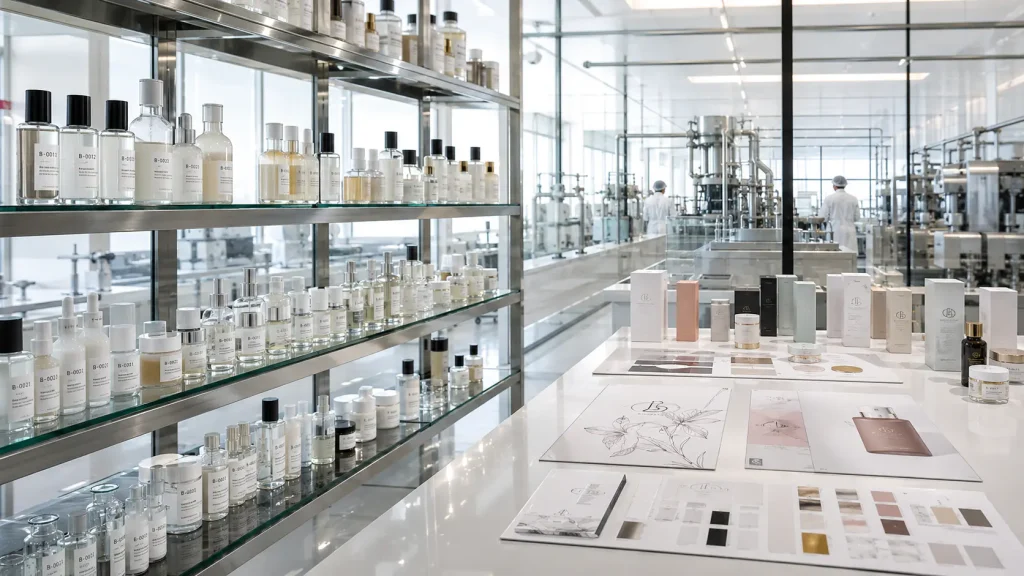
Private label generally begins with a product or formula that already exists within the manufacturer’s formulation library.
The manufacturer may already have:
- Developed the formula
- Produced it previously
- Established raw material specifications
- Developed the manufacturing method
- Built experience producing it at commercial scale
The brand then differentiates the commercial product through areas such as:
- Brand name
- Product name
- Logo
- Artwork
- Packaging
- Positioning
- Marketing
In this type of arrangement, the underlying formula often remains part of the manufacturer’s existing platform unless another arrangement is specifically negotiated.
That means another brand may potentially purchase the same or a related formulation.
This is one of the trade-offs that can make private label faster and less development-intensive:
the formulation foundation already exists.
But using that foundation does not automatically create ownership of it.
Related Guide: If you’re considering an existing manufacturer-developed formula and want to understand how product selection, customization, packaging, MOQ, ownership, and scaling typically work, read our Private Label Skincare: A Complete Guide for Beauty Brands →
4. Does Paying for Custom Formulation Mean You Own It?
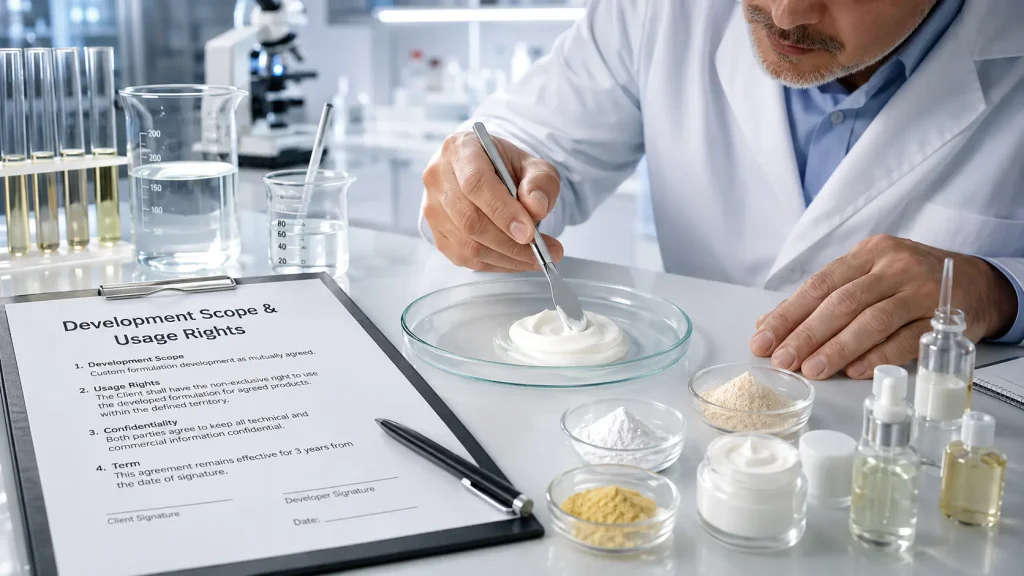
Not automatically.
This is one of the most important points for beauty brands to clarify before paying development fees.
A manufacturer or formulation laboratory may create a product around a brand-specific brief covering:
- Active ingredients
- Texture
- Viscosity
- Fragrance
- Color
- Sensory characteristics
- Product format
- Packaging
- Claims direction
- Target market
That clearly makes the project customized.
But customization describes how the product was developed.
It does not answer:
who controls the resulting formula afterward.
Depending on the project, the agreement could provide:
- Brand ownership of defined formula rights
- Manufacturer ownership with brand exclusivity
- Exclusive manufacturing access
- Defined territorial rights
- Defined documentation access
- A formula buyout or later transfer route
- Another negotiated arrangement
The development invoice and the ownership clause therefore answer two different commercial questions.
5. Custom Formula & Exclusive Formula Are Not the Same
Custom describes development.
Exclusive describes restrictions on use.
Custom Formula
The formula is created, adapted, or optimized around a particular product brief.
Exclusive Formula
The agreement limits who else may use or receive the formula, product, or defined version of it.
For example, exclusivity may apply:
- Only to the exact formula
- Only to a specific product category
- Only within a defined territory
- Only for a defined period
- Only while minimum purchase requirements are met
So:
Customization describes development.
Exclusivity describes usage restrictions.
Ownership describes control of the underlying rights.
6. What Should “Exclusive Formula” Actually Mean?
The word “exclusive” is not detailed enough by itself.
Exclusive to Whom?
Is the restriction granted to:
- One brand?
- One legal entity?
- A group of related companies?
- One product line?
Exclusive Where?
Does it apply:
- Globally?
- Only in the United States?
- Only in the European Union?
- In selected countries?
- Only in a particular retail channel?
Exclusive for How Long?
Is exclusivity:
- Permanent?
- Time-limited?
- Linked to the manufacturing agreement?
- Conditional on annual purchasing levels?
Exclusive to What?
Does the restriction cover:
- The exact quantitative formula?
- A defined formula family?
- Specific modifications?
- A combination of active ingredients?
- A product format or texture?
Could the manufacturer create another version by changing fragrance, concentration, texture, or another characteristic?
This should be defined clearly.
What Happens if Conditions Are Not Met?
If exclusivity depends on purchasing volume, timing, territory, or other commercial conditions, the agreement should explain what happens when those conditions are no longer satisfied.
“Exclusive” should be defined in writing rather than assumed from a sales conversation.
7. Base Formula & Brand-Specific Modifications May Be Different Assets
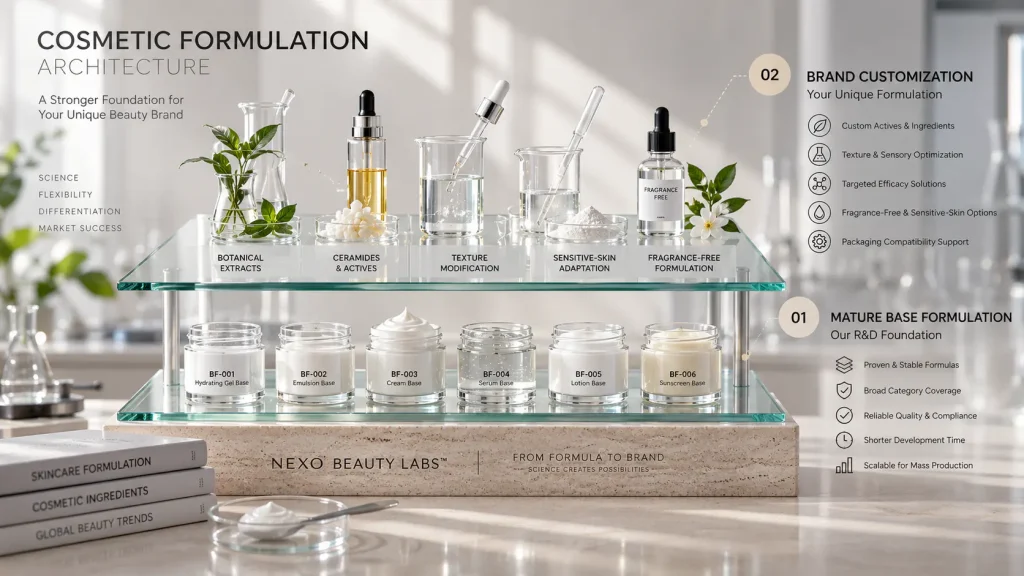
This distinction is particularly important in customized ODM development.
Imagine a manufacturer already has a mature barrier serum.
A brand then requests:
- A different ceramide system
- A new botanical extract
- Lower viscosity
- Fragrance-free positioning
- A different sensory profile
The project now contains at least two conceptual layers:
Pre-Existing Base Formula
and:
Project-Specific Modifications
The agreement should clarify the rights associated with both.
Useful questions include:
- Does the manufacturer retain rights to the original base?
- Who controls the project-specific modifications?
- Are those modifications exclusive?
- Can the original base continue to be offered?
- Can similar modifications be made for another customer?
- Which version will be documented for the brand?
Without this distinction, the brand and manufacturer may both use the phrase “custom formula” while expecting completely different rights.
8. Can Cosmetic Formulas Be Protected as Trade Secrets?
A cosmetic formulation or manufacturing process may potentially be managed as confidential intellectual property, including as a trade secret where the applicable legal requirements are met.
In general, trade-secret protection involves information that:
- Is not generally known or readily accessible
- Has commercial value because it is secret
- Is subject to reasonable measures designed to maintain confidentiality
Depending on the product and jurisdiction, relevant confidential information could include:
- Quantitative formula
- Raw material specifications
- Manufacturing sequence
- Processing parameters
- Technical know-how
- Supplier information
This is another reason confidentiality procedures matter.
However, trade-secret status, ownership, contract rights, and exclusivity are separate legal concepts and should not be treated as interchangeable.
9. Formula Documentation Is Not the Same as Formula Ownership
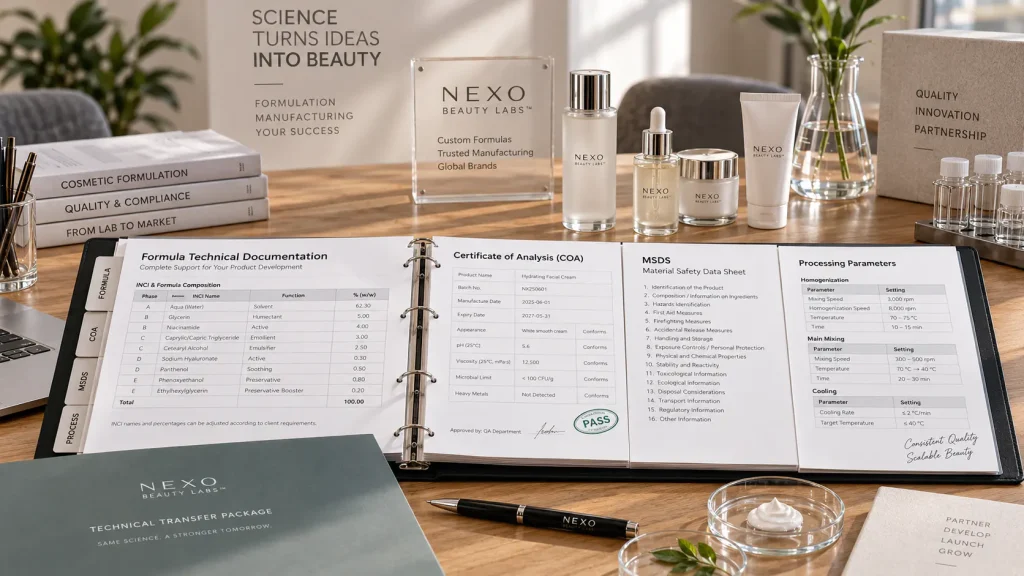
A brand may assume that paying for formulation means receiving every technical document associated with the product.
That should not be assumed.
Formula-related information may include:
- INCI ingredient list
- Quantitative formula
- Ingredient trade names
- Raw material grades
- Raw material specifications
- Supplier information
- Manufacturing instructions
- Ingredient addition sequence
- Processing temperatures
- Mixing parameters
- Finished-product specifications
- Testing documentation
Different projects can provide different levels of access.
For example, a brand may receive information needed for labeling or market documentation while detailed manufacturing process information remains subject to separate commercial or confidentiality terms.
Ask:
“Exactly which technical documents are deliverables under this agreement?”
rather than assuming “custom development” automatically includes every piece of formulation and manufacturing information.
10. An INCI List Is Not the Complete Formula
This is another useful distinction for beauty brands.
An ingredient declaration tells you which ingredients are present according to applicable labeling requirements.
It does not necessarily reveal:
- Exact percentages
- Raw material trade names
- Supplier grades
- Processing sequence
- Mixing conditions
- Heating and cooling profile
- Manufacturing equipment
So having an INCI list does not mean a brand possesses enough information to reproduce a commercial formula at another factory.
11. Formula Ownership & Manufacturing Know-How Are Different
A cosmetic formula is more than an ingredient spreadsheet.
Two manufacturers working from similar percentages can still produce different:
- Viscosity
- Particle distribution
- Texture
- Appearance
- Stability
- Sensory characteristics
because manufacturing also depends on factors such as:
- Order of ingredient addition
- Mixing speed
- Shear
- Heating
- Cooling
- Homogenization
- Processing time
- Equipment
Some of this information may represent manufacturing know-how rather than simply the formula composition itself.
A project that requires manufacturing portability should therefore clarify not only formula rights, but also which process information can be transferred.
12. Can a Brand Take Its Formula to Another Manufacturer?
Sometimes — but not automatically.
Transferability can depend on:
- Ownership rights
- License terms
- Contract restrictions
- Confidentiality obligations
- Documentation access
- Manufacturing specifications
- Raw material information
- Technical-transfer rights
Even when a brand has the contractual right to move a formula, another manufacturer still needs enough information and development work to reproduce the intended product reliably.
Technology transfer can require:
- Formula review
- Raw material matching or substitution
- Laboratory batches
- Process redevelopment
- Stability evaluation
- Packaging compatibility work
- Scale-up
Different factories may use different raw materials, equipment, and process conditions.
So changing manufacturer is not necessarily as simple as sending over the ingredient percentages.
If manufacturing flexibility matters to your long-term strategy, clarify portability and technical-transfer rights before development begins.
13. Formula Rights vs. Other Beauty Brand Intellectual Property
A finished cosmetic product can involve several separate intellectual-property or commercial assets.
Brand Assets
- Trademark
- Brand name
- Logo
- Product name
- Marketing assets
- Artwork
Packaging Assets
- Artwork
- Structural design
- Custom molds
- Tooling
- Decoration files
Formula & Technical Assets
- Pre-existing base formula
- Project-specific formulation
- Formula modifications
- Quantitative documentation
- Manufacturing specifications
- Process know-how
Different parties may control different parts of the same finished product.
The existence of one brand-owned asset does not automatically determine ownership of all the others.
14. What About Custom Packaging & Mold Ownership?
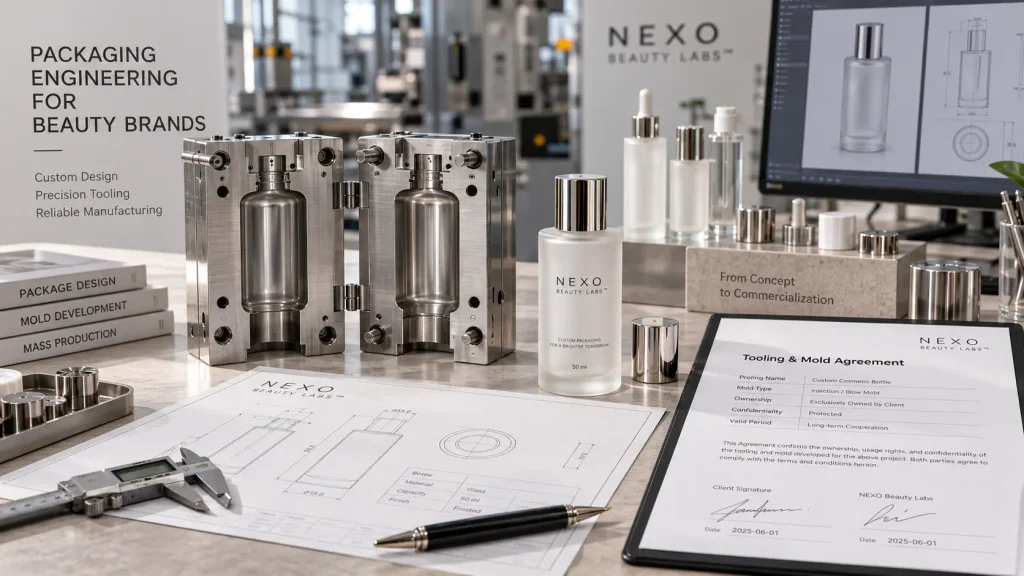
Formula ownership is not the only ownership question in cosmetic product development.
Custom packaging and tooling can raise similar issues.
If a brand pays to develop a proprietary bottle mold, clarify:
- Who owns the physical mold?
- Who paid the tooling fee?
- Where will the mold be stored?
- Can the supplier use it for another customer?
- Does the brand have exclusive use?
- Can the mold be transferred to another supplier?
- Who pays maintenance or storage costs?
- What happens if the supplier relationship ends?
These points should ideally be resolved before expensive tooling is produced.
Related Guide: Mold ownership is only one part of packaging development. If you’re also evaluating packaging formats, materials, formula compatibility, dispensing, decoration, MOQ, tooling, and manufacturing feasibility, see our Guide to Choosing Cosmetic Packaging →
15. What Should a Cosmetic Formulation Agreement Clarify?
Background / Pre-Existing Formula Rights
- What does each party already own or control before the project?
- Is an existing manufacturer formula being used?
Project-Specific Formula Rights
- Who controls the final formula?
- Who controls modifications created during development?
- Are derivative versions covered?
Exclusivity
- Is the formula or product exclusive?
- What exactly is protected?
- Which territories are covered?
- How long does it last?
- Are minimum purchasing requirements involved?
Confidentiality
- What information is confidential?
- Who may access it?
- Can it be shared with regulators, laboratories, or other approved partners?
- How long do confidentiality obligations continue?
Documentation Deliverables
- Will the brand receive the quantitative formula?
- Will raw material grades or supplier information be provided?
- Will manufacturing instructions be provided?
- Which technical information remains subject to manufacturer restrictions?
Manufacturing Rights
- Must the formula remain with the original manufacturer?
- Can the brand appoint another manufacturer?
- Can the manufacturer subcontract any production?
Transfer & Transition Rights
- Can technical information be transferred?
- What happens when the relationship ends?
- Is transition assistance available?
Packaging & Tooling
- Who owns custom molds?
- Who can use them?
- Can they be transferred?
Future Development
- Who controls reformulations?
- Who controls cost-optimized versions?
- Who controls line extensions based on the original formula?
The agreement does not need to use the same terminology for every project.
What matters is that commercially important rights are clear enough that both parties understand the same thing.
Private Label vs. ODM vs. Custom Formula Rights
Development model alone does not determine ownership.
The commercial and contractual terms do.
Related Guide: Formula rights are only one difference between these development models. For a broader comparison of customization, development time, MOQ, cost, formula control, and the manufacturer’s role, read OEM vs. ODM vs. Private Label Cosmetics →
Questions Beauty Brands Should Ask Before Development
Before significant formulation work begins, ask:
- Who owns or controls the starting formula?
- Is this a pre-existing manufacturer platform?
- Is the project being developed specifically for our brand?
- Who controls modifications created during development?
- Who controls the final quantitative formula?
- Is the finished formula exclusive?
- What exactly does exclusivity cover?
- Can the manufacturer offer similar products to other brands?
- How long does exclusivity last?
- Is exclusivity linked to purchase volume?
- What formula documentation will we receive?
- Will manufacturing instructions be included?
- Can the formula be transferred to another manufacturer?
- What information can be shared during a technical transfer?
- Who controls reformulations and future derivatives?
- Who owns packaging molds and tooling?
- What confidentiality protections apply?
- What happens if the manufacturing relationship ends?
These questions are much easier to resolve before a hero product becomes commercially successful.
Related Guide: Formula rights are only one part of manufacturer due diligence. Before committing to a production partner, also evaluate R&D capabilities, quality systems, product-category experience, MOQ, packaging support, testing, communication, scalability, and commercial terms. See our How to Choose a Reliable Cosmetic Manufacturer →
Why Written Agreements Matter
Words such as:
Custom
Exclusive
Proprietary
Confidential
Brand-Owned
can sound precise while still meaning different things to different people.
A sales discussion can establish commercial expectations.
But important rights should ultimately be reflected in the written agreement that governs the project.
Clear written terms help reduce future disagreements regarding:
- Formula ownership
- Formula use
- Exclusivity
- Confidentiality
- Documentation
- Manufacturing rights
- Technology transfer
- Packaging molds
- Future production
Frequently Asked Questions
Who owns a custom cosmetic formula?
There is no universal rule. Ownership depends on the development structure, pre-existing rights, and most importantly the written agreement between the relevant parties. A formula being custom-developed does not automatically transfer all rights to the brand.
If I paid for cosmetic formulation, do I own the formula?
Not necessarily. Paying for development services and obtaining ownership of the resulting formula are separate commercial and contractual questions. Confirm ownership before development begins.
Does custom formulation automatically mean the formula is exclusive?
No. Custom describes how the formula was developed. Exclusivity determines whether other parties may use the same or defined similar formula. They should be addressed separately.
Can a private label formula be exclusive?
Potentially, depending on the manufacturer’s policies and agreement. Private label generally starts with an existing formulation platform, so exclusivity should not be assumed.
What is the difference between formula ownership and formula exclusivity?
Ownership relates to who controls the relevant formula rights. Exclusivity places restrictions on who else may use or receive the formula or product. A brand can potentially have exclusive use without owning the underlying formula.
Can I take my custom cosmetic formula to another manufacturer?
It depends on ownership, license terms, documentation access, confidentiality obligations, transfer rights, and the agreement. Even when transfer is allowed, another manufacturer may need to perform laboratory, sourcing, compatibility, or scale-up work.
Is an INCI list enough to manufacture my formula somewhere else?
No. An INCI list generally does not provide the quantitative composition, raw material grades, manufacturing sequence, process parameters, or other technical information needed to reproduce a commercial product consistently.
Can a cosmetic formula be a trade secret?
Potentially. Confidential formulas, processes, and technical information may qualify for trade-secret protection where the applicable requirements are met, including commercial value from secrecy and reasonable efforts to maintain confidentiality.
Does an NDA give me formula ownership?
No. An NDA primarily addresses confidentiality and permitted disclosure. Ownership, exclusivity, manufacturing rights, and transfer rights should be defined separately.
Who owns a custom cosmetic packaging mold?
That depends on the tooling agreement. Brands should clarify ownership, exclusive use, storage, maintenance, supplier use, and transferability before a mold is manufactured.
What should a cosmetic formulation agreement include?
Depending on the project, important topics can include pre-existing formula rights, final formula rights, exclusivity, confidentiality, documentation deliverables, manufacturing rights, technology-transfer rights, packaging/tooling rights, future modifications, and termination arrangements.
Clarify Formula Rights Before Development Begins
Formula ownership should not become a question after months of R&D have already been completed.
The key distinctions are:
Custom Formula ≠ Formula Ownership
Formula Ownership ≠ Formula Exclusivity
Formula Documentation ≠ Manufacturing Know-How
Confidentiality ≠ Ownership Transfer
At NEXO Beauty Labs, product development can range from mature private label solutions to customized ODM and more tailored OEM formulation projects depending on product requirements and brand strategy.
Before development begins, brands should discuss not only the formula concept itself, but also the intended development scope, customization, documentation, packaging, confidentiality, exclusivity, and any commercially important formula-rights requirements.
Request a Cosmetic Formulation & OEM/ODM Consultation with NEXO Beauty Labs to discuss your product concept, development route, formula customization, packaging, documentation, and manufacturing requirements.