
Roll-On vs Stick vs Spray Deodorant: Which Format Should Your Personal Care Brand Develop?
Compare roll-on, stick and spray deodorant formats from a personal care product development perspective, including formulation, sensory experience, packaging, positioning and manufacturing considerations.
A deodorant can be developed as a familiar roll-on, portable solid stick, or lightweight spray.
All three can serve the same broad underarm-care category, but they create very different product systems.
The format can change:
- Formula architecture
- Application method
- Drying experience
- Residue
- Packaging
- Stability
- Filling
- Manufacturing
- MOQ
- Consumer expectations
So the better question isn’t:
“Which deodorant format is best?”
It is:
“Which format best supports the consumer, usage occasion, product positioning, and application experience our brand wants to create?”
This guide compares roll-on, stick, and spray deodorant from a beauty and personal-care OEM/ODM product-development perspective.
Quick Answer: Roll-On vs Stick vs Spray Deodorant
No format is automatically more effective simply because it is a roll-on, stick, or spray.
The right choice is the format where the deodorant system, application method, sensory experience, packaging, stability, and manufacturing process work together.
1. Start With the Deodorant Positioning — Not the Format
Before choosing a roll-on bottle, stick mechanism, or spray nozzle, define what kind of product the brand is actually building.
The concept might be:
- Botanical-inspired daily deodorant
- Minimalist personal care
- Sensitive-skin-oriented deodorant
- Sport or active-lifestyle product
- Premium wellness deodorant
- Fragrance-led personal care
- Compact travel product
- Fast-drying lifestyle deodorant
Each direction creates different expectations around:
- Wetness
- Drying speed
- Residue
- Fragrance
- Skin feel
- Packaging
- Application
A stronger development sequence is:
Target Consumer → Usage Scenario → Product Positioning → Sensory Target → Deodorant System → Formula → Packaging → Format
2. What Is a Roll-On Deodorant?

Roll-on deodorant uses a liquid or fluid formula delivered through a rotating ball applicator.
It naturally supports concepts around:
- Everyday use
- Direct application
- Botanical positioning
- Fragrance-led personal care
- Compact packaging
- Familiar consumer routines
- Wellness-oriented products
The format is easy for consumers to understand, but sensory performance matters immediately.
Consumers notice:
- How wet it feels
- How evenly it spreads
- How quickly it dries
- Whether it feels sticky
- Whether residue remains
Roll-On Development Considerations
- Formula viscosity
- Ball diameter
- Ball housing
- Product pickup
- Dispensing consistency
- Application wetness
- Dry-down
- Stickiness
- Residue
- Fragrance
- Leakage
- Formula-packaging compatibility
A formula that is too fluid may dispense excessively or increase leakage risk.
A formula that is too viscous may not move around the roller ball consistently.
Viscosity + Roller Mechanism = Application Performance
For one botanical-inspired direction, see Agarwood & Mint Botanical Roll-On Deodorant.
3. What Is a Deodorant Stick?
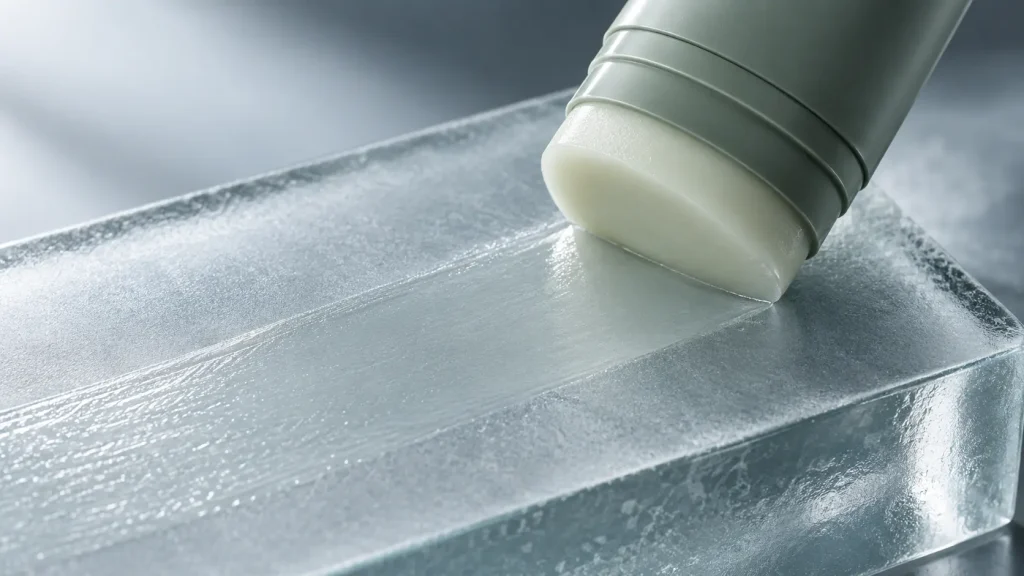
A deodorant stick is not simply a roll-on formula converted into solid form.
It uses a different formulation architecture and manufacturing process.
Stick deodorant can naturally support:
- Sport positioning
- Travel
- Active lifestyles
- Minimalist application
- Solid personal care
- Premium packaging
- Low-mess daily use
The formula needs enough structure to stay stable inside the component while still transferring comfortably to the skin.
Stick Development Considerations
- Structural firmness
- Glide
- Drag
- Payoff
- Waxiness
- Oiliness
- Residue
- Visible marks
- Crumbling
- Breakage
- Sweating
- Shrinkage
- Heat behavior
- Packaging mechanism
A stick that is too hard can create excessive drag.
A stick that is too soft may deform or perform poorly inside the package.
The development challenge is:
Structure + Glide + Payoff + Stability
4. “Invisible Stick” Should Be a Finished-Product Goal — Not Just a Name
White residue is a common development concern in solid deodorant formats.
Its appearance can depend on:
- Powders
- Waxes
- Active or odor-control materials
- Application amount
- Formula payoff
- Skin and fabric interaction
A brand should therefore avoid assuming that a clear-looking or pale stick automatically becomes “invisible” during real consumer use.
If low-residue or reduced-white-mark positioning is important, it should be considered as part of the finished product-development target.
5. What Is a Spray Deodorant?

Spray deodorant creates a lighter, dispersed application experience.
It can support concepts around:
- Freshness
- Quick application
- Fragrance
- Lightweight skin feel
- Lifestyle positioning
- Modern personal care
But “spray” is a broad format rather than one single packaging technology.
Pump Spray / Fine Mist
A pump system uses mechanical action to dispense a low-viscosity formula through a nozzle.
Aerosol Spray
An aerosol is a pressurized packaging system and represents a different technical project.
Depending on the design, it can introduce additional considerations around:
- Propellant system
- Container pressure
- Valve and actuator
- Specialized filling
- Leak testing
- Transportation and storage requirements
A brand should therefore clarify early:
“Do we want a pump spray or a pressurized aerosol?”
Spray Development Considerations
- Formula viscosity
- Spray mechanism
- Nozzle compatibility
- Spray pattern
- Droplet distribution
- Dose consistency
- Drying experience
- Clogging
- Leakage
- Packaging compatibility
- Filling requirements
A roll-on formula should not automatically be transferred into a spray bottle and expected to perform correctly.
The dispensing system is part of the formulation strategy.
6. Which Deodorant Format Fits the Consumer Best?
Choose Roll-On When Your Priority Is:
- Familiar daily application
- Direct controlled use
- Botanical storytelling
- Fragrance or wellness positioning
- Compact packaging
Choose Stick When Your Priority Is:
- Portability
- Sport or active lifestyles
- Solid-format differentiation
- Low-mess application
- Minimalist or premium packaging
Choose Spray When Your Priority Is:
- Quick application
- Lightweight sensory experience
- Freshness
- Fragrance
- Non-contact dispensing
- Lifestyle-oriented positioning
These are consumer-positioning tendencies rather than universal performance rankings.
7. Deodorant vs Antiperspirant: Define This Before Formulation
Deodorant and antiperspirant should not automatically be treated as interchangeable product terms.
A deodorant is generally designed around:
Odor Management + Freshness + Personal Care
An antiperspirant is designed to reduce perspiration using an appropriate antiperspirant active system.
This distinction can change:
- Ingredient selection
- Claims
- Testing
- Labeling
- Product classification
- Documentation
- Manufacturing requirements
For the United States, this distinction is especially important.
A deodorant positioned only around odor and freshness is generally treated as a cosmetic.
A product intended to reduce underarm perspiration is an antiperspirant and must follow the applicable U.S. OTC drug requirements.
The development brief should therefore answer:
“Are we making a deodorant, an antiperspirant-deodorant, or another underarm-care product?”
before formula and claims are finalized.
For more background, see Natural Deodorant: How It Works, Ingredients & What to Expect.
8. “Aluminum-Free” and “Antiperspirant” Are Not the Same Product Story
Brands should be particularly careful when developing products for the U.S. market.
An aluminum-free deodorant can support:
- Odor-control positioning
- Freshness
- Botanical or wellness concepts
- Fragrance-led personal care
But a product should not automatically make perspiration-reduction claims simply because consumers associate deodorant with sweat control.
For U.S. projects, antiperspirant claims require an appropriate OTC antiperspirant active system and compliance pathway.
Odor claim ≠ Sweat-reduction claim
should therefore be clear from the beginning of development.
9. “Natural Deodorant” Does Not Define One Formula
Natural or botanical deodorant is a positioning direction rather than one universally standardized formulation architecture.
Depending on the product concept, deodorant formulas may explore combinations of:
- Odor-control ingredients
- Absorbent materials
- Botanical ingredients
- Fragrance systems
- Emollients
- Formula-base technologies
- Skin-feel modifiers
A botanical ingredient list does not automatically mean:
- Better odor performance
- Safer for every consumer
- Suitable for sensitive skin
- Antiperspirant performance
The complete finished formula should support the positioning.
10. Fragrance Alone Is Not a Deodorant Performance Strategy

Fragrance can be an important part of deodorant identity.
Possible directions include:
- Fresh
- Mint
- Woody
- Botanical
- Floral
- Herbal
- Marine
- Clean
- Wellness-inspired
But fragrance serves a different role from the complete odor-management system.
Fragrance present ≠ automatically proven deodorant performance.
A strong product should integrate:
Functional Deodorant System + Fragrance + Skin Feel + Format
rather than relying only on masking odor with a stronger scent.
11. Sensitive-Skin Positioning Depends on More Than Format
It is tempting to describe one format as automatically more suitable for sensitive skin.
But consumer tolerance can depend on:
- Complete ingredient system
- Fragrance
- Alcohol where present
- Formula pH where relevant
- Powders and absorbents
- Mechanical drag
- Application friction
- Frequency of use
- Post-shaving application
A spray may reduce direct applicator friction.
A well-designed roll-on may provide smooth controlled application.
A poorly balanced stick may create unnecessary drag.
Sensitive-skin positioning should therefore follow the finished product — not the format name alone.
12. Sensory Experience Changes by Deodorant Format
Roll-On Sensory Targets
- Controlled wetness
- Smooth application
- Acceptable dry-down
- Low stickiness
- Low residue
Stick Sensory Targets
- Smooth glide
- Low drag
- Controlled payoff
- Low waxiness
- Reduced visible residue
- Comfortable after-feel
Spray Sensory Targets
- Fine dispensing
- Controlled wetness
- Quick dry-down
- Low residue
- Comfortable skin feel
Deodorant is typically a frequently used personal-care product.
Consumers may try it because of ingredients, fragrance, packaging, or advertising.
But repeat purchase is strongly influenced by what happens every time the product is applied.
Positioning attracts the first purchase. Application experience supports repeat use.
13. Packaging Is Part of the Deodorant Product System
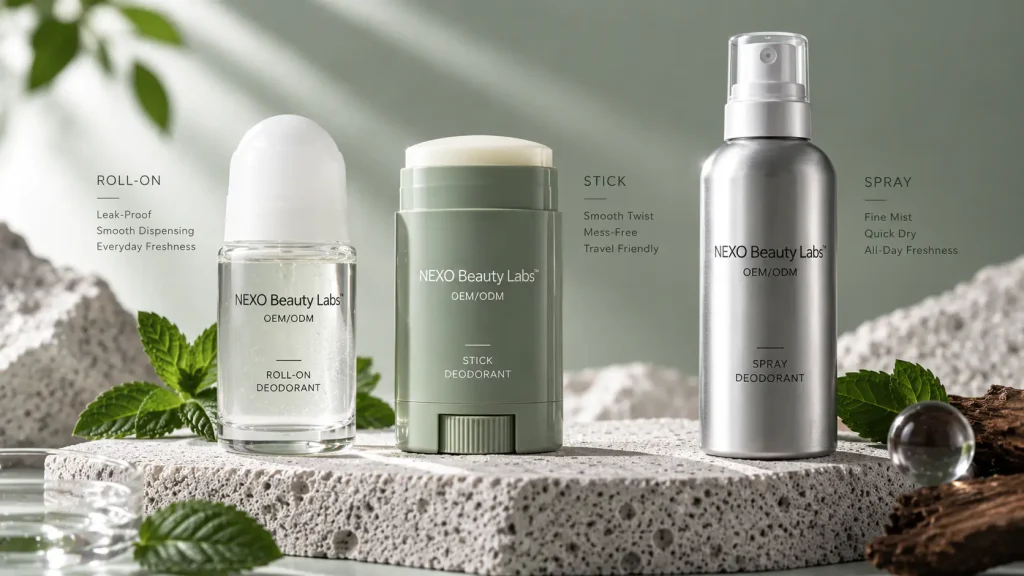
Roll-On Packaging
Development should consider:
- Ball diameter
- Ball housing
- Formula viscosity
- Product pickup
- Closure
- Leakage
Stick Packaging
Development should consider:
- Stick dimensions
- Twist-up mechanism
- Formula adhesion
- Advance and retract performance
- Heat behavior
- Filling conditions
Spray Packaging
Development should consider:
- Formula viscosity
- Pump, valve, or dispensing technology
- Nozzle / actuator
- Spray pattern
- Dose
- Closure
- Leakage
- Filling requirements
Formula + Packaging + Applicator = Finished Product System
For more detail, see How to Choose Cosmetic Packaging for Skincare & Beauty Products.
14. Heat Stability Is Especially Important for Deodorant Sticks

Solid and semi-solid deodorants introduce an especially important development question:
How does the product behave when temperature changes?
Depending on the formula, evaluation may monitor:
- Softening
- Sweating
- Shrinkage
- Cracking
- Deformation
- Oil separation
- Surface appearance
- Changes in glide
These characteristics can affect:
- Consumer application
- Warehousing
- Transportation
- Warm-weather distribution
- Retail storage
A stick that looks excellent at room temperature still needs to make sense under realistic storage and distribution conditions.
15. Stability & Testing Should Match the Format
Roll-On
Relevant evaluation may include:
- Appearance
- Odor
- pH where relevant
- Viscosity
- Dry-down
- Leakage
- Roller performance
- Packaging compatibility
Stick
Relevant evaluation may include:
- Appearance
- Odor
- Firmness
- Glide
- Payoff
- Sweating
- Cracking
- Shrinkage
- Temperature behavior
- Packaging function
Spray
Relevant evaluation may include:
- Appearance
- Odor
- Viscosity
- Spray pattern
- Dose consistency
- Nozzle performance
- Clogging
- Leakage
- Packaging compatibility
Microbiological quality, preservative-system evaluation, performance testing, and other product-specific work may also be relevant depending on the formula.
For more detail, see Cosmetic Stability Testing: What Beauty Brands Need to Know and Cosmetic Product Testing Before Mass Production.
16. Manufacturing Requirements Change by Deodorant Format
Roll-On Manufacturing
Commercial production may involve:
- Liquid formula preparation
- Viscosity adjustment
- Controlled filling
- Roller-ball assembly
- Closure assembly
- Leakage checks
Stick Manufacturing
Depending on the formula, production may involve:
- Heating
- Mixing
- Ingredient dissolution or dispersion
- Controlled hot filling or pouring
- Cooling
- Solidification
- Surface appearance control
- Packaging-mechanism checks
Cooling conditions can influence the final structure, surface appearance, shrinkage, and product consistency.
Spray Manufacturing
Requirements depend strongly on the selected dispensing technology.
A pump-spray project may involve:
- Low-viscosity formula preparation
- Controlled filling
- Pump and nozzle assembly
- Spray-pattern evaluation
Aerosol production requires a different specialized filling and packaging setup.
Format is also a manufacturing decision.
17. MOQ Can Change Significantly Between Formats
For OEM/ODM projects, packaging availability can influence format selection as much as formulation.
MOQ can be affected by:
- Formula batch size
- Specialty ingredients
- Roll-on components
- Stick mechanisms
- Spray pumps or aerosol components
- Custom colors
- Decoration
- Custom molds
- Filling setup
- Testing
A readily available roll-on bottle and a fully customized stick component can create very different minimum-order requirements.
Likewise, a standard pump spray and specialized aerosol project should not be assumed to have the same commercial structure.
There is no universal rule that one deodorant format always has the lowest MOQ.
The practical MOQ is determined by the complete product specification.
For more detail, see Cosmetic MOQ Explained: What Determines Minimum Order Quantity?.
18. Private Label, ODM & Custom Deodorant Development
Private Label Deodorant
A private label project can begin with an existing developed roll-on, stick, spray, or other deodorant formulation.
This can reduce original formulation work while allowing branding, packaging, fragrance, and available customization.
Customized ODM
An ODM project can adapt an existing product platform through selected changes such as:
- Fragrance
- Botanical ingredients
- Odor-control system
- Texture
- Drying profile
- Color
- Packaging
Custom OEM Formulation
A more customized project can be developed around:
- Target consumer
- Deodorant vs antiperspirant direction
- Usage scenario
- Odor-control strategy
- Fragrance
- Sensory target
- Physical format
- Packaging
- Claims
- Target market
The right development route depends on how much genuine formula and format differentiation the brand requires.
19. Can One Brand Develop Roll-On, Stick & Spray Deodorants?
Yes.
Different formats can address different consumer moments.
Botanical Roll-On
Everyday personal care + direct application
↓
Sport Stick
Portable + active lifestyle
↓
Fresh Spray
Quick application + fragrance / lifestyle use
The stronger portfolio question is not:
“Can we make the same deodorant in three formats?”
It is:
“Why does the consumer need each format?”
If every SKU has a distinct usage occasion, format expansion can create a more complete personal-care portfolio.
Which Deodorant Format Should Your Brand Develop?
Consider Roll-On When:
- Everyday application matters
- Direct controlled use fits the concept
- Botanical or wellness positioning is central
- Fragrance is important
- Familiar consumer use is an advantage
Consider Stick When:
- Sport or active lifestyle is central
- Portability matters
- Solid-format differentiation is useful
- Low-mess application supports the concept
- Premium or minimalist packaging is important
Consider Spray When:
- Quick application matters
- Freshness or fragrance is central
- Lightweight sensory experience is important
- Non-contact application supports the concept
- The selected pump or aerosol technology fits the project
A stronger development sequence is:
Target Consumer
↓
Usage Scenario
↓
Deodorant vs Antiperspirant Direction
↓
Product Positioning
↓
Functional + Fragrance Strategy
↓
Sensory Target
↓
Formula Architecture
↓
Packaging / Applicator
↓
Stability & Testing
↓
Manufacturing & MOQ
↓
Final Deodorant Format
Frequently Asked Questions
Is roll-on deodorant better than stick deodorant?
Neither is automatically better. Roll-on provides a fluid direct-application experience, while stick deodorant creates a solid format centered on glide, portability, payoff, residue, and structural stability. The better choice depends on the consumer and product positioning.
Is spray deodorant better than stick deodorant?
Not universally. Spray can support fast, lightweight, non-contact application, while stick provides direct and controlled solid application. Finished-product performance depends on the formula and intended use rather than format alone.
Which deodorant format dries fastest?
Spray products are often positioned around quick drying, while roll-on formulas typically create a wetter application experience. Actual drying time depends on the finished formulation, dose, dispensing system, and application.
What is the difference between deodorant and antiperspirant?
Deodorant is generally positioned around odor management and freshness. Antiperspirant is intended to reduce perspiration using an appropriate active system. Regulatory requirements differ by target market.
Is deodorant regulated as a cosmetic in the United States?
A deodorant intended only for cosmetic purposes such as odor management is generally regulated as a cosmetic in the United States. A deodorant that also makes antiperspirant claims is subject to both cosmetic and OTC drug requirements.
Can aluminum-free deodorant be an antiperspirant?
For a U.S. project, perspiration-reduction claims need to comply with the applicable OTC antiperspirant requirements and permitted active system. An aluminum-free odor-control deodorant should not automatically be marketed with antiperspirant claims.
Is natural deodorant always aluminum-free?
“Natural” is not a universal technical definition of deodorant formulation. The actual ingredient list and product claims should be evaluated instead of assuming that the word natural guarantees a particular composition.
Can natural deodorant be made as a roll-on?
Yes. Botanical or natural-inspired positioning can be developed in roll-on format when the formula, packaging, sensory profile, stability, and claims support the concept.
Can natural deodorant be made as a stick?
Yes. Botanical positioning does not determine physical format. Solid deodorant sticks can also support natural-inspired, wellness, or minimalist concepts.
What is the difference between pump spray and aerosol deodorant?
A pump spray uses mechanical action to dispense the formula. An aerosol uses a pressurized dispensing system and requires a different package, filling process, and technical development route.
Why does deodorant stick leave white marks?
Visible residue can be influenced by powders, waxes, active materials, product payoff, application amount, and the complete formula. Low-white-mark positioning should therefore be evaluated at finished-product level.
Why does deodorant stick melt or sweat?
Solid deodorant structure can change with temperature. Wax and emollient balance, cooling conditions, storage temperature, and packaging can influence softening, sweating, shrinkage, or deformation.
Does deodorant fragrance affect the formula?
Yes. Fragrance can affect sensory experience, odor profile, appearance, compatibility, and stability. It should be selected as part of the formulation rather than treated only as a marketing decision.
Which deodorant format is best for sensitive skin?
No format is automatically best. Consumer tolerance depends on the complete formula, fragrance, alcohol where present, application friction, residue, and individual skin response.
Does deodorant need stability testing?
Yes. The relevant evaluation should reflect the actual format — including viscosity and roller performance for roll-ons, structural and heat behavior for sticks, and spray or nozzle performance for sprays.
Which deodorant format has the lowest MOQ?
There is no universal answer. MOQ depends on formula batch size, packaging availability, custom components, decoration, filling, testing, and supplier minimums.
Can one brand develop roll-on, stick and spray deodorants?
Yes. Different formats can serve different consumer occasions as long as each SKU has a clear reason to exist within the broader personal-care portfolio.
Develop the Deodorant Experience Before Choosing the Format
A deodorant-development project should not begin with:
“Which format is trending?”
It should begin with:
Who is the consumer?
When and where will they use the product?
Are we developing a deodorant or antiperspirant?
How should application feel?
What positioning should consumers understand immediately?
Can the formula, packaging, stability, and manufacturing process support that experience consistently?
Once those decisions are clear, choosing roll-on, stick, spray, or another physical format becomes much easier.
At NEXO Beauty Labs, deodorant and personal-care development can be approached across private label, ODM, and custom OEM pathways together with formulation, fragrance and sensory design, packaging, stability evaluation, product testing, scale-up, and commercial manufacturing.
Whether your brand is exploring a botanical roll-on, portable deodorant stick, or lightweight spray, the strongest format is the one that supports the complete product strategy — not simply the one that looks most distinctive on the shelf.
Request a Deodorant OEM/ODM Consultation with NEXO Beauty Labs to discuss your deodorant format, formulation, fragrance, packaging, MOQ, testing, and manufacturing requirements.