From Idea to Shelf: How Nexo Beauty Labs Helps Brands Launch Beauty Products
Looking for a beauty product development partner? Here's how Nexo Beauty Lab takes your product from first idea to finished, shelf-ready reality.
Every beauty product starts with an idea. Turning that idea into a safe, stable, market-ready product is where the real work begins.
Formula development, ingredient sourcing, sampling, testing, packaging, manufacturing, quality control, and market requirements all need to come together before a finished skincare, haircare, or personal care product is ready to launch.
At Nexo Beauty Lab, we work with beauty brands through this entire cosmetic product development process — from the first product brief to finished inventory ready for shipment.
Whether you’re launching your first hero product, expanding an existing line, or developing a fully custom formula, here’s what the journey from idea to shelf actually looks like.
Step 1: Define Your Product Concept & Brand Vision
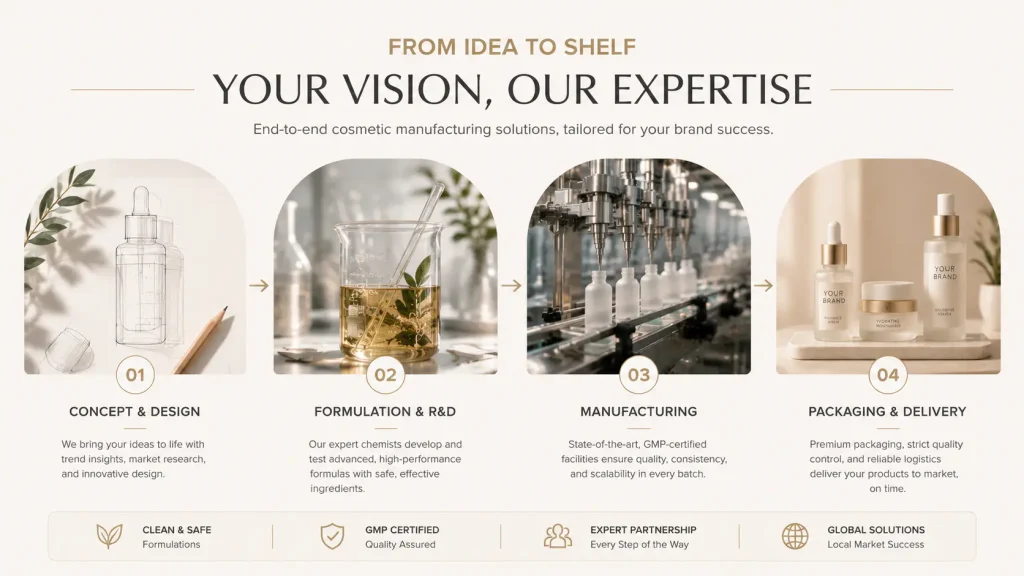
A successful product development project starts with a clear brief.
Before formulation begins, we work with you to understand what you’re actually trying to build:
- What type of product do you want to develop?
- Who is your target customer?
- What problem or consumer need should the product address?
- Which ingredients, textures, fragrances, or claims matter to your positioning?
- What is your target retail price?
- Which markets do you plan to sell in?
- What packaging direction fits your brand?
This stage also helps determine which manufacturing model makes the most sense.
- Private Label: suitable when speed and lower development complexity are the priority.
- ODM: start with an existing formulation platform and customize selected elements to fit your brand.
- Custom OEM: develop a more customized formula according to an agreed product brief and specifications.
The terminology used for OEM, ODM, and private label can vary between manufacturers, so formula customization, exclusivity, ownership, MOQ, testing responsibilities, and other terms should always be confirmed as part of the project agreement.
If you’re still deciding which development route fits your product strategy, read our OEM vs. ODM vs. Private Label Cosmetics Guide for a more detailed comparison of customization, development time, MOQ, formula ownership, cost, and product differentiation.
Step 2: Cosmetic Formula Development
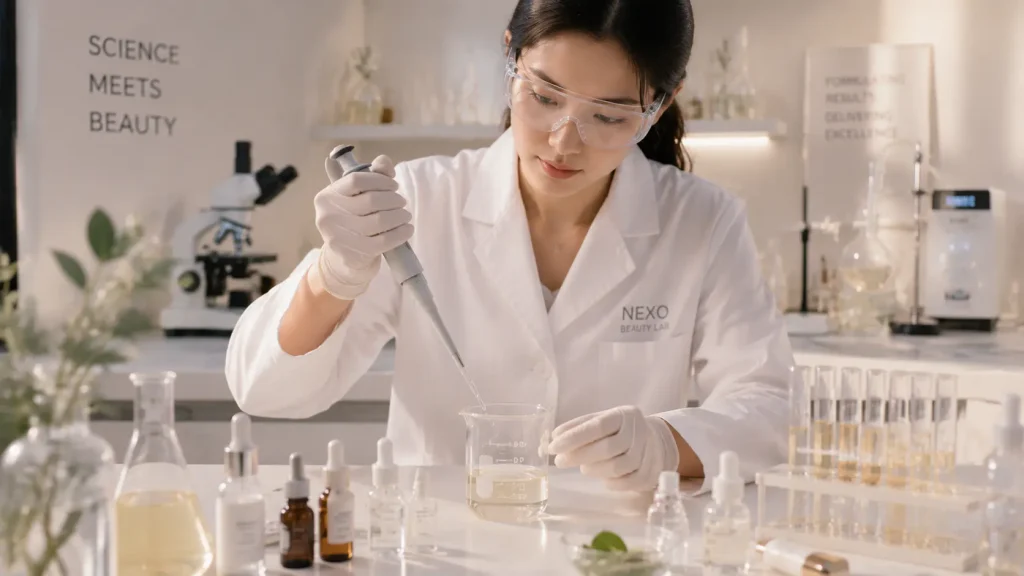
Once the product direction is clear, formulation development begins.
For an ODM project, this may involve starting with an existing formulation and adjusting selected characteristics such as:
- Botanical extracts or active ingredients
- Fragrance
- Color
- Texture
- Viscosity
- Skin feel
For a custom OEM project, our R&D team develops the formula around your product brief, balancing several factors at once:
- Product performance
- Sensory experience
- Formula stability
- Ingredient compatibility
- Manufacturing feasibility
- Target cost
- Market positioning
A good cosmetic formula isn’t simply a collection of trending ingredients. Those ingredients need to work together as a stable, manufacturable product that delivers the texture and experience your customer expects.
Step 3: Samples, Revisions & Product Testing
Before commercial production begins, you evaluate physical samples of the formula.
This is where you can assess:
- Texture and spreadability
- Absorption
- Skin or hair feel
- Fragrance
- Color and appearance
- Viscosity
- Overall sensory experience
If something doesn’t match the product brief, the formula can be adjusted and sampled again before approval.
Product testing is also an important part of the development process. Depending on the formula, packaging, claims, product category, and intended market, evaluation may include areas such as:
- Stability testing — evaluating how the formula performs under defined conditions over time.
- Microbiological testing — evaluating microbiological quality and the effectiveness of the preservation system where applicable.
- Packaging compatibility testing — evaluating how the formula and packaging perform together.
- Product-specific testing — additional testing may be needed depending on the product, claims, and target market.
Testing requirements are not identical for every cosmetic product, so they should be planned according to the actual project rather than treated as a one-size-fits-all checklist.
Step 4: Packaging Development & Branding
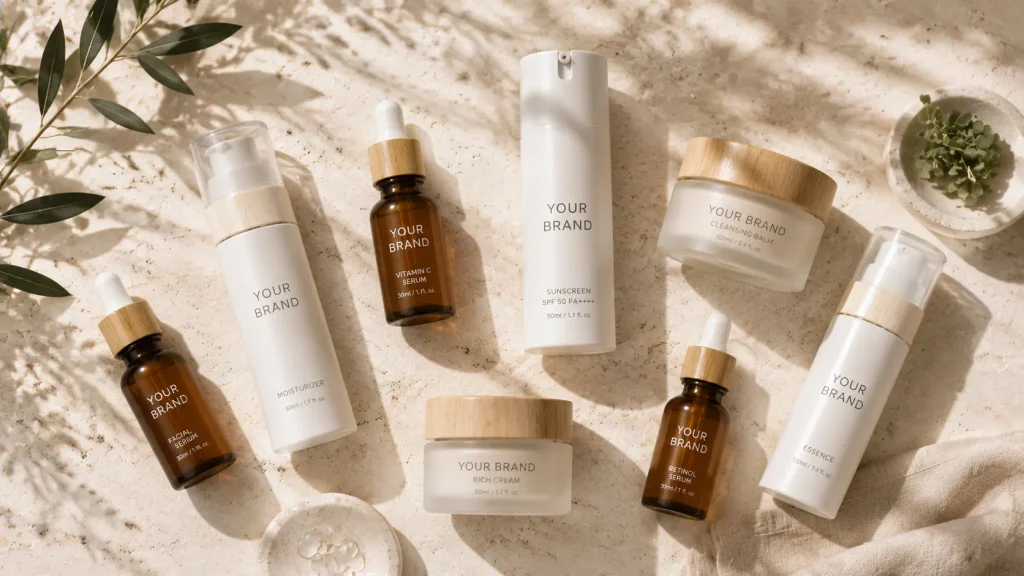
Packaging is often the first physical interaction a customer has with your product, but its role goes far beyond appearance.
The right packaging also needs to work with the formula, dispensing method, transportation requirements, target price, and overall brand positioning.
Depending on your project, packaging development can include:
- Bottles, jars, tubes, pumps, droppers, or other primary packaging
- Stock or customized packaging
- Labels and printing
- Logo and decorative finishes
- Outer cartons
- Inserts and secondary packaging
For brands testing a new category, stock packaging can help simplify the initial launch. More customized components can be introduced when the product and sales volume justify the additional tooling, development time, and MOQ.
Packaging should also be considered early enough for compatibility and sourcing requirements to be addressed before production.
If you’re comparing bottles, jars, tubes, pumps, droppers, airless systems, or stock versus custom packaging, see our Guide to Choosing Cosmetic Packaging for a deeper look at formula compatibility, dispensing, MOQ, cost, branding, and consumer experience.
Step 5: Scale-Up, Manufacturing & Quality Control
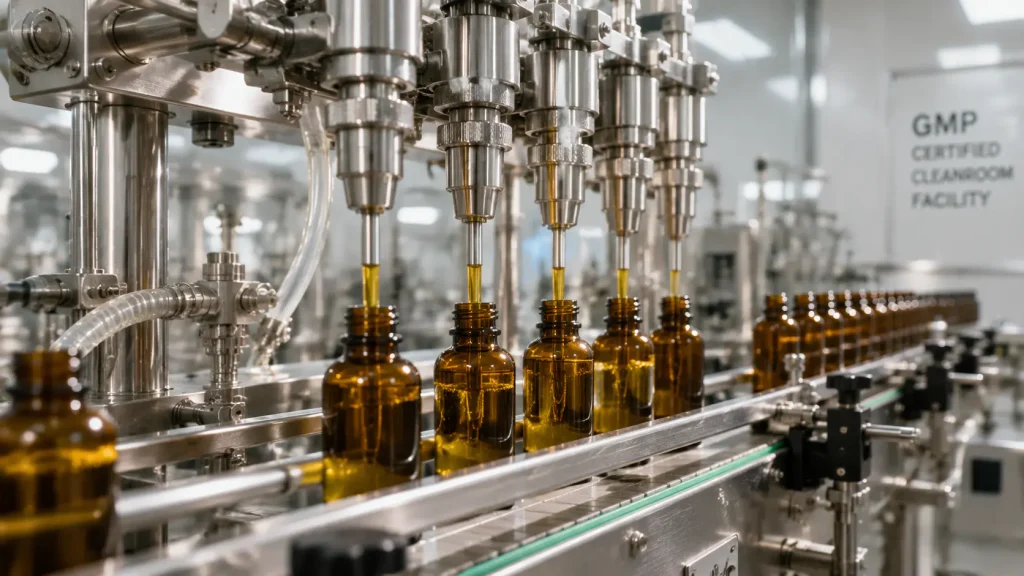
Once the formula, packaging, and project specifications are approved, development moves toward commercial production.
One important part of this transition is scale-up.
A formula created in a laboratory still needs to perform consistently when manufactured in larger production equipment. Manufacturing parameters are therefore established so the commercial batch can reproduce the characteristics of the approved formula as closely as possible.
During production, quality checks can occur at multiple stages.
- Raw material checks — reviewing incoming ingredients and materials according to applicable specifications.
- In-process checks — monitoring relevant production characteristics such as appearance, pH, viscosity, or other defined parameters.
- Filling and packaging checks — monitoring filling, packaging integrity, coding, and presentation.
- Finished-product checks — confirming the production batch meets its defined release specifications.
Nexo Beauty Lab manufactures under ISO 22716 Cosmetic GMP standards, with quality procedures covering the cosmetic manufacturing process from incoming materials through finished goods.
Step 6: Filling, Packing & Delivery
Once the manufactured bulk product is ready for filling, it moves into its final primary packaging.
Depending on the product format, this can involve bottles, jars, tubes, pumps, droppers, roll-ons, sachets, sticks, or other packaging systems.
Finished units are then labeled, coded, placed into any required secondary packaging, and prepared for shipment.
Once the batch clears the required release process, finished inventory can be prepared for delivery to your warehouse, fulfillment center, distributor, or other agreed destination.
Step 7: Reorders, Scaling & New Product Development
Getting the first production run delivered isn’t the end of the product development relationship.
As your brand grows, the next priorities may include:
- Reordering successful products
- Increasing production quantities
- Developing new sizes or variations
- Updating packaging
- Expanding a hero product into a complete range
- Moving from an existing ODM formula toward a more customized product
Because the formula, packaging components, specifications, and production requirements have already been established, repeat production can become more streamlined than the initial development project.
How Long Does Cosmetic Product Development Take?
There is no universal timeline for launching a cosmetic product.
The development schedule depends on factors such as:
- Private label, ODM, or custom OEM route
- Formula complexity
- Number of sample revisions
- Testing requirements
- Ingredient availability
- Stock versus custom packaging
- Packaging production lead times
- Artwork approvals
- Order quantity
- Target-market requirements
A relatively straightforward project based on an existing formulation and stock packaging can usually move faster than a fully custom product requiring multiple formulation rounds, specialized testing, and custom packaging.
For that reason, the most useful timeline is not a generic industry number. It’s a project-specific schedule created after the manufacturer understands what you’re developing.
For a more detailed stage-by-stage look at formulation, sampling, testing, packaging, approvals, manufacturing, and the factors that can affect launch timing, see our Cosmetic Product Development Timeline Guide.
What Affects the Cost of Developing a Cosmetic Product?
Like timelines, cosmetic product development costs vary significantly from one project to another.
The biggest cost drivers generally include:
- Formula development: an existing formulation usually requires less development work than a fully customized product.
- Raw materials: ingredient selection and concentration influence formula cost.
- Testing: different products and markets may require different testing programs.
- Packaging: stock packaging and custom-molded packaging have very different cost structures.
- Decoration: printing, coating, labeling, and other finishes affect packaging cost.
- MOQ: order quantity influences purchasing, manufacturing, packaging, and unit economics.
The best way to understand the real investment required is to develop a clear product brief and request a quotation based on your actual formula, packaging, quantity, and target market.
What Is the Minimum Order Quantity for Cosmetics?
There is no single cosmetic MOQ that applies to every product.
Minimum quantities can change depending on:
- Product category
- Formula
- Packaging
- Raw material minimums
- Decoration requirements
- Degree of customization
For emerging brands, starting with fewer hero SKUs and simpler packaging can often be more practical than launching a large collection immediately.
Nexo Beauty Lab supports flexible manufacturing approaches across private label, ODM, and custom product development. Final MOQ should be confirmed according to the specific product and packaging selected.
What Should You Prepare Before Contacting a Cosmetic Manufacturer?
You don’t need to be a cosmetic chemist before talking to a manufacturer.
But preparing a few basic details can make the conversation much more productive:
- Product type
- Target consumer
- Main product benefits
- Reference products you like
- Preferred ingredients or ingredients to avoid
- Desired texture and fragrance
- Target price positioning
- Estimated initial order quantity
- Packaging direction
- Target market or countries
- Desired launch timing
You don’t need to have every detail finalized. A good manufacturing partner should be able to help turn the commercial concept into a realistic development brief.
Related Guide: Once your project brief is taking shape, the next step is evaluating whether a manufacturing partner has the right R&D, quality systems, product-category experience, MOQ, packaging support, testing capabilities, communication, and scalability. See our How to Choose a Reliable Cosmetic Manufacturer →
Quality Standards & Market Compliance
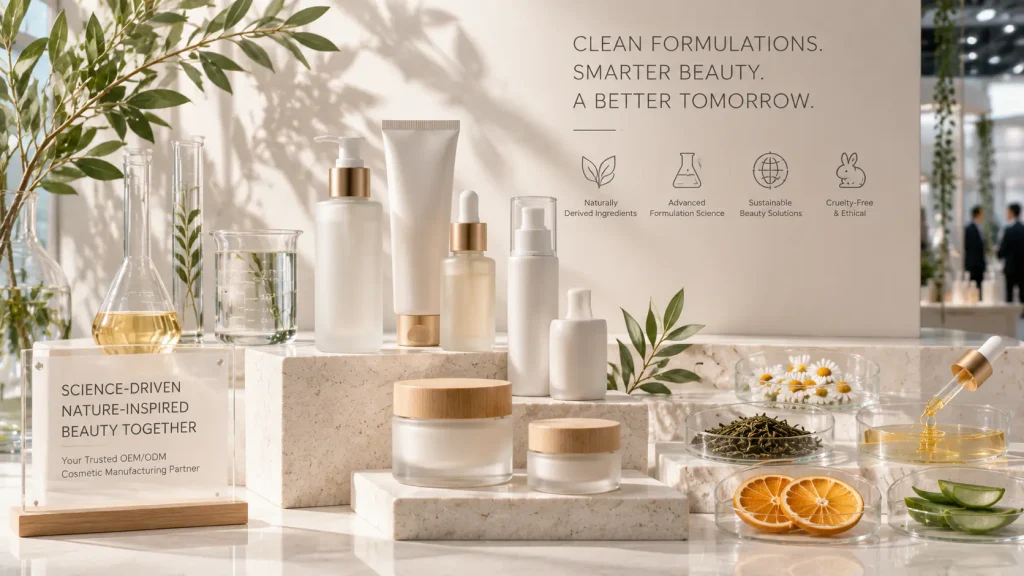
Quality and compliance should be considered from the beginning of product development rather than being added at the end.
Nexo Beauty Lab supports beauty brands with:
- ISO 22716 Cosmetic GMP manufacturing
- U.S. cosmetic market compliance support
- EU cosmetic compliance support
- Halal manufacturing options for applicable projects
The specific documentation, testing, notification, labeling, and compliance requirements depend on the product category and the market where the finished product will be sold.
Why Beauty Brands Work with Nexo Beauty Lab
A cosmetic manufacturer should do more than simply fill bottles.
The right partner should help connect your product concept, formulation, packaging, quality requirements, and manufacturing strategy into one workable development process.
- Private Label, ODM & OEM options. Choose a development path based on your desired speed, customization, and investment level.
- In-house R&D. Work directly with formulation professionals throughout product development.
- Skincare & haircare development. Build products across multiple beauty and personal care categories.
- Packaging support. Coordinate formula and packaging development rather than sourcing them as completely separate projects.
- Quality-focused manufacturing. Move from approved sample to commercial production with defined manufacturing and quality procedures.
- Scalable support. Start with your first launch and continue into reorders, new SKUs, and larger production volumes.
Frequently Asked Questions
What is the cosmetic product development process?
The cosmetic product development process typically moves from product concept and formulation through sampling, testing, packaging, production, filling, quality control, and delivery. The exact stages depend on the formula, manufacturing model, packaging, claims, and target market.
What is the difference between OEM, ODM, and private label cosmetics?
Private label generally involves selecting an existing product with limited customization. ODM typically starts with a manufacturer’s existing development platform and allows selected customization. OEM usually refers to a more customized product developed according to agreed brand specifications. Exact terminology varies between manufacturers, so always confirm the scope of the service.
Do I need my own cosmetic formula before contacting a manufacturer?
No. Brands can approach a manufacturer with a product concept and brief. Depending on the project, you may select an existing formulation, customize a formulation platform, or work with an R&D team to develop a new formula.
How long does it take to develop a cosmetic product?
It depends on the level of customization, formula complexity, sample revisions, testing, packaging, sourcing, and production requirements. Existing formulations and stock packaging generally allow faster development than highly customized projects.
How much does it cost to develop a beauty product?
Development costs depend on the formula, ingredients, testing, packaging, customization, and order quantity. A project-specific quotation is more useful than a generic industry estimate.
What is a typical MOQ for cosmetics?
There is no universal MOQ. Minimum quantities depend on the product, formula, packaging, raw materials, customization, and manufacturing requirements.
Can I start with private label or ODM and move to a custom formula later?
Yes. Some brands use an existing formula to enter the market and validate demand, then develop more customized products as the brand grows.
Can a cosmetic manufacturer help with packaging?
Yes. A full-service OEM/ODM partner can help coordinate primary packaging, secondary packaging, decoration, labels, and other packaging requirements alongside formula development.
Ready to Turn Your Beauty Product Idea Into Reality?
Launching a beauty product doesn’t require you to understand every detail of formulation science, packaging engineering, or manufacturing before you begin.
What matters is having a clear vision and choosing a product development partner that can turn that vision into a realistic formulation, packaging, testing, and production plan.
From your first product concept through formulation, sampling, manufacturing, and finished inventory, Nexo Beauty Lab provides OEM, ODM, and private label solutions designed to help beauty brands move from idea to shelf.
Request an OEM/ODM Consultation with NEXO Beauty Labs to discuss your product idea, target market, formulation requirements, packaging direction, MOQ, and next steps.