
Sunscreen Product Development: Beyond the SPF Number
Learn how to develop sunscreen products through UV filter selection, SPF testing, sensory design, packaging and market-specific requirements.
How UV filter strategy, sensory design, testing and packaging shape a market-ready sunscreen.
Developing a sunscreen involves much more than choosing UV filters and aiming for a high SPF number.
For beauty brands, the process connects protection goals, formulation compatibility, sensory performance, packaging, testing and market-specific requirements. A formula may feel elegant in the lab, but that alone does not establish its SPF performance, UVA protection, stability or suitability for commercial production.
This guide follows the development process in order. It is a general reference, not regulatory advice, so confirm requirements for your target market with a qualified professional.
1. Define the Sunscreen Brief Before Formulation
Start with positioning, not an SPF number. A strong sunscreen brief defines the target market, protection goals and intended user experience before formulation begins.
- Target market: U.S., EU or another region
- Application: Face, body, sport or daily wear
- Protection targets: SPF, UVA protection and other applicable requirements
- Consumer profile: Daily commuters, outdoor users, athletes or consumers who prefer lightweight textures
- Sensory direction: Lightweight, matte, dewy, low-tack or moisturizing
- Commercial constraints: Target cost, MOQ, packaging and launch timing
Our guide to what to include in a cosmetic product development brief covers these decisions in more detail. If you are still deciding which physical sunscreen format best fits your product concept, the comparison of sunscreen sticks, lotions and mists can help clarify the options.
The clearer the brief, the easier it becomes to evaluate formulation options, packaging requirements and the testing needed for the intended product.
2. Choose a UV Filter Strategy for the Intended Market
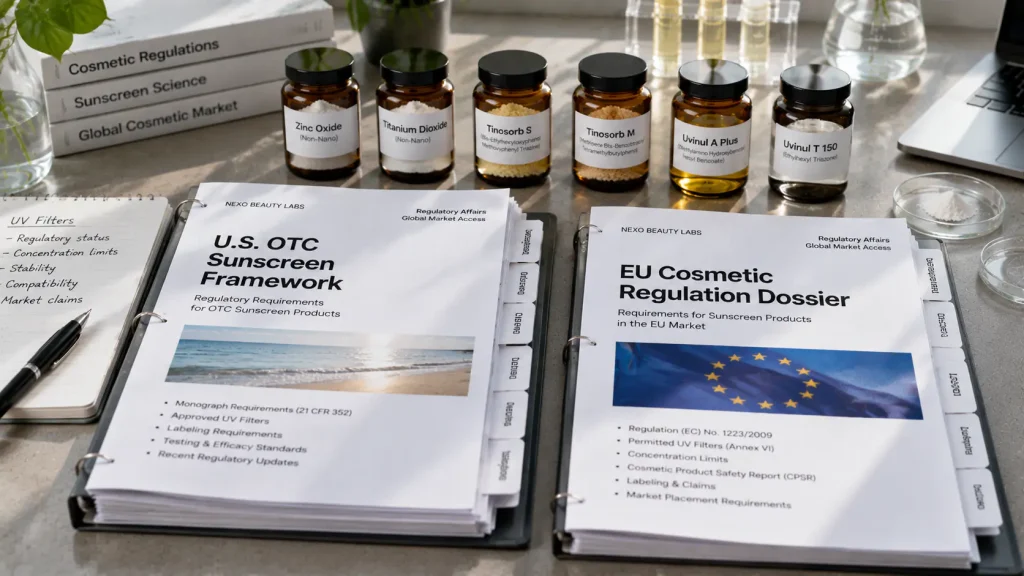
Brands sometimes start with a popular UV filter and think about the target market later. It works better the other way around.
UV filter selection depends on which ingredients and concentrations are permitted in the target market, the intended UVB and UVA protection, solubility and dispersion, compatibility with the formulation system, and photostability in the finished product.
Regulatory pathways also differ. In the U.S., sunscreens are generally regulated as over-the-counter drugs. In the EU, sunscreen products are regulated under the cosmetics framework. A formula and labeling plan developed for one market cannot simply be copied to another without assessing the applicable requirements.
For brands planning to sell internationally, this decision should happen early. It can affect the available UV filters, formula architecture, testing program, claims and documentation.
UV filters are essential to sunscreen performance, but the finished formulation determines how the overall system behaves.
The right UV filter strategy starts with the target market and protection requirements—not simply with the most popular ingredient.
3. Understand SPF, UVA Protection and Water Resistance

SPF, UVA protection and water resistance are related, but they are not interchangeable.
According to the U.S. FDA’s sunscreen guidance, SPF primarily indicates protection against UVB radiation, which is strongly associated with sunburn. In the U.S., the term Broad Spectrum indicates that a sunscreen meets the applicable requirements for protection against both UVA and UVB radiation.
Water-resistance claims also have specific requirements. U.S. sunscreen labels may state water resistance for 40 or 80 minutes when supported by the required testing.
These are U.S. examples, not universal rules. The EU has its own sunscreen recommendations and labeling framework, while PA ratings are used in parts of Asia. Brands should not assume that different market terms or ratings are directly interchangeable.
The key point for developers is that the SPF target is a development objective. The tested finished product determines which protection claims can be supported.
An Important Development in Sunscreen Testing
In September 2026, the European Commission reported results from a testing campaign involving 74 sunscreen products and day creams. The campaign found a high correlation between conventional in vivo testing and the in vitro method EN ISO 23675:2024 for evaluating SPF, supporting the reliability of the laboratory approach in the products assessed.
The Commission advised manufacturers to prioritize testing approaches that avoid exposing human volunteers to UV radiation when determining SPF and UVA protection.
However, the method has important limitations. It currently excludes sunscreen sticks and powders and does not establish water-resistance claims. Its suitability must be assessed for the specific product and intended claim.
This development highlights an important principle for sunscreen R&D: testing methods are evolving, but brands still need to select an appropriate, validated approach for the finished product and target market.
4. Design Texture Around Real Consumer Use
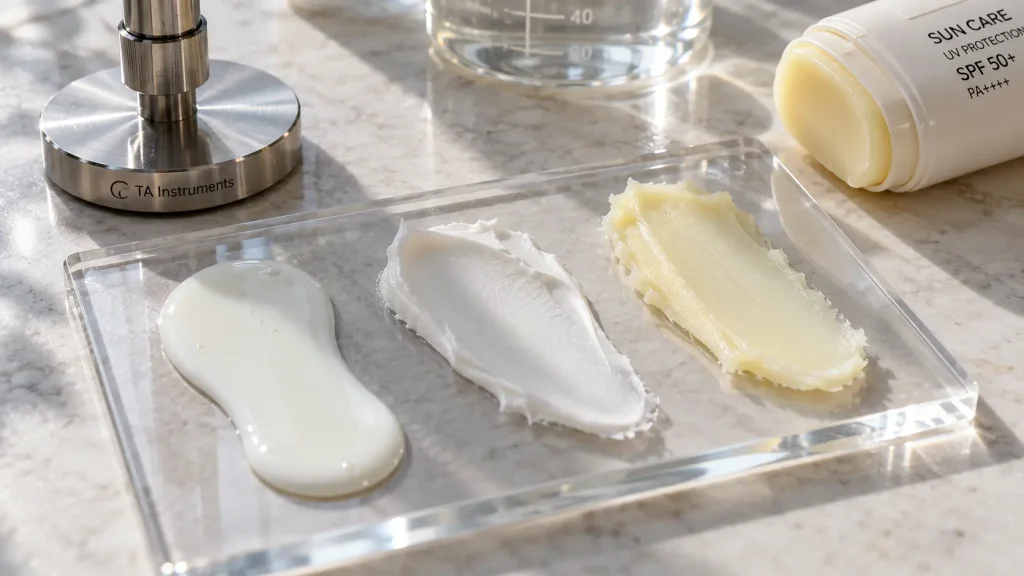
A sunscreen has to deliver its intended protection while offering an experience people will use consistently. Different positioning calls for different sensory goals.
| Product positioning | Development focus |
|---|---|
| Daily facial sunscreen | Easy spreading, low tack and compatibility with makeup |
| Matte sunscreen | Fresh feel, shine control and after-dry feel |
| Moisturizing sunscreen | Hydration, spreadability and a comfortable film |
| Sport sunscreen | Intended use, water-resistance goals and appropriate testing |
| Sunscreen stick | Smooth glide, coverage and convenience |
| Sunscreen spray | Spray pattern, dose control, packaging and safe-use requirements |
No texture is automatically better. Sensory goals should be set together with protection goals, formula structure and the intended use scenario.
For hot and humid markets, climate-adaptive beauty product development explores how environment, sensory design, packaging and usage scenarios can influence product development.
A formula that feels pleasant in a laboratory evaluation still needs to deliver its intended protection when used according to the product’s directions.
5. Stability and Film Performance Matter
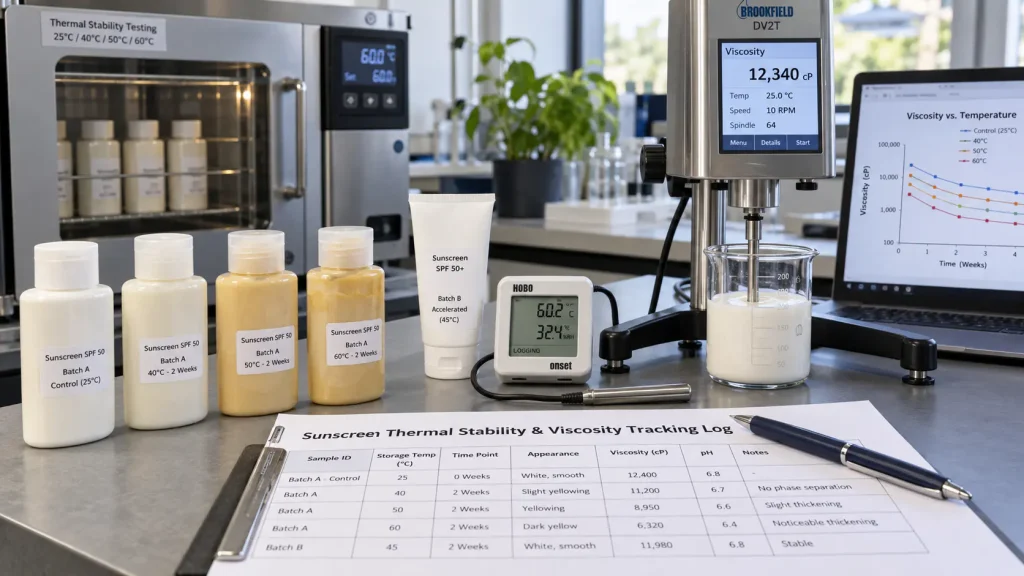
Choosing the right filters is not enough. Film uniformity, viscosity, spreadability and the amount of product consumers actually apply all matter to the finished product’s performance.
Depending on the formula, stability work may monitor appearance, color, odor, pH, viscosity, separation or precipitation, and the effects of shipping and storage conditions.
For sunscreen, these evaluations complement rather than replace finished-product protection testing. A good-looking, good-feeling laboratory sample does not establish the final SPF or UVA protection claim.
The formula’s ability to maintain its intended characteristics over time can be assessed through cosmetic stability testing.
6. Evaluate Packaging With the Finished Formula
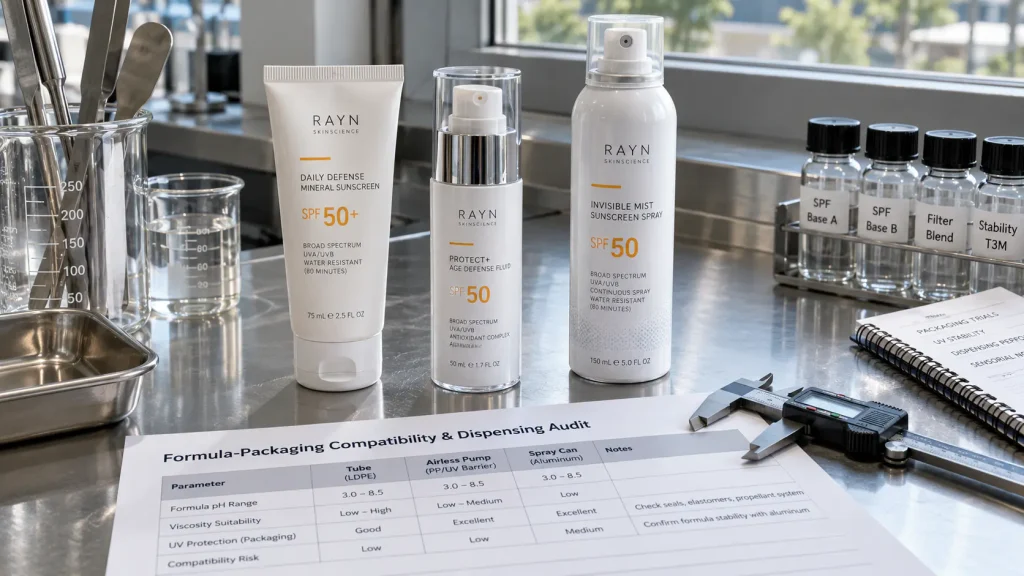
Formula and packaging should be evaluated as one finished product system. A sunscreen package needs to protect the product appropriately while also supporting the intended dispensing experience.
Depending on the format, development may need to consider:
- Formula viscosity and dispensing
- Packaging material compatibility
- Leakage and closure performance
- Spray pattern and dose delivery
- Stick structure and glide
- Product exposure during use
- Storage and transport conditions
- Filling and assembly requirements
A sunscreen lotion, stick and spray can require different packaging systems. The selected package should be tested with the actual formula rather than approved based on appearance alone. The cosmetic packaging selection process should account for compatibility, dispensing, protection and manufacturing requirements.
7. Plan Finished-Product Testing Before Launch
Sunscreen development requires more than routine stability and sensory evaluation. The testing program must match the protection claims and applicable requirements of the intended market.
Depending on the product and market, the development plan may need to address:
- SPF testing
- UVA protection testing
- Water-resistance testing where relevant
- Stability evaluation
- Packaging compatibility
- Microbiological quality and preservation where applicable
- Labeling and claims review
Testing requirements vary by market and claim. A result for one formula, format or testing method should not automatically be applied to another finished product.
A broader cosmetic product testing program helps brands plan product-specific evaluation before commercial launch.
The key principle is straightforward: the final sunscreen must support the protection claims made on its packaging.
8. Consider Manufacturing Feasibility Early
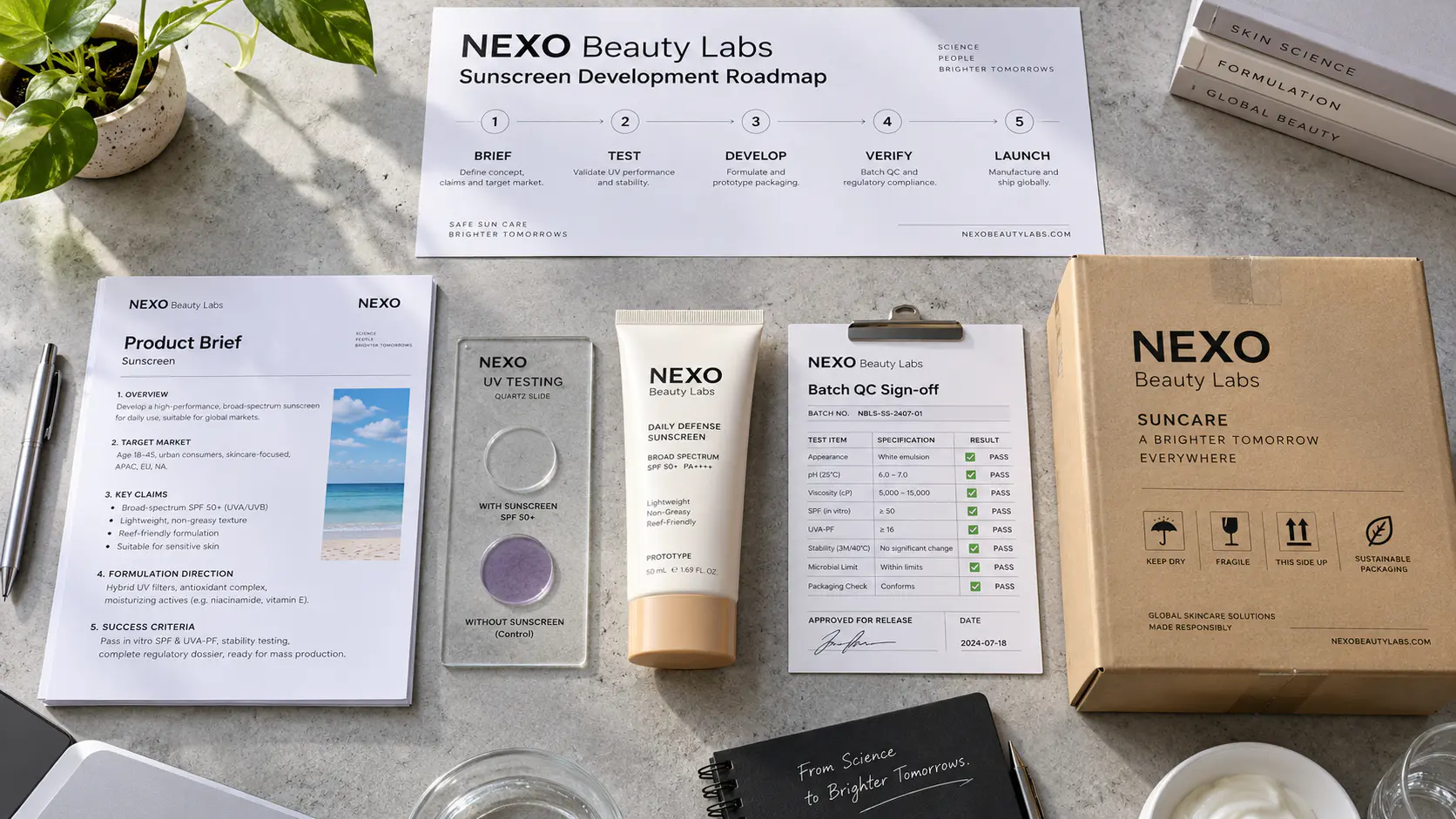
A sunscreen formula that performs well in laboratory development still needs to be manufactured consistently at commercial scale.
Before finalizing the product, consider:
- Raw-material availability
- Mixing and processing requirements
- Batch consistency
- Filling equipment compatibility
- Packaging assembly
- Quality-control specifications
- Minimum order quantities
- Production lead times
Different formats can introduce different production challenges. A fluid sunscreen, a structured stick and a spray product do not necessarily share the same processing or filling requirements.
These considerations should be discussed before the brand commits to a final formula and packaging combination.
9. Build the Product Around a Clear Market Position
A sunscreen product should communicate a clear reason to choose it.
Possible directions include:
- Daily facial sunscreen: comfortable application and compatibility with everyday skincare and makeup routines.
- Matte sunscreen: a finish designed around the target consumer’s preferences.
- Moisturizing sunscreen: protection combined with a more nourishing sensory profile.
- Sport sunscreen: a product developed for the intended activity and applicable water-resistance requirements.
- Portable sunscreen stick: a convenient format for targeted application and carrying.
- Sunscreen spray: a spray-based format with specific dispensing and application considerations.
These are product-positioning directions, not substitutes for protection testing. The finished product must support its SPF, UVA and other applicable claims.
Environmental conditions can also influence product positioning, sensory targets and intended usage scenarios. For brands developing products for hot and humid markets, climate-adaptive beauty product development offers a broader framework for considering these factors.
Frequently Asked Questions
What should a brand define before developing a sunscreen?
Start with the target market, intended consumer, application format, protection goals, sensory requirements, packaging, budget and launch timeline. These decisions help determine the appropriate formulation and testing strategy.
Can the same sunscreen formula be sold in the U.S. and EU?
Not automatically. The permitted UV filters, regulatory pathways, labeling requirements and applicable testing expectations differ between markets. A formula intended for multiple markets needs a market-specific compliance review.
Does a higher SPF automatically mean better UVA protection?
No. SPF primarily addresses protection against sunburn-producing UV radiation, while UVA protection needs to be evaluated using the applicable method and requirements. Brands should verify the protection profile of the finished product rather than infer it from SPF alone.
Can a sunscreen claim water resistance without testing?
Water-resistance claims require appropriate supporting testing under the applicable market framework. Brands should confirm the required method and permitted labeling before making such claims.
Why does sunscreen texture matter?
Texture affects spreadability, finish, residue, layering and the overall application experience. However, sensory quality does not replace protection testing or establish the SPF of the finished product.
Does sunscreen packaging affect product performance?
Yes. The package needs to be compatible with the formula and support appropriate dispensing, storage and consumer use. Packaging compatibility and functional performance should be evaluated with the finished product.
Can an OEM/ODM manufacturer support sunscreen development?
A qualified development partner may support formulation, sensory design, packaging coordination, testing planning, scale-up and manufacturing. Brands should confirm the manufacturer’s actual sunscreen capabilities and the specific testing and regulatory support available for their target markets.
Developing a Sunscreen for Your Brand?
A successful sunscreen project needs to connect protection goals, formula design, sensory performance, packaging, testing and manufacturing from the beginning.
The development process should start with a clear brief, select a suitable formulation strategy for the target market, and evaluate the finished product against the claims it is intended to make.
At NEXO Beauty Labs, cosmetic product development can connect formulation, sensory design, packaging coordination, product evaluation, scale-up and OEM/ODM manufacturing, subject to the specific product requirements and capabilities confirmed for each project.
Request a Consultation with NEXO Beauty Labs to discuss your sunscreen concept, target market, packaging and product-development requirements.