
Hair Oil vs Hair Serum: Which Format Should Your Haircare Brand Develop?
Compare hair oil vs hair serum by formula, hair type, texture, ingredients, packaging, stability, manufacturing, and OEM/ODM product development.
Haircare has moved far beyond the traditional shampoo-and-conditioner routine.
Modern beauty brands can now build treatment-focused collections around leave-in serums, botanical oils, scalp treatments, repair systems, microcapsule products, and single-dose formats.
Two of the most common leave-on haircare categories are hair oil and hair serum.
Both can be developed around shine, smoothing, frizz control, conditioning, damage-care, styling, and premium sensory experiences.
But they do not necessarily use the same formula structure, ingredient system, texture, application method, packaging, or manufacturing process.
So the better question isn’t:
“Is hair oil or hair serum better?”
It is:
“Which format best supports the target hair type, consumer concern, texture, product benefit, and brand experience we want to create?”
This guide compares hair oil and hair serum from a beauty-brand formulation and OEM/ODM product-development perspective.
Quick Answer: Hair Oil vs Hair Serum
Neither format is automatically more effective or more advanced.
The performance of the finished product depends on the complete formulation, ingredient system, use level, consumer application, packaging, and supporting testing.
1. What Is a Hair Oil?
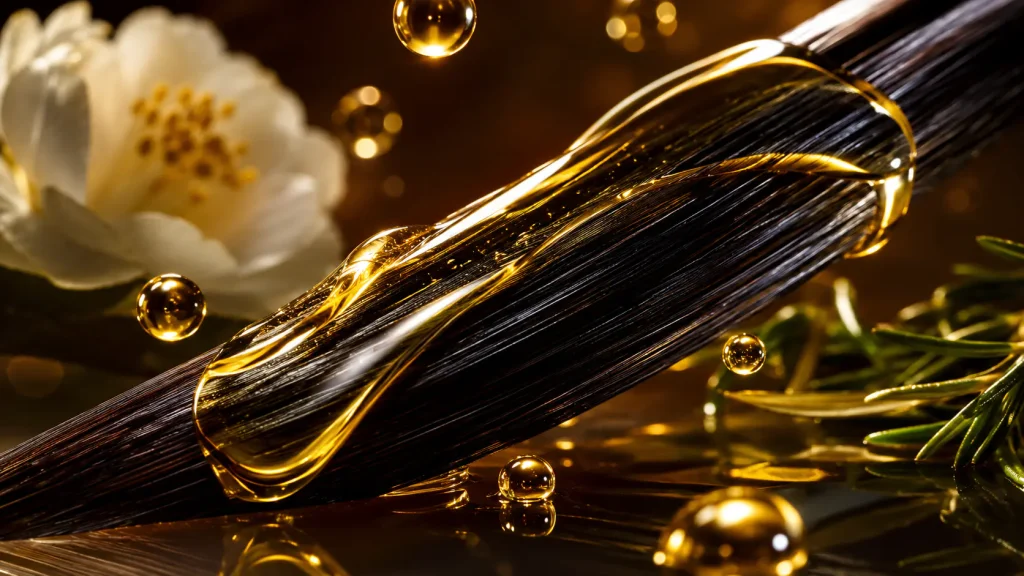
A hair oil is generally built around an oil-based or predominantly oil-phase formulation system.
Depending on the concept, it can be developed around:
- Shine
- Smoothing
- Softness
- Frizz control
- Dry-hair care
- Damage-care routines
- Split-end appearance
- Finishing
- Botanical ingredient storytelling
- Premium hair rituals
Hair oil does not automatically mean a thick or greasy product.
Modern formulations can range from richer botanical-oil systems to lightweight dry-oil textures designed to provide slip and shine with controlled residue.
Hair Oil Development Considerations
When developing a hair oil, consider:
- Oil and emollient selection
- Oil blend ratio
- Spreadability
- Slip
- Greasiness
- Residue
- Shine
- Fragrance
- Oxidative stability
- Packaging compatibility
- Consumer dosage
The biggest challenge is often balancing conditioning with weight.
A sensory profile that feels luxurious on coarse or very dry hair may feel too heavy on fine hair.
This is why target hair type should be defined before the oil system is finalized.
2. Do All Hair Oils Penetrate the Hair Shaft?
No.
One of the most common oversimplifications in haircare content is:
“Hair oil penetrates the hair while serum only stays on the surface.”
Different oils have different molecular structures and therefore do not behave identically on or within the hair fiber.
Depending on the oil and complete formulation, benefits may come from a combination of:
- Surface lubrication
- Reduced friction
- Improved shine
- Improved combability
- Reduced water-related swelling
- Penetration into parts of the hair fiber for certain oils
This means oil selection should be based on the desired product performance rather than the assumption that every plant oil behaves the same way.
3. What Is a Hair Serum?
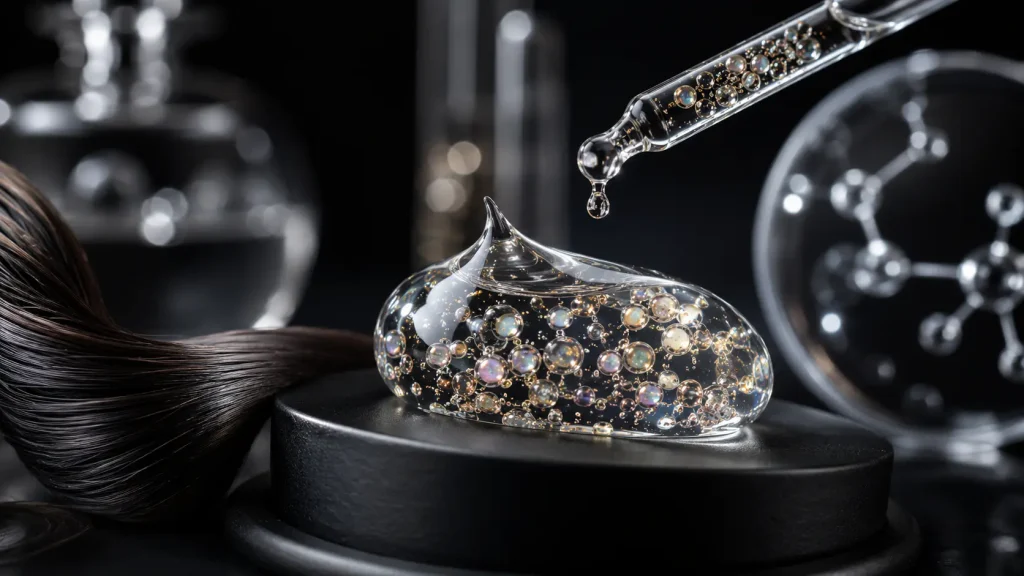
Hair serum is a broader formulation category than hair oil.
Depending on the product concept, a serum may be:
- Water-based
- Gel-serum based
- Emulsion-based
- Silicone-containing
- Silicone-free
- Oil-serum based
- Bi-phase
- Hybrid
- Microcapsule-based
This flexibility allows brands to build serum concepts around:
- Lightweight conditioning
- Smoothing
- Frizz control
- Shine
- Damage-care positioning
- Styling support
- Protein or peptide stories
- Hair-fiber care
- Microcapsule technology
- Scalp or root care when specifically formulated for that application
The key difference is therefore not simply “oil versus treatment.”
Hair oil begins with a more defined oil-system direction, while hair serum gives the formulator a wider range of possible product architectures.
4. Do All Hair Serums Contain Silicone?
No.
Many traditional smoothing serums use silicones because they can form a thin film over the hair fiber, reduce friction, improve slip, and enhance shine.
But “hair serum” does not automatically mean “silicone serum.”
Brands can also develop:
- Silicone-free serums
- Water-based serums
- Emulsion serums
- Oil-serum hybrids
- Bio-based sensory systems
- Microcapsule serums
The ingredient system should follow the performance and sensory target rather than an assumption about what a serum must contain.
5. Hair Oil vs Hair Serum for Different Hair Types
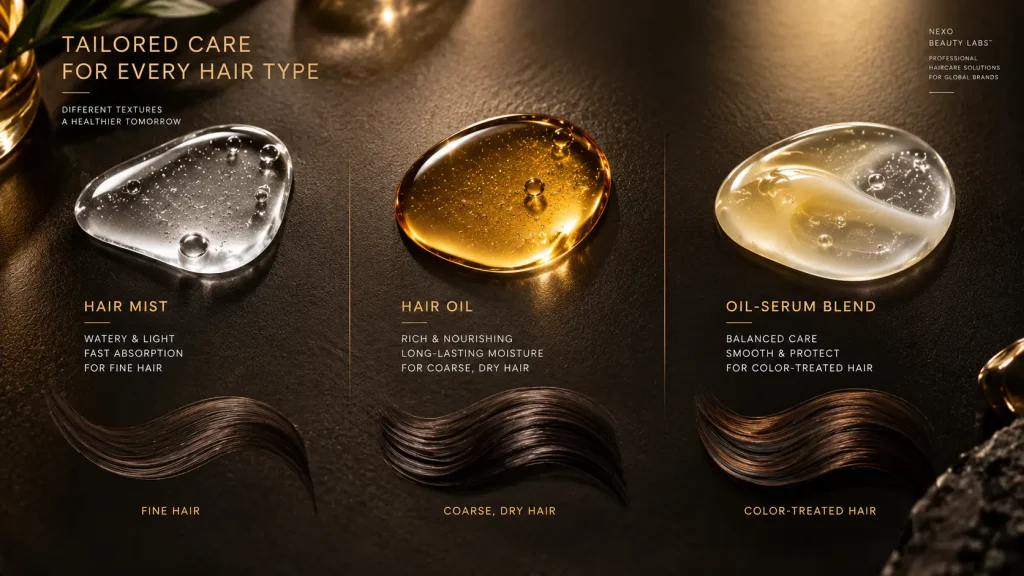
Fine Hair
Fine hair often benefits from:
- Low residue
- Controlled dosage
- Fast spreading
- Lightweight conditioning
- Minimal root heaviness
A lightweight serum can naturally fit this positioning.
But a carefully formulated light hair oil can also work if the emollient system and dosage are designed to avoid excessive weight.
Fine hair does not automatically mean “serum only.”
Dry or Coarse Hair
Dry or coarse hair concepts may prioritize:
- Slip
- Softness
- Smoothing
- Shine
- Frizz control
- Richer conditioning
Hair oil can fit this sensory direction naturally, although richer serum and hybrid systems are also possible.
Color-Treated or Chemically Processed Hair
Product development may focus on:
- Hair-fiber smoothness
- Manageability
- Reduced friction
- Breakage-related appearance
- Conditioning
- Shine
Both oil and serum formats can support this type of positioning.
The choice should depend on the desired texture, ingredient system, performance target, and consumer routine.
Curly or Wavy Hair
Curly and wavy hair products often need to balance:
- Conditioning
- Definition
- Frizz control
- Slip
- Weight
- Shine
A formula suitable for coarse curls may be too heavy for fine waves.
The product should therefore be designed around the actual target consumer rather than the general label “curly hair.”
6. Choose Hair Oil When Shine & Sensory Luxury Matter Most
Hair oil can be a strong direction when your brand wants to emphasize:
- Gloss
- Smoothness
- Softness
- Frizz control
- Dry-hair care
- Botanical oils
- Premium finishing
- Oil-led sensory storytelling
Botanical Ingredient Storytelling
Hair oils naturally support recognizable botanical ingredient stories.
Rosemary Repair & Shine Hair Oil can support a rosemary-led smoothing and shine concept.
Camellia Velvet Hair Oil can support silky, botanical, premium positioning.
Moroccan Fig Lightweight Hair Repair Oil demonstrates how a hair-oil concept can be positioned around lightweight sensory performance rather than traditional heaviness.
The important point is:
More oil does not automatically mean more repair or better performance.
The oil system should match the hair type, use level, desired finish, and product positioning.
7. Choose Hair Serum When Treatment Flexibility Matters Most
A hair serum can be a stronger direction when the brand wants:
- Lightweight treatment
- Flexible texture design
- Technology-led storytelling
- Repair or damage-care positioning
- Protein or peptide concepts
- Microcapsule systems
- Smoothing
- Styling support
- Different application possibilities
Because serum is a broader formulation category, it gives brands greater freedom to design around the specific consumer need.
For example, 4-Protein Micro-Capsule Hair Repair Serum combines a treatment-oriented haircare story with visible format differentiation.
8. Texture Is Part of Haircare Positioning
Consumers experience leave-on haircare through texture before they understand the formulation technology behind it.
They notice:
- Slip
- Oiliness
- Tackiness
- Smoothness
- Shine
- Residue
- Spreadability
- Combability
- Weight
- After-feel
A premium botanical oil might aim for:
Silky + Glossy + Nourishing + Luxurious
A modern repair serum might aim for:
Lightweight + Smooth + Technical + Treatment-Led
Both can occupy premium market positions.
They simply communicate different product identities.
Texture is not only a formulation characteristic — it is part of the brand experience.
9. Heat Protection Is Not an Automatic Hair Serum Benefit
Many consumer-facing hair serums are positioned around blow-drying, styling, or thermal protection.
But the word “serum” alone does not mean that every product provides meaningful heat protection.
If heat-care positioning is important, product development should consider:
- Film-forming ingredient system
- Application amount
- Hair-fiber coverage
- Styling conditions
- Finished-product performance
- Testing appropriate to the intended claim
The same principle applies to hair oils.
A product should not automatically inherit performance claims simply because of its format.
10. Packaging Should Follow the Formula
Hair Oil Packaging
Common options include:
- Pumps
- Droppers
- Controlled-dose bottles
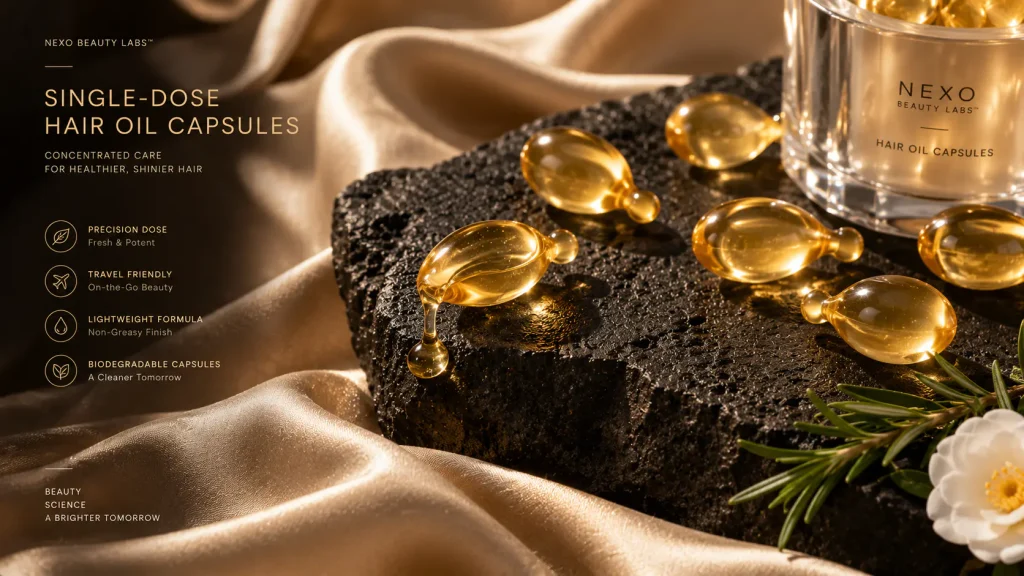
- Single-dose capsules
Hair Serum Packaging
Depending on viscosity and application, options can include:
- Pumps
- Airless systems
- Droppers
- Precision applicators
Development should consider:
- Viscosity
- Dose
- Leakage
- Dispensing consistency
- Formula-packaging compatibility
- Consumer application
- Commercial filling
A premium-looking pump is not useful if the formula cannot move through it reliably.
For more on packaging development, see How to Choose Cosmetic Packaging for Skincare & Beauty Products.
11. Single-Dose Hair Oil Creates Another Product Direction
Hair oil does not need to be packaged only in a conventional bottle.
Bottled Hair Oil
Can support:
- Flexible dosage
- Familiar application
- Everyday use
- Larger product volume
Single-Dose Hair Oil Capsules
Can support:
- Pre-measured dosage
- Travel convenience
- Premium ritual
- Visual differentiation
- Single-use positioning
This changes more than packaging.
It changes how the consumer interacts with and doses the product.
For more on single-dose product systems, see Serum Capsules vs Bottled Serums.
12. Hair Serum & Scalp Serum Are Different Development Concepts
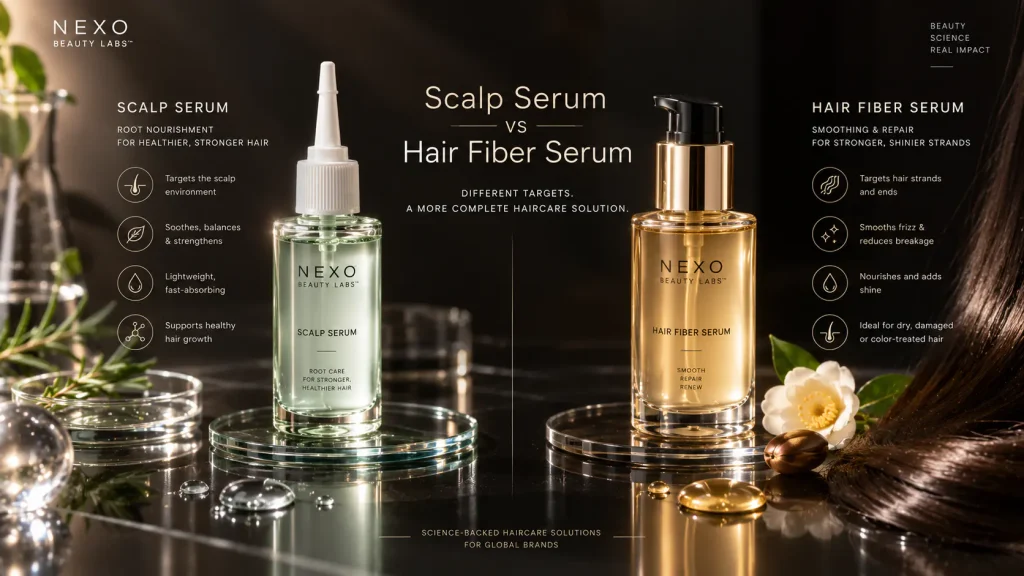
Brands should distinguish between hair-fiber serum and scalp serum.
A hair-fiber serum generally targets the lengths and ends, with positioning around:
- Smoothing
- Conditioning
- Shine
- Frizz control
- Styling
- Damage-care
A scalp serum is designed primarily for application directly to the scalp and roots.
Depending on positioning, it may focus on:
- Scalp balance
- Oiliness
- Comfort
- Visible buildup
- Stronger-looking hair
- Fuller-looking roots
- Daily scalp wellness
This changes the ingredient strategy, texture, applicator, sensory requirements, and claims direction.
For scalp-care development, see How to Develop a Scalp Serum.
13. Stability Requirements Differ Between Hair Oil & Hair Serum
Hair Oil
Depending on the system, development may monitor:
- Oxidative stability
- Color
- Odor
- Clarity or appearance
- Fragrance stability
- Ingredient compatibility
- Packaging interaction
Hair Serum
Depending on the formulation architecture, evaluation may involve:
- pH where relevant
- Viscosity
- Emulsion or phase stability
- Active compatibility
- Texture
- Color
- Precipitation
- Microcapsule or bead integrity where applicable
- Packaging compatibility
A formula that performs well immediately after development still needs to maintain the intended product characteristics over time.
For more detail, see Cosmetic Stability Testing: What Beauty Brands Need to Know and Cosmetic Product Testing Before Mass Production.
14. Manufacturing Processes Can Also Be Different

Hair Oil Manufacturing
Depending on the formulation, production may involve:
- Oil and emollient blending
- Ingredient dissolution
- Antioxidant incorporation
- Fragrance incorporation
- Filtration where appropriate
- Controlled filling
Hair Serum Manufacturing
Depending on formulation architecture, production can involve:
- Mixing
- Emulsification
- Solubilization
- Active incorporation
- Homogenization
- Viscosity control
- Microcapsule incorporation where applicable
- Controlled filling
Advanced formats create additional process requirements.
Visible microcapsule systems need the particles to remain compatible with formulation, filling, packaging, and consumer dispensing.
Single-dose oil capsules require the oil formula and capsule system to function together.
So every concept eventually needs to answer:
Can this formula be reproduced consistently at commercial scale?
15. How Do Hair Oil & Hair Serum Affect MOQ and Cost?
The finished format can also influence the commercial structure of the project.
MOQ and cost may depend on:
- Formula batch size
- Specialty oils or active ingredients
- Packaging supplier minimums
- Pumps, droppers, or applicators
- Single-dose capsule requirements
- Microcapsule systems
- Decoration
- Filling setup
- Testing
- Order quantity
A simple stock-pump hair oil and a custom microcapsule hair serum may have very different MOQ structures.
But this does not mean serum always has a higher MOQ than oil.
The complete product specification determines the practical manufacturing minimum.
16. Which Format Is Right for Your Haircare Brand?
Choose Hair Oil If Your Priority Is:
- Shine
- Smoothing
- Frizz control
- Softness
- Dry-hair care
- Botanical ingredient storytelling
- Premium finishing experience
- Oil-led sensory positioning
Choose Hair Serum If Your Priority Is:
- Lightweight treatment
- Flexible texture design
- Technology storytelling
- Repair or damage-care positioning
- Active ingredient systems
- Protein or peptide concepts
- Microcapsule technology
- Styling or heat-care concepts where supported
A stronger development sequence is:
Target Hair Type
↓
Consumer Need
↓
Product Benefit
↓
Sensory Target
↓
Formula Architecture
↓
Ingredient Strategy
↓
Packaging
↓
Manufacturing
rather than choosing the words “hair oil” or “hair serum” first and forcing the product to fit the format.
Can a Haircare Brand Develop Both Hair Oil & Serum?
Yes.
The two formats can serve different stages of the same routine.
For example:
Shampoo → Conditioner → Repair Serum → Finishing Hair Oil
The serum can focus on lightweight treatment, smoothing, or damage-care positioning.
The oil can focus on softness, shine, frizz control, and finishing.
They do not need to compete.
A strong haircare portfolio gives each product a distinct role and usage moment.
Private Label, ODM & Custom Haircare Development
Private Label Hair Oil or Serum
A private label project begins with an existing developed product or formulation platform.
This can reduce the amount of original R&D required before launch while allowing branding and packaging customization according to the manufacturer’s program.
ODM Haircare Development
An ODM project may start from an existing haircare platform and customize selected characteristics such as:
- Botanical ingredients
- Selected active ingredients
- Fragrance
- Texture
- Hair-type positioning
- Packaging
Custom OEM Haircare Development
A more customized OEM project can be built around a specific product brief involving:
- Target hair type
- Main product benefit
- Sensory target
- Ingredient strategy
- Texture
- Packaging
- Claims direction
- Target market
The development model should be selected according to how much formula differentiation the brand actually needs.
Frequently Asked Questions
Is hair oil the same as hair serum?
No. Hair oil generally begins with an oil-based formulation direction. Hair serum is a broader category that can include water-based, emulsion, silicone, oil-serum, bi-phase, or hybrid systems.
Which is better for damaged hair: hair oil or hair serum?
Neither format is automatically better. Hair oil can provide lubrication, conditioning, shine, and reduced friction, while a serum can be designed around lightweight conditioning, film-forming systems, proteins, peptides, or other damage-care concepts. The complete formulation matters more than the format name.
Does hair oil penetrate the hair shaft?
Some oils can penetrate the hair fiber to varying degrees, while others act mainly through surface lubrication and film effects. Penetration depends on the chemistry of the oil and the complete product formulation.
Does hair serum only coat the hair?
Not necessarily. Many traditional silicone serums work strongly through surface film formation, but “hair serum” describes a broader format that can use water, emulsions, oils, silicones, proteins, polymers, microcapsules, or hybrid systems.
Can hair oil be lightweight?
Yes. Lightweight emollients, selected botanical oils, volatile or dry-feel sensory components where appropriate, and controlled dosing can create a lighter hair-oil experience.
Can a hair serum contain oils?
Yes. Hair serums can include oils or be designed as oil-serum or hybrid systems depending on the target texture and performance.
Is hair serum automatically a heat protectant?
No. Heat-protection performance depends on the finished formulation and appropriate supporting evidence. The product should be developed and evaluated specifically for that positioning.
What packaging is suitable for hair oil?
Pumps, droppers, controlled-dose bottles, and single-dose capsules are possible depending on formula viscosity, dosage, filling, and consumer use.
What packaging is suitable for hair serum?
Pumps, airless systems, droppers, and specialized applicators can all be used depending on formula viscosity, application area, product format, and dispensing requirements.
Is scalp serum the same as hair serum?
Not necessarily. A scalp serum is specifically developed for the scalp and root environment. Hair-fiber serum usually focuses on the lengths and ends, although brands sometimes use the term “hair serum” broadly.
Can a beauty brand develop both hair oil and hair serum?
Yes. The two products can serve different roles within the same routine — for example, a lightweight treatment serum followed by a finishing oil for shine and smoothness.
Which has a lower MOQ: hair oil or hair serum?
There is no universal answer. MOQ depends on formula batch size, ingredients, packaging, product format, decoration, filling, and manufacturing setup rather than whether the product is simply called an oil or serum.
Develop the Format Around the Haircare Need
The choice between hair oil and hair serum should not begin with which format is currently more fashionable.
It should begin with:
Hair Type + Consumer Need + Product Benefit + Sensory Target + Formula + Packaging + Manufacturing
Hair oil can create a strong shine, smoothness, botanical, conditioning, and premium-finishing story.
Hair serum provides greater flexibility for lightweight treatments, technology-led concepts, differentiated textures, and targeted haircare positioning.
At NEXO Beauty Labs, haircare development can be approached across private label, ODM, and custom OEM pathways together with formulation, sensory design, packaging, stability evaluation, scale-up, and commercial manufacturing.
Whether you are developing a botanical finishing oil, lightweight damage-care serum, microcapsule treatment, or single-dose haircare format, the right product architecture should support the hair type and consumer need you are actually trying to address.
Request a Haircare OEM/ODM Consultation with NEXO Beauty Labs to discuss your hair oil, hair serum, scalp care, formulation, packaging, MOQ, and manufacturing requirements.