
Serum Capsules vs Bottled Serums: Which Format Is Right for Your Brand?
Serum capsules vs bottled serums: how they differ, the pros and cons of each, and how to decide which format is right for your next product.
Serums can reach consumers in very different formats.
The familiar option is a multi-use serum packaged in a dropper, pump, or airless bottle. The alternative is a single-dose serum capsule designed to be opened immediately before application.
Both formats can support effective skincare products, but the packaging decision affects much more than appearance.
It can influence formula design, exposure during use, dosage, texture, packaging compatibility, manufacturing complexity, cost, consumer experience, and brand positioning.
So the right question isn’t simply:
Are serum capsules better than bottled serums?
A more useful question is:
Which format best supports the formula, consumer, positioning, price point, and commercial strategy of your product?
This guide compares serum capsules and bottled serums from both a formulation and beauty product development perspective.
What Is the Difference Between Serum Capsules and Bottled Serums?
Bottled Serums
Bottled serums are multi-use products packaged in systems such as:
- Dropper bottles
- Pump bottles
- Airless bottles
The consumer dispenses the desired amount from the same package over multiple applications.
This format works across a wide range of serum textures and remains familiar to skincare consumers.
Serum Capsules
Serum capsules are individually sealed, pre-measured doses designed for single use.
Each capsule contains a defined amount of formula and remains closed until the consumer opens it for application.
Depending on the manufacturing system, brands may develop different:
- Capsule shapes
- Capsule colors
- Surface finishes
- Fill volumes
- Formula colors
- Outer packaging concepts
Capsules are particularly interesting for concentrated, premium, waterless, or treatment-inspired skincare concepts, although compatibility always depends on the actual formula and capsule system.
EXPLORE SERUM CAPSULE FORMATS
For brands exploring single-dose skincare, different capsule concepts can be developed around brightening, barrier care, botanical age care, premium treatment, and other positioning directions. Browse our Facial Serum Capsules Collection →to explore different product and format possibilities.
Serum Capsules vs Bottled Serums: Quick Comparison
Why Serum Packaging Matters to the Formula
Packaging shouldn’t be chosen only after the formula is complete.
The serum and packaging need to function as one product system.
Depending on the formula, packaging can influence:
- Exposure to air
- Exposure to light
- Dosage
- Dispensing
- Consumer handling
- Packaging compatibility
- Product presentation
- Manufacturing requirements
- Finished-product cost
The importance of each factor depends on the specific formulation.
A well-designed conventional serum can perform successfully in an appropriate bottle, while another concept may benefit from individually sealed single-dose packaging.
The format should follow the formula and product strategy rather than the other way around.
Advantages of Serum Capsules
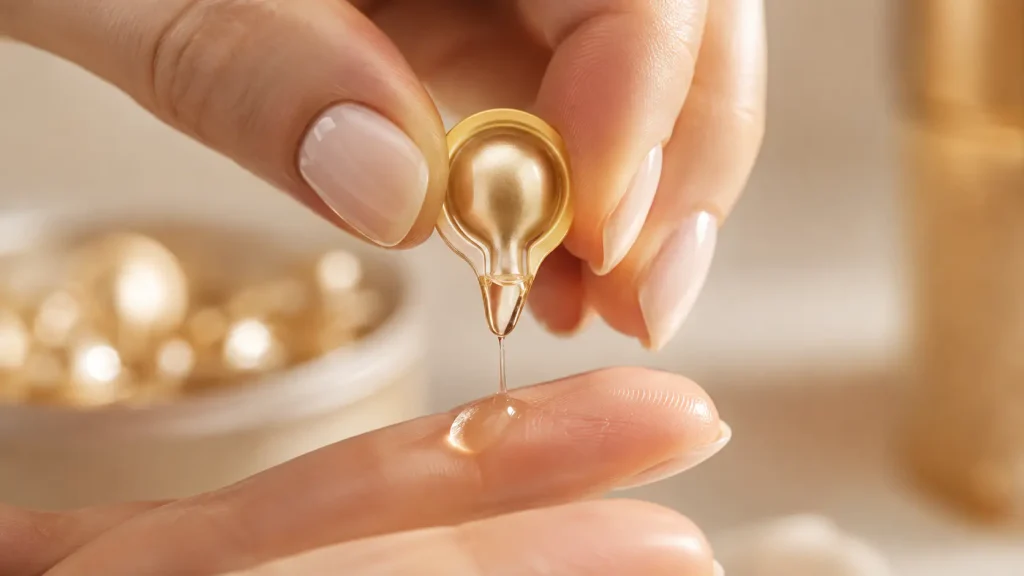
1. Individually Sealed Doses
Each unused capsule remains sealed until the consumer is ready to apply it.
Unlike a multi-use package, opening one dose does not require opening the rest of the product supply.
This can be useful when the brand wants to build positioning around:
- Single-use freshness
- Precision skincare
- Concentrated formulas
- Travel routines
- Premium treatment rituals
Whether individual sealing creates a meaningful stability advantage should still be evaluated according to the specific formula.
2. Pre-Measured Dosing
Each capsule can be manufactured with a defined fill volume.
This means the brand controls the intended amount per application rather than asking consumers to estimate a number of drops or pumps.
That can be useful for products built around a clear application protocol or premium treatment routine.
3. Strong Waterless & Oil-Serum Opportunities
One of the most interesting applications for cosmetic soft capsules is the development of anhydrous or lipid-based serum systems.
These can use lightweight emollients and oil-compatible ingredients to create concentrated formulas with distinctive textures.
Possible formula components may include:
- Squalane
- Meadowfoam seed oil
- Camellia seed oil
- Rosehip oil
- Sea buckthorn oil
- Other lightweight emollients
- Oil-compatible antioxidant or age-care ingredients
However, a capsule is not automatically waterless.
The formulation has to be developed specifically for the selected capsule shell, filling process, and product concept.
4. Differentiated Consumer Experience
The capsule format creates a noticeably different skincare ritual.
Consumers select one dose, open it, dispense the serum, and apply the entire unit.
That experience can support positioning around:
- Premium skincare
- Precision
- Innovation
- Travel convenience
- Single-dose routines
- Treatment-inspired skincare
In crowded serum categories, the delivery format itself can therefore become part of the brand’s differentiation.
5. Capsule-Level Visual Customization
Unlike a conventional serum where most visual differentiation comes from the bottle, capsule products can create branding at two levels:
- The individual capsule
- The outer package
Depending on manufacturing capabilities, possible customization can include:
- Capsule color
- Clear, pearl, matte, or metallic appearance
- Shape
- Size
- Fill volume
- Serum appearance
- Outer jar, bottle, pouch, box, or other secondary packaging
This gives brands additional opportunities to create a recognizable visual identity.
Serum Capsule Considerations & Limitations
More Specialized Manufacturing
Soft capsule products require a manufacturing process designed around the formula, capsule shell, fill volume, sealing, and finished packaging.
The serum can’t simply be developed independently and poured into any capsule later.
Formula Compatibility Is More Restricted
A conventional bottle can accommodate a very wide range of serum architectures.
A capsule system introduces additional compatibility requirements involving:
- Formula viscosity
- Water content
- Solvent system
- Capsule-shell compatibility
- Ingredient compatibility
- Filling behavior
- Sealing
- Storage stability
This makes early coordination between formulation and capsule development particularly important.
Higher Production Complexity
Individual capsule formation, filling, sealing, inspection, and final packaging generally involve a more specialized process than filling one multi-use serum bottle.
That complexity needs to be considered when determining target price and product positioning.
Fixed Dose
A pre-measured dose removes guesswork, but it also reduces flexibility.
A consumer who wants to use significantly less or more product cannot adjust the amount as easily as with a pump or dropper.
Sustainability Needs to Be Evaluated as a Complete System
Neither capsules nor bottles should automatically be described as the more sustainable choice.
The evaluation needs to consider factors such as:
- Shell material
- Outer packaging
- Number of components
- Material weight
- Recyclability or end-of-life route
- Transportation
- Product waste
A sustainability claim should therefore be based on the actual packaging configuration rather than the format name alone.
Advantages of Bottled Serums
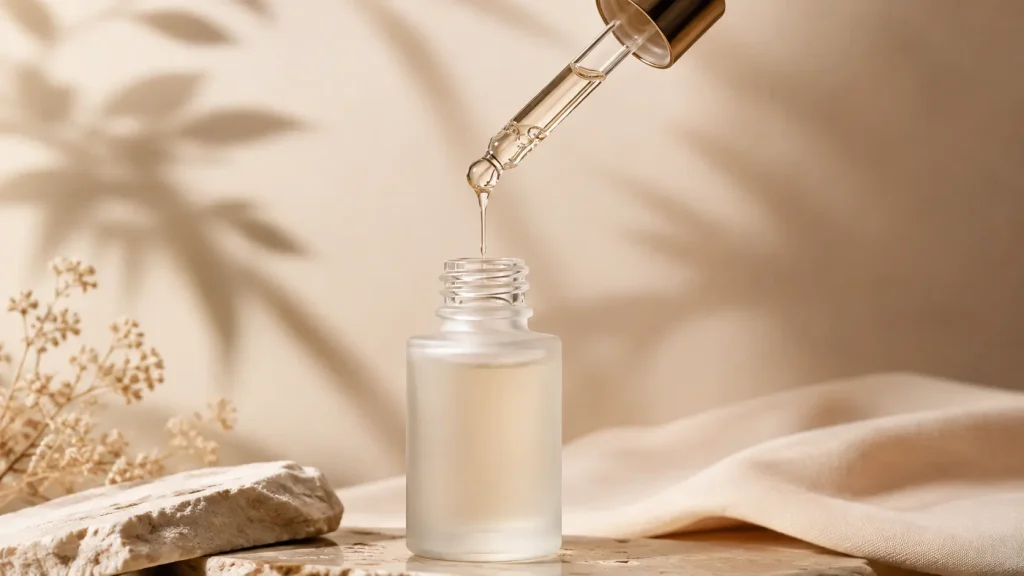
1. Familiar Application
Droppers, pumps, and airless bottles already have well-established consumer usage patterns.
This can reduce the need to teach customers a new application method.
2. Flexible Dosing
Consumers can adjust the amount based on their routine.
For example:
- Face only
- Face and neck
- Morning versus evening routines
- Layering with other skincare
- Personal texture preferences
This makes bottled serums practical for many everyday-use concepts.
3. Broad Formula Compatibility
With the right packaging system, bottled products can support a broad range of serum textures, including:
- Water serums
- Gel serums
- Milky serums
- Light emulsions
- Oil serums
- Bi-phase formulas
The bottle, pump, dropper, or airless dispensing system can be selected according to viscosity and formula requirements.
4. Broad Price-Point Flexibility
Bottled serums can be developed for mass, masstige, prestige, or luxury positioning.
Brands can choose simpler stock packaging for cost efficiency or highly customized components for stronger premium differentiation.
5. Extensive Packaging Options
Bottled serums can still be highly differentiated through:
- Glass or plastic containers
- Airless systems
- Droppers
- Pumps
- Opaque packaging
- Custom colors
- Coatings
- Printing
- Special decoration
- Custom shapes
Choosing a bottle does not mean accepting generic positioning.
For a deeper look at matching viscosity, formula sensitivity, dispensing, compatibility, MOQ, and branding with the right package, see our
Guide to Choosing Cosmetic Packaging for Skincare & Beauty Products.
Bottled Serum Considerations
Repeated Use of the Same Package
The same package is normally opened or activated throughout the consumer usage period.
The actual degree of formula exposure depends strongly on the dispensing system.
For example, an airless pump and an open-neck container create very different product environments.
This is why formula stability and packaging selection should be evaluated together.
Less Controlled Consumer Dosing
Different consumers may dispense very different amounts, particularly with droppers.
That can be useful when flexibility is desired, but less useful when the brand wants to communicate a tightly controlled per-use dosage.
Format Differentiation Can Be Harder
Bottled serums are extremely familiar.
That familiarity can help usability, but it also means the brand may need to rely more heavily on formulation, packaging design, ingredients, storytelling, or dispensing innovation to stand apart from competitors.
Which Formulas Are Best Suited to Serum Capsules?
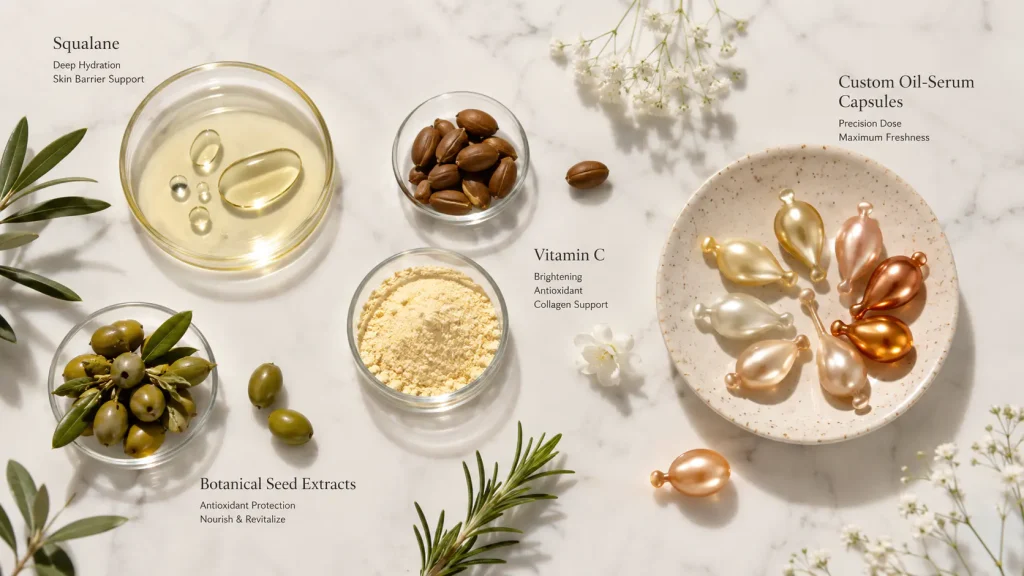
There is no universal ingredient list for capsule serums.
Instead, the ingredients should be selected according to the formula system and product positioning.
Brightening & Radiance Capsule Concepts
A waterless brightening or radiance-focused capsule may be developed around a lipid-based system containing ingredients such as:
- Oil-compatible vitamin C derivatives
- Squalane
- Meadowfoam seed oil
- Camellia seed oil
- Other compatible antioxidants or emollients
Any active needs to be selected according to its solubility, stability, permitted use, and compatibility with the complete formula and capsule system.
Barrier-Support Capsule Concepts
Oil-serum capsules can also fit naturally with lipid-focused skincare positioning.
Possible ingredients may include:
- Squalane
- Camellia seed oil
- Sea buckthorn oil
- Compatible ceramide or lipid systems
- Other emollient oils
Bakuchiol & Age-Care Capsule Concepts
Another direction combines premium botanical or age-care positioning with a waterless sensory profile.
Potential ingredients can include:
- Bakuchiol
- Rosehip oil
- Coenzyme Q10
- Meadowfoam seed oil
- Squalane
These are examples of product-development directions rather than a universal capsule formula.
Can Any Bottled Serum Be Converted Into a Capsule?
No — not automatically.
Changing from a bottle to a capsule is not simply a packaging substitution.
The manufacturer needs to evaluate factors such as:
- Formula viscosity
- Water content
- Solubility system
- Ingredient compatibility
- Capsule-shell compatibility
- Fill volume
- Formula stability
- Sealing behavior
- Application amount
A formula originally designed for a pump or dropper may therefore need to be modified or reformulated before it can be used successfully in a capsule system.
For this reason, brands interested in serum capsules should ideally decide on the format early in product development.
Serum Capsules vs Bottled Serums: Which Is Better for Sensitive Ingredients?
There is no universal answer.
Single-dose packaging has the practical advantage that unopened doses remain sealed while one unit is being used.
However, ingredient stability also depends on:
- The intrinsic stability of the ingredient
- Formula composition
- Water activity or water content
- Antioxidant system
- Packaging material
- Light protection
- Storage conditions
- Manufacturing process
A properly selected airless or protective bottle can also provide an effective packaging solution for many serum formulations.
Packaging should therefore be selected based on the needs of the actual formula rather than assuming one format always provides better protection.
Which Format Fits Your Brand Positioning?
Choose Serum Capsules When You Want:
- Pre-measured dosing
- A distinctive single-use ritual
- Premium or treatment-inspired positioning
- Strong visual differentiation
- Travel-friendly individual doses
- Waterless or oil-serum concepts
- Custom capsule colors, shapes, or finishes
- A format that becomes part of the product story
Choose Bottled Serums When You Want:
- Familiar everyday application
- Flexible dosage
- A broad range of serum textures
- Greater price-point flexibility
- Larger multi-use quantities
- Easy integration into an existing skincare range
- A wide selection of conventional packaging systems
Neither format is inherently better.
The strongest choice is the one that makes the formula, packaging, consumer experience, price point, and brand story work together.
How Do Serum Capsules Affect Manufacturing Cost & MOQ?
Capsule projects have a different manufacturing structure from conventional bottled serums.
Cost and minimum order quantities can be influenced by:
- Capsule shell specification
- Formula
- Fill volume
- Capsule color and finish
- Capsule size and shape
- Production setup
- Outer packaging
- Decoration
- Testing requirements
- Order quantity
Bottled products have their own cost drivers, including:
- Bottle
- Dropper or pump
- Decoration
- Labels
- Cartons
- Formula quantity
- Filling
There is therefore no universal rule that one format always has a specific MOQ or exact cost premium.
The complete product specification needs to be quoted as a system.
Private Label, ODM & Custom OEM Serum Development

Private Label Serum Capsules
A private label project can begin with an existing serum capsule concept that has already been developed by the manufacturer.
Depending on the project, customization may focus on:
- Branding
- Outer packaging
- Selected visual details
- Product positioning
This can reduce the amount of original formulation development required before launch.
ODM Serum Capsule Development
ODM development can start from an existing capsule or formulation platform and adapt selected characteristics to the brand concept.
Depending on manufacturing capabilities, customization may include:
- Ingredient system
- Serum appearance
- Capsule color
- Capsule finish
- Capsule size
- Capsule shape
- Fill volume
- Fragrance or fragrance-free direction
- Outer packaging
Custom OEM Serum Capsule Development
For a more differentiated concept, the formula and capsule delivery system can be developed together.
This is especially important because capsule products need the formula, shell material, viscosity, filling conditions, sealing process, dosage, and storage system to work as one product.
Greater customization can create stronger differentiation but may also involve additional R&D, compatibility evaluation, sampling, and manufacturing development.
Frequently Asked Questions
Are serum capsules more effective than bottled serums?
Not automatically. Product performance depends primarily on the formula, ingredients, use level, stability, manufacturing quality, packaging compatibility, and how the product is used. Capsules mainly change the delivery and packaging system.
Do serum capsules keep ingredients fresher?
Unused capsules remain individually sealed until application, which reduces repeated opening or dispensing of the remaining doses during consumer use. Whether this creates a meaningful stability advantage depends on the specific ingredient and formulation.
Are serum capsules always waterless?
No. Waterless oil-serum capsules are an important product-development direction, but the capsule format itself does not automatically mean that every capsule formula is anhydrous.
Can any serum be put into a capsule?
No. Formula viscosity, water content, ingredient solubility, capsule-shell compatibility, fill volume, stability, and processing requirements all need to be evaluated. A bottled formula may require reformulation before capsule filling.
Are serum capsules more expensive to manufacture?
Capsule production generally involves a more specialized manufacturing and filling process than conventional bottled serum production. Actual cost depends on formula, capsule specification, customization, packaging, quantity, and manufacturing requirements.
Can serum capsule color and shape be customized?
Depending on the manufacturing system, capsule characteristics such as color, finish, size, shape, fill volume, and serum appearance may be customized.
Are serum capsules more sustainable than bottles?
Not automatically. Sustainability depends on the complete material and packaging system, including shell material, outer packaging, component count, recyclability or biodegradability, transport, and product waste.
Which serum format is better for travel?
Individually portioned capsules can be convenient for travel because consumers can take only the number of doses they expect to use. Bottled serums can also work well for travel when offered in appropriate small or travel-sized packaging.
Should a startup choose serum capsules or a bottled serum?
A bottled serum can be a practical choice when familiar application, broad formula flexibility, and price-point flexibility are priorities. Capsules may be more attractive when strong visual differentiation, precise dosing, premium positioning, or a distinctive product ritual is central to the brand.
Can I private label serum capsules?
Yes, if the manufacturer offers an existing capsule platform. The available customization may include branding, outer packaging, capsule appearance, formula options, or other characteristics depending on the project.
Develop Your Serum Format with NEXO Beauty Labs
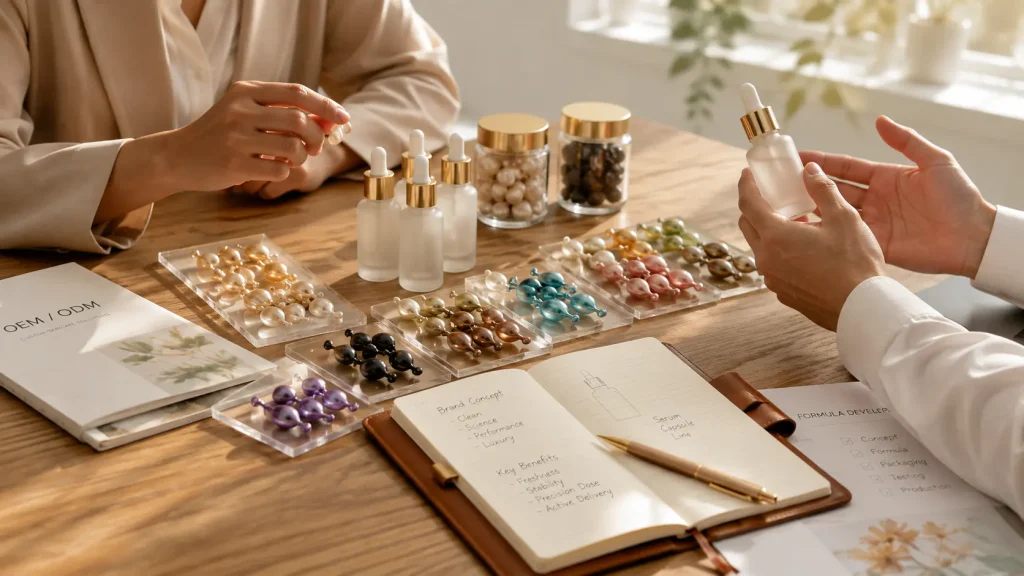
Choosing between serum capsules and bottled serums should happen alongside formulation development rather than after the formula has already been finalized.
At
NEXO Beauty Labs, brands can develop both conventional bottled serums and single-dose cosmetic capsule concepts through private label, ODM, and custom OEM development.
Depending on the project, capsule customization can include:
- Serum formulation
- Active ingredient systems
- Waterless oil-serum concepts
- Capsule color and finish
- Capsule shape and size
- Fill volume
- Serum appearance
- Fragrance or fragrance-free concepts
- Outer packaging
- Private label development
- ODM customization
- Custom OEM development
Whether the next product is a brightening serum capsule, barrier-support oil capsule, bakuchiol age-care capsule, or conventional bottled serum, the format should strengthen the product rather than simply make it look different.
Request a Serum Capsule OEM/ODM Consultation with NEXO Beauty Labs to discuss your formula, capsule format, packaging, customization, MOQ, and launch requirements.