How Long Does It Take to Develop a Cosmetic Product? From Concept to Mass Production
Learn how long cosmetic product development can take, from concept and formulation to sampling, packaging, testing, pilot production and mass manufacturing.
How long does it take to turn a beauty product idea into something ready for commercial production?
The answer depends heavily on what you’re developing.
A straightforward product based on an existing formula and stock packaging may move through development in a matter of weeks or a few months. A fully custom formula with multiple revisions, specialized ingredients, testing, custom packaging, and scale-up can take many months — and complex projects can take longer.
The reason is simple: cosmetic product development is not one step and it is rarely a perfectly linear process.
Formulation, sampling, packaging, testing, claims review, sourcing, scale-up, and manufacturing planning all influence the final schedule, and several of these workstreams can happen at the same time.
This guide explains the cosmetic product development timeline stage by stage, what commonly creates delays, and how beauty brands can plan a more realistic path from concept to production.
Quick Answer: How Long Does Cosmetic Product Development Take?
For planning purposes, development generally becomes longer as the level of customization increases.
These are planning patterns rather than guaranteed lead times. Product category, formula complexity, target market, testing strategy, packaging, number of SKUs, and manufacturing capacity can significantly change the schedule.
It is also important to distinguish between:
- Development timeline: concept to a product ready for commercial manufacturing.
- Launch timeline: concept to finished inventory delivered and ready to sell.
Shipping, warehousing, retail preparation, and launch logistics can extend the second timeline beyond the first.
A Typical Cosmetic Product Development Journey
A cosmetic product generally moves through a path similar to:
Concept → Formulation → Sampling → Packaging → Testing → Scale-Up → Mass Production
But this should not be interpreted as seven completely separate boxes that happen one after another.
Packaging sourcing can begin while samples are still being reviewed. Testing requirements can be scoped during formulation. Claims can be discussed before the final formula is locked. Manufacturing feasibility can be considered before scale-up.
This overlap is one of the most important ideas in realistic beauty product launch planning.
Stage 1: Product Concept & Development Brief
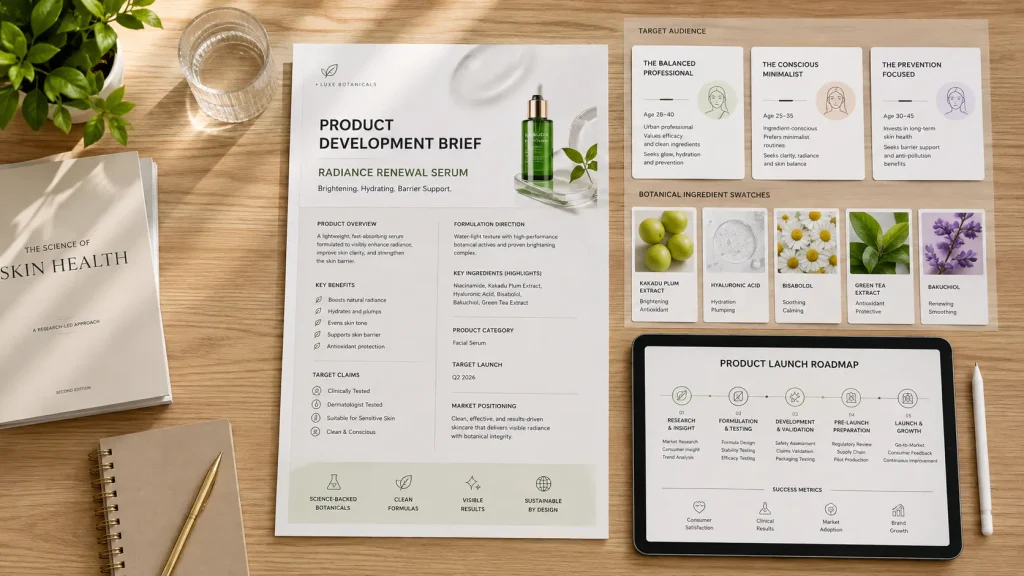
Product development begins before the laboratory starts mixing ingredients.
A strong development brief defines what the brand is actually trying to create.
This may include:
- Product category
- Target consumer
- Main product benefit
- Desired texture and sensory profile
- Hero ingredient direction
- Fragrance direction
- Target market
- Price positioning
- Packaging direction
- Expected order quantity
- Desired launch timing
For example:
“We want a facial serum.”
leaves dozens of development questions unanswered.
A stronger brief could be:
“A lightweight, fragrance-free barrier serum for sensitive skin with fast absorption, an airless packaging direction, premium positioning, and intended launch in the U.S. market.”
The second gives the formulation, packaging, and commercial teams a much clearer target.
One of the easiest ways to shorten a development timeline is to reduce ambiguity before formulation begins.
Stage 2: Formula Development
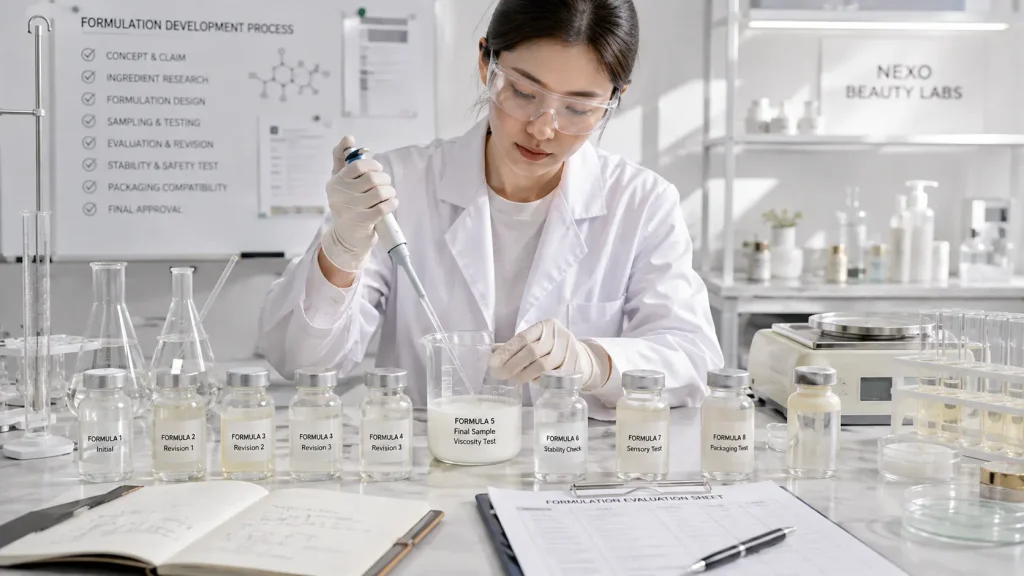
Once the product strategy is clear, the R&D team begins translating it into a workable formula.
Development may involve decisions around:
- Base formulation system
- Active ingredients
- Ingredient compatibility
- Texture
- Viscosity
- Fragrance
- Color
- Preservation strategy
- Sensory profile
- Target cost
- Manufacturing feasibility
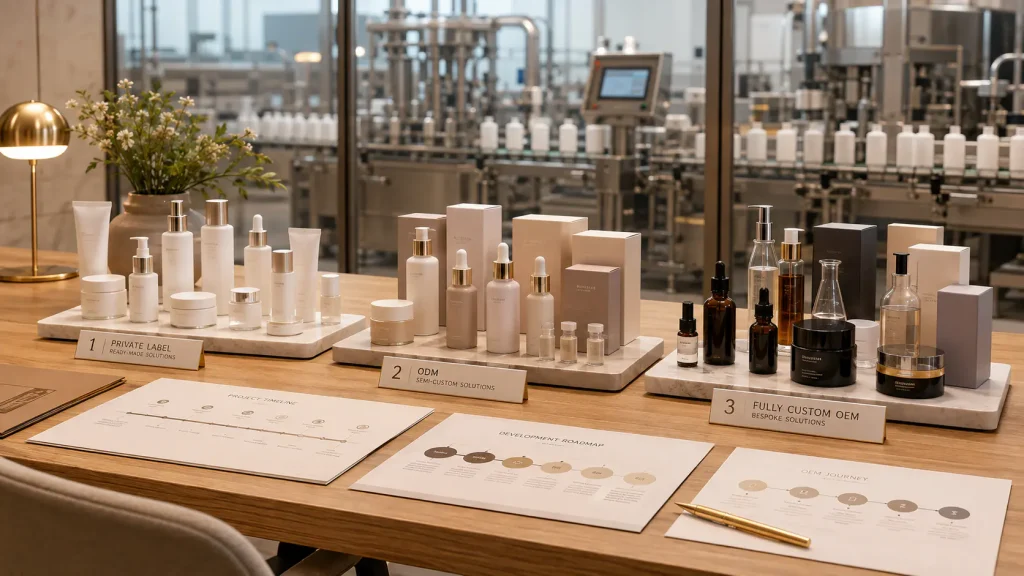
The amount of R&D required depends significantly on the development model.
Private Label
Private label typically begins with an existing ready-developed formula.
Development work is therefore more focused on product selection, samples, branding, packaging, and any customization the manufacturer offers.
Customized ODM
ODM often starts with a manufacturer-developed formulation platform but allows selected customization.
Depending on the project, ingredients, fragrance, texture, appearance, or positioning may be adjusted.
Fully Custom Formulation
A highly customized OEM project may require multiple laboratory prototypes before the product reaches the desired balance between performance, sensory experience, stability, packaging, cost, and manufacturability.
This is why custom formulation is normally measured as a development program rather than one sample request.
If you want a deeper look at how a cosmetic formula is built — including ingredient architecture, texture, stability, sensory experience, cost, packaging compatibility, and manufacturing feasibility — see our Cosmetic Product Formulation Guide.
Stage 3: Sampling & Formula Revisions
The first sample is rarely the final sample.
Once a prototype is produced, the brand may evaluate:
- Texture
- Viscosity
- Appearance
- Color
- Fragrance
- Spreadability
- Absorption
- Stickiness
- Residue
- Overall consumer experience
The quality of feedback has a direct effect on how efficiently revisions can move.
Compare:
“It doesn’t feel premium enough.”
with:
“Absorption is too slow, the finish remains tacky after application, and we would like slightly lower viscosity.”
The second gives the formulation team measurable direction.
Repeated revisions are one of the easiest ways for a development schedule to expand.
Clear and consolidated feedback can reduce unnecessary cycles.
Stage 4: Packaging Selection & Development
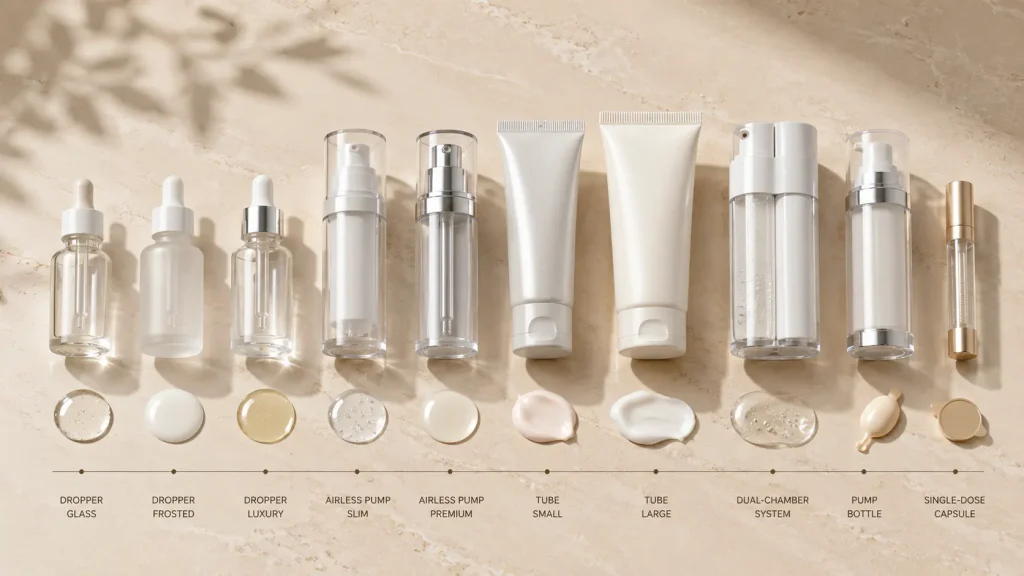
Packaging is one of the most common hidden timeline variables.
Beauty brands naturally focus on visual questions:
- Which bottle looks premium?
- Which pump fits the brand?
- Which color and finish match the collection?
But packaging is also a technical system.
The formula needs to fill, store, dispense, and remain compatible with its final package.
Common formats can include:
- Droppers
- Pumps
- Airless systems
- Jars
- Tubes
- Sprays
- Roll-ons
- Dual-chamber systems
- Single-dose capsules
A readily available stock package can usually move more quickly than packaging involving custom molds, specialized components, unique decoration, or complex filling systems.
Formula and packaging development should therefore run together whenever practical.
Stage 5: Product Testing
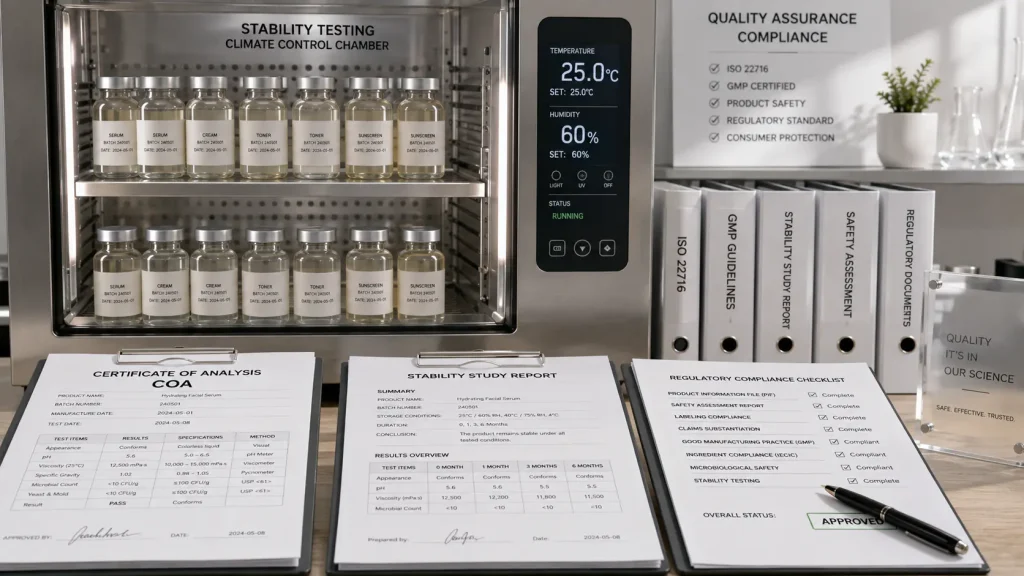
An approved laboratory sample does not automatically mean a product is ready for commercial production.
Depending on the formula and project, evaluation may involve:
- Stability testing
- Physical and chemical evaluation
- Microbiological evaluation
- Preservative-system evaluation where applicable
- Packaging compatibility
- Sensory evaluation
- Claim-related testing
The correct testing program depends on the actual formula, packaging, intended use, product claims, and target market.
This means testing can become a major part of the project’s critical path.
It should be discussed early rather than added as an afterthought immediately before production.
For a more detailed explanation of stability, microbiological evaluation, preservative efficacy, packaging compatibility, sensory testing, claims support, and scale-up before commercial production, read our Cosmetic Product Testing Before Mass Production Guide.
Stage 6: Regulatory & Claims Planning
Target-market decisions can influence formulation, packaging, documentation, labels, testing, and claims — which means they can also influence timing.
A product intended for one country may not have exactly the same requirements as a product intended for several markets.
This is why the intended sales market belongs in the original development brief.
Waiting until formula and packaging development are nearly complete before asking:
“Can we launch this same product in several different markets?”
can create avoidable additional work.
Claims should also be considered early.
If the brand intends to communicate specific product benefits that require additional evidence, the testing and claims plan should be incorporated into the development schedule.
Stage 7: Pilot Production & Scale-Up
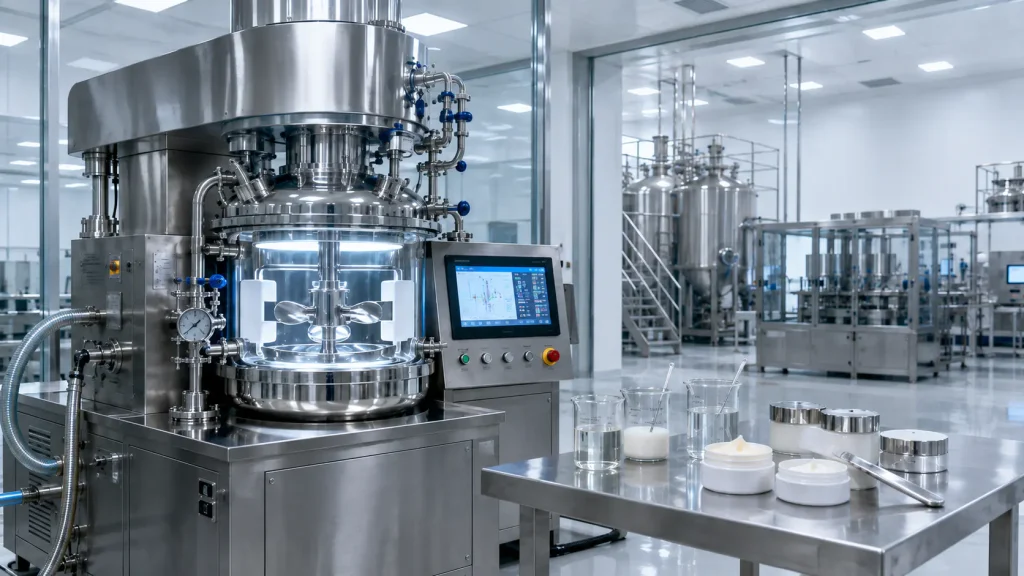
A laboratory batch and a commercial batch are not simply the same process at different volumes.
Larger manufacturing equipment can change variables such as:
- Mixing
- Shear
- Heating rate
- Cooling rate
- Ingredient addition sequence
- Processing time
- Filling behavior
Even when ingredient percentages remain unchanged, the finished product can behave differently.
Possible differences include:
- Viscosity
- Texture
- Appearance
- Dispersion
- Sensory characteristics
Depending on the formula and process, pilot or scale-up evaluation may therefore be used to establish how the product should be manufactured commercially.
The objective is to connect:
Approved Lab Formula → Controlled Manufacturing Process → Repeatable Commercial Product
Stage 8: Mass Production & Quality Control
Once the formula, packaging, manufacturing process, and relevant evaluation stages are ready, the project can move toward commercial production.
The process can include:
- Raw material preparation
- Batch manufacturing
- In-process quality checks
- Bulk product evaluation
- Filling
- Packaging
- Batch identification
- Finished-product inspection
- Release and shipment preparation
The goal is not simply to manufacture a large quantity of product.
It is to reproduce the approved product consistently.
A successful development process should therefore answer two questions:
Can we create this formula?
and:
Can we manufacture it consistently at commercial scale?
For a step-by-step look at what happens during commercial production — from raw material preparation and batch processing through filling, packaging, quality control, finished-product release, and distribution — continue with our Complete Cosmetic Manufacturing Process Guide.
Which Development Stages Can Happen at the Same Time?
One reason cosmetic launch timelines are often misunderstood is that brands assume every stage must finish before the next begins.
Some dependencies are unavoidable, but several workstreams can often overlap.
The total project timeline is therefore not simply the sum of every individual stage.
It is determined by the project’s critical path — the sequence of dependent work that ultimately controls when commercial production can begin.
What Usually Delays a Cosmetic Product Launch?
Delays are often caused by several smaller issues accumulating rather than one dramatic failure.
Common causes include:
- Unclear product brief
- Repeated formula revisions
- Slow or contradictory sample feedback
- Late packaging decisions
- Custom packaging lead times
- Specialty ingredient availability
- Formula-packaging compatibility issues
- Additional testing
- Changing claims
- Changing target markets
- Artwork revisions
- MOQ changes
- Scale-up adjustments
- Production-capacity scheduling
Another major source of delay is treating every activity as completely sequential.
If packaging discussions begin only after formulation ends, testing is considered only after packaging is finalized, and manufacturing is discussed only after all testing is complete, the project may spend unnecessary time waiting between stages.
How Beauty Brands Can Keep Development on Schedule
The fastest development projects aren’t necessarily the ones where the laboratory is asked to rush every step.
They are often the projects with fewer unnecessary revisions and better coordination.
Brands can improve efficiency by:
- Creating a detailed product brief early.
- Defining target markets before formulation is advanced.
- Starting packaging discussions alongside formula development.
- Giving specific and consolidated sample feedback.
- Avoiding unnecessary ingredient changes once the product direction is working.
- Discussing testing and claim requirements early.
- Considering manufacturing feasibility before final formula approval.
- Identifying long-lead ingredients and packaging components early.
- Leaving reasonable contingency in the launch plan.
A development project rarely becomes significantly faster by forcing every technical stage into the shortest possible window.
It becomes faster when fewer stages have to be repeated.
Frequently Asked Questions
How long does it take to develop a cosmetic product?
It depends on the product and development model. Existing private label formulas can generally move more quickly because much of the formulation work already exists, while customized ODM and fully custom products require additional development, evaluation, packaging, and manufacturing preparation.
How long does it take to develop a skincare product?
Simple skincare projects based on existing formulations and stock packaging may move through development in weeks or a few months, while fully customized skincare products are more commonly measured in multiple months. Testing, packaging, formula revisions, target-market requirements, and scale-up can extend the schedule.
Is private label faster than custom formulation?
Generally, yes. Private label usually begins with an existing formula, reducing initial R&D. However, packaging, artwork, product evaluation, production scheduling, documentation, and target-market requirements may still affect the final launch timeline.
What takes the longest during cosmetic product development?
There is no single stage that is always the longest. Depending on the project, the critical path may be formulation revisions, stability work, specialty ingredient sourcing, custom packaging, claims testing, target-market preparation, or scale-up.
Can packaging delay cosmetic production?
Yes. Custom molds, specialty pumps, complex component systems, decoration, supplier minimums, and international sourcing can all extend packaging lead times. Late packaging decisions can also create compatibility or filling issues.
Can formulation and packaging development happen at the same time?
Often, yes. Early packaging discussions allow formulation teams to consider viscosity, filling, dispensing, compatibility, and package dimensions while the product is still being refined.
Does every cosmetic product need pilot production?
Not every project follows the same pilot process. Whether a dedicated pilot batch is appropriate depends on formula complexity, manufacturing equipment, batch size, product format, and the manufacturer’s scale-up strategy.
Does testing happen before or after packaging is selected?
Ideally, formula and packaging decisions overlap. Some product testing and stability work may need the intended final packaging system, so choosing packaging too late can create additional evaluation or redevelopment.
When should a beauty brand set its final launch date?
A public launch date is safer once the critical development variables — formula direction, packaging, testing plan, target-market requirements, and production schedule — are sufficiently clear. Setting an inflexible date too early can create pressure to rush technical decisions.
Can a manufacturer guarantee an exact development timeline?
A manufacturer can provide a project schedule based on the agreed scope, but development contains variables such as revisions, testing results, supplier lead times, packaging, and scale-up. The most useful timeline is therefore project-specific and updated as major milestones are approved.
From Product Idea to Commercial Production
A cosmetic product development timeline is not simply a countdown from the first laboratory sample to mass production.
It is a coordinated process connecting:
Product Strategy → Formulation → Packaging → Testing → Scale-Up → Manufacturing
When these workstreams are planned together, brands can reduce avoidable revisions and make important decisions earlier.
At NEXO Beauty Labs , we support beauty brands across private label, ODM, and custom OEM development — from initial product brief and formulation through packaging, testing, manufacturing preparation, and commercial production.
Whether you’re launching your first hero SKU or developing a broader skincare, haircare, body care, sun care, or personal care range, the most useful timeline is one built around the actual complexity of your product.
Request a Cosmetic Product Development Consultation with NEXO Beauty Labs to discuss your product concept, formulation route, packaging, testing requirements, MOQ, and a realistic path from idea to production.