Clay Mask vs Peeling Gel vs Exfoliating Cleanser: Which Exfoliation Format Should Your Skincare Brand Develop?
Compare clay masks, peeling gels and exfoliating cleansers from a skincare product development perspective, including formula, texture, actives and positioning.
Exfoliation is not one single skincare format.
Beauty brands can approach rough-feeling texture, pore-care positioning, smoothing, and exfoliation-oriented skincare through clay masks, peeling gels, exfoliating cleansers, and other treatment systems.
But these formats create very different consumer routines.
A clay mask can become a weekly treatment ritual.
A peeling gel creates a massage-and-rinse experience.
An exfoliating cleanser integrates the concept directly into the cleansing step.
So the better question isn’t:
“Which exfoliator is best?”
It is:
“Which format best supports the target consumer, skin concern, usage frequency, sensory experience, exfoliation strategy, and skincare routine we want to build?”
This guide compares clay masks, peeling gels, and exfoliating cleansers from a beauty-brand formulation and OEM/ODM product-development perspective.
Quick Answer: Clay Mask vs Peeling Gel vs Exfoliating Cleanser
The strongest format is not automatically the most intensive one.
The right choice is the format where mechanism + frequency + formula + consumer experience make sense together.
1. Exfoliation Strategy Should Come Before Product Format
A common development mistake is starting with a request such as:
“We want an AHA/BHA clay mask.”
That jumps directly to ingredients and format before defining what the finished product actually needs to do.
A stronger product brief starts with:
- Who is the target consumer?
- What skin concern is the product designed around?
- Is the main objective cleansing, smoothing, oil care, or periodic treatment?
- How frequently should the product be used?
- Is it part of cleansing or a separate treatment?
- How intensive should the experience feel?
- What should the skin feel like afterward?
- What claims direction fits the brand and target market?
A practical framework might be:
Routine Cleansing
→ Exfoliating cleanser
Periodic Texture Refinement
→ Peeling gel
Weekly Pore / Oil-Care Treatment
→ Clay mask
Exfoliation strategy first. Product format second.
2. Product Format & Exfoliation Mechanism Are Not the Same Thing
This distinction is critical.
A product format describes how the consumer interacts with the product:
- Clay mask
- Peeling gel
- Cleanser
An exfoliation strategy describes how the finished formula is intended to create its exfoliation-oriented effect.
Possible approaches include:
- AHA-based systems
- BHA-based systems
- PHA-based systems
- Enzyme-oriented systems
- Physical exfoliation
- Rub-off / gommage systems
- Combination approaches
These two decisions interact, but they are not interchangeable.
A clay mask may contain acids — or it may use clay primarily for oil-absorbing and pore-cleansing positioning.
A peeling gel may contain enzyme-related ingredients — but its distinctive consumer experience can still come primarily from the gel’s massage and rub-off behavior.
An exfoliating cleanser may contain an acid system — but it still needs to perform successfully as a rinse-off cleanser.
Format + Mechanism + Usage Frequency need to be designed together.
3. What Is a Clay Mask?
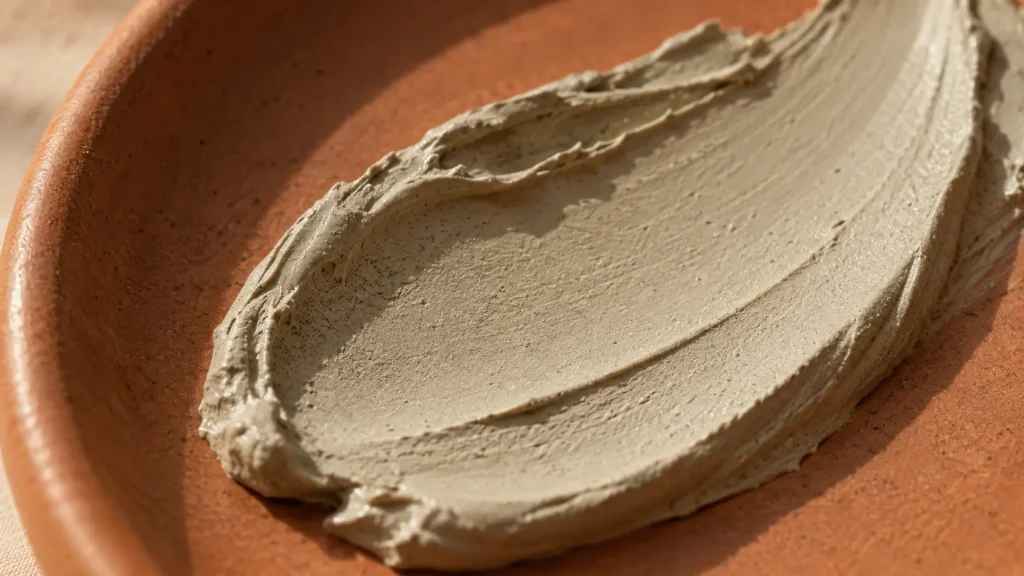
Clay masks naturally support treatment-oriented skincare.
Depending on formulation and claims strategy, they can fit concepts around:
- Pore-care routines
- Excess-oil care
- Oily or combination skin
- Deep-cleansing-oriented positioning
- Weekly treatment
- Spa-inspired skincare
- Smoother-looking texture
Common mineral-clay directions include materials such as kaolin or bentonite, depending on the formulation.
But clay-mask development involves much more than maximizing the percentage of clay.
Clay Mask Development Considerations
- Clay dispersion
- Powder wetting
- Suspension stability
- Viscosity
- Spreadability
- Dry-down behavior
- Tightness perception
- Cracking or flaking
- Rinsability
- Residue
- Active compatibility
- Packaging
A mask can communicate strong pore-care and oil-care positioning without becoming excessively drying.
The goal is not:
“Make it feel as intense as possible.”
It is:
“Create the right treatment experience for the intended consumer.”
For one formulation direction, see Cloud Clay AHA BHA PHA Pore-Refining Clay Mask.
4. Clay Mask Does Not Automatically Mean Chemical Exfoliation
Clay and exfoliating acids perform different formulation roles.
Mineral clays can support:
- Absorption of excess surface oil
- Cleansing-oriented product positioning
- Texture and body within the formulation
- A characteristic mask dry-down experience
AHA, BHA, PHA, enzymes, or physical particles introduce a separate exfoliation strategy.
That means:
Clay Mask ≠ Automatically Exfoliating Mask
and:
Exfoliating Clay Mask = Clay Treatment Format + Defined Exfoliation Strategy
Brands should define both parts clearly during formulation development.
5. What Is a Peeling Gel?
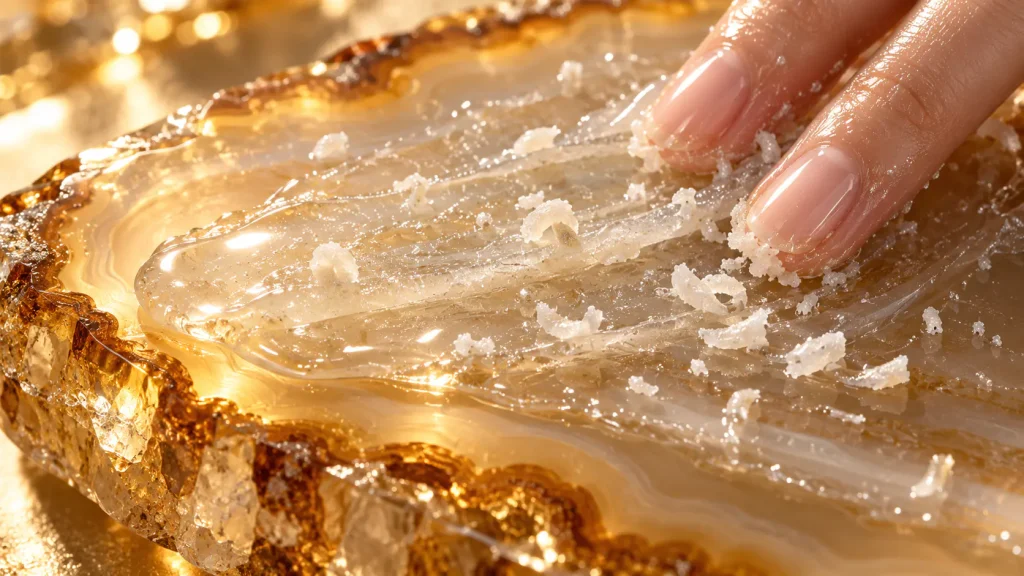
Peeling gel creates a very different consumer ritual from a clay mask.
Instead of applying the product and waiting for a defined treatment period, the consumer typically massages the gel over the skin before rinsing.
During this process, visible rolls or clumps can form.
This gives peeling gel an immediate tactile and visual feedback loop that makes the product feel highly interactive.
Possible positioning includes:
- Smoothing
- Surface refinement
- Brightening-oriented routines
- Periodic exfoliation
- Lightweight treatment
- Massage-based skincare
Peeling Gel Development Considerations
- Gel structure
- Spreadability
- Rub-off behavior
- Massage friction
- Clump formation
- Residue
- Rinsability
- Stickiness
- Fragrance
- Ingredient compatibility
- Stability
For one product direction, see 5-Enzyme Brightening Peeling Gel.
6. What Are the Visible “Rolls” in a Peeling Gel?
This is one of the most misunderstood parts of the category.
The visible material produced during massage should not automatically be described as:
“All of the dead skin being removed.”
In many gommage-style peeling gels, polymers, cellulose-related materials, or other formula components aggregate during rubbing and create visible clumps.
Those clumps can interact with:
- Loose surface skin cells
- Skin oils
- Surface debris
- The peeling-gel formula itself
This means the visible roll-off is part of the product mechanism and consumer ritual.
It should not be presented as proof that every visible particle is removed dead skin.
For brands, more defensible positioning includes:
- Helps remove surface buildup
- Leaves skin feeling smoother
- Provides a massage-based exfoliating experience
- Helps refine the feel of rough surface texture
according to the actual finished formula and supporting evidence.
7. Peeling Gel Is Not the Same as a Chemical Peel or Peel-Off Mask
The word “peeling” can create confusion.
Peeling Gel / Gommage
Usually describes a massage-based rub-off treatment where the formula forms visible rolls or clumps during use.
Chemical Peel
Generally describes an acid-based exfoliation treatment in which product strength, pH, exposure time, intended use, and market requirements become especially important.
Peel-Off Mask
Forms a continuous film that dries and is physically peeled from the skin.
These three formats create completely different:
- Consumer rituals
- Formula architectures
- Exposure patterns
- Packaging requirements
- Claims considerations
Brands should therefore avoid using these names interchangeably.
8. What Is an Exfoliating Cleanser?
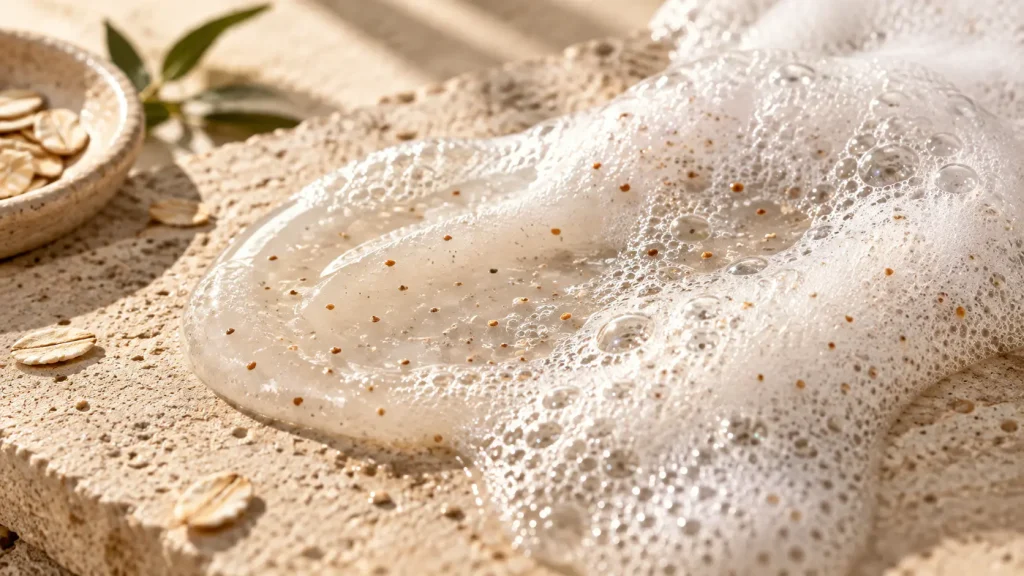
An exfoliating cleanser integrates cleansing and exfoliation-oriented care into one rinse-off step.
This can support brands focused on:
- Streamlined routines
- Oily or combination-skin positioning
- Texture-care concepts
- Pore-focused cleansing
- Skincare-inspired daily cleansing
- Convenient routine entry
But the product still needs to succeed first as a cleanser.
That means balancing:
Cleansing System + Exfoliation Strategy + Skin Comfort
Exfoliating Cleanser Development Considerations
- Surfactant system
- Exfoliation strategy
- pH where relevant
- Foam
- Rinse feel
- Tightness perception
- Viscosity
- Skin comfort
- Packaging
- Stability
More exfoliating ingredients do not automatically create a better cleanser.
9. Rinse-Off Exfoliation Is Different From Leave-On Exfoliation
An exfoliating cleanser creates a very different exposure pattern from an exfoliating toner, serum, lotion, or treatment mask.
A rinse-off product stays in contact with the skin for a comparatively limited period before being removed.
That means formulation development should consider:
- Ingredient type
- Ingredient level
- pH where relevant
- Surfactant system
- Contact time
- Directions for use
- Consumer tolerance
- Frequency
The same active percentage should not automatically be expected to perform identically in a rinse-off cleanser and a leave-on serum.
Finished-product format matters.
10. AHA, BHA, PHA, Enzyme & Physical Exfoliation Create Different Development Directions
AHA-Based Concepts
Alpha hydroxy acid concepts can use ingredients such as glycolic or lactic acid depending on the formula and market.
Development should consider:
- Acid type
- Concentration
- Final formula pH
- Other ingredients
- Application format
- Usage frequency
- Target-market labeling
The ingredient name alone does not determine the intensity of the finished product.
BHA-Based Concepts
Salicylic acid is commonly associated with BHA skincare concepts.
Depending on market, intended use, concentration, and claims, regulatory requirements should be reviewed early in development.
PHA-Based Concepts
PHA-containing formulas can support another exfoliation-oriented direction depending on the desired formula and consumer experience.
As with other acids, the complete formulation matters more than the marketing abbreviation alone.
Enzyme-Oriented Concepts
Enzyme-related ingredients can support product stories around:
- Periodic refinement
- Smoothing
- Gentle-feeling treatment concepts
- Radiance-oriented positioning
However:
Enzyme ingredient present ≠ automatically proven enzymatic exfoliation in the finished product.
Compatibility, activity, formula environment, processing, stability, and finished-product evidence still matter.
Physical Exfoliation
Physical exfoliation uses mechanical action during application.
Development considerations can include:
- Particle material
- Particle size and shape
- Concentration
- Distribution
- Suspension
- Massage behavior
- Skin feel
- Rinsability
- Target-market requirements
Combination Systems
Some products combine multiple strategies.
For example:
AHA + BHA + PHA
or:
Acid + Enzyme + Physical / Massage Action
But:
More mechanisms ≠ automatically better performance.
Each mechanism adds formulation, sensory, stability, usage, and claims considerations.
11. Physical Exfoliating Materials Need Market Review Too
Physical exfoliation is not only a sensory decision.
The material itself can also be subject to market-specific requirements.
Brands should review:
- Particle composition
- Biodegradability where relevant
- Rinse-off status
- Environmental requirements
- Target-market restrictions
This should happen before the product formula and packaging are finalized.
12. Usage Frequency Should Be Defined Before Formula Development
A daily-use cleanser and a periodic treatment should not automatically use the same formulation intensity.
Before development, decide whether the product is intended for:
Routine Cleansing
Periodic Refinement
or
Weekly / Intensive Treatment
Frequency can influence:
- Ingredient system
- Use level
- Formula pH
- Sensory targets
- Directions for use
- Packaging size
- Claims
- Consumer education
The final instructions should follow the actual finished formula.
“Exfoliating” does not automatically mean “daily use.”
13. AHA Products Need Additional Labeling Consideration
Brands developing AHA-containing skincare for the United States should consider applicable FDA guidance regarding increased sun sensitivity.
This is another reason the ingredient system and target market should be defined early.
An AHA formula cannot be evaluated only through:
“What concentration should we use?”
Development also needs to consider:
- Acid type
- Concentration
- Final pH
- Complete formulation
- Directions
- Warnings
- Packaging
- Target market
14. Claims Should Match the Finished Product
Exfoliation is a category where brands can easily move from an ingredient story to an unsupported finished-product claim.
For example:
AHA/BHA present
does not automatically mean:
“clinically reduces pores.”
Likewise:
Enzyme ingredient present
does not automatically establish:
“proven brightening.”
Claims should reflect:
- Finished formula
- Ingredient level
- Product format
- Usage directions
- Testing
- Supporting evidence
- Target-market requirements
Cosmetic positioning can focus on areas such as:
- Smoother-looking skin
- Refined-looking texture
- Removal of surface buildup
- Oil-control-oriented care
- Pore-cleansing routines
- Improved skin feel
Therapeutic claims need additional regulatory review.
15. Sensory Experience Matters Especially in Exfoliating Skincare
Exfoliation is often marketed through ingredients and performance.
But consumers also experience:
- Tightness
- Dryness perception
- Smoothness
- Cooling
- Stickiness
- Residue
- Massage friction
- Rinse feel
- Comfort
A clay mask may feel excessively tight.
A peeling gel may create too much residue or friction.
An exfoliating cleanser may leave skin feeling overly stripped.
Even a sophisticated active-ingredient story can fail commercially if the product is unpleasant to use.
Performance positioning attracts attention. Sensory experience influences repeat use.
16. Packaging Should Follow Texture & Usage
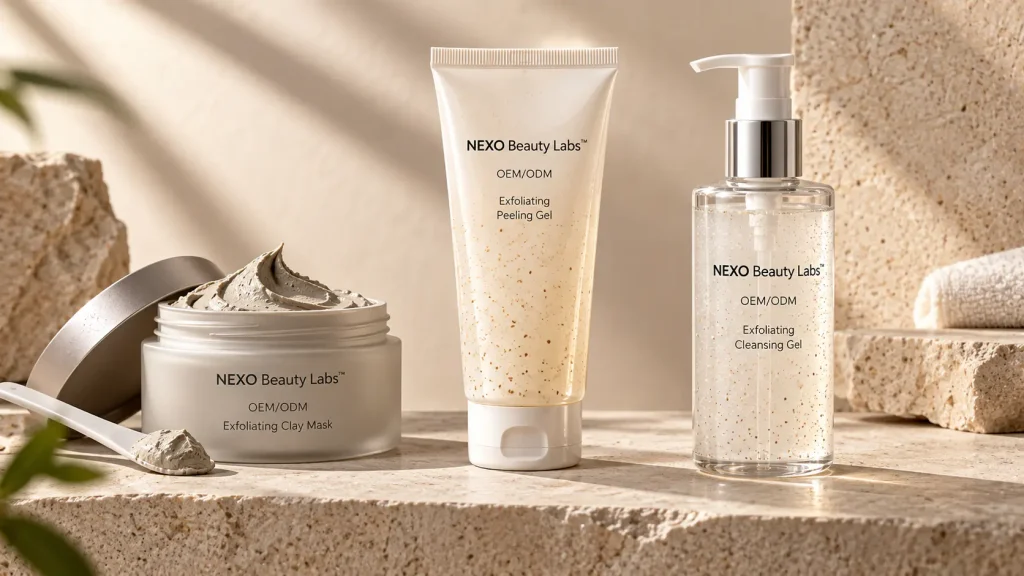
Clay Mask Packaging
Common directions include:
- Jar
- Tube
A spatula or other applicator can also be considered depending on the product concept.
Peeling Gel Packaging
Common options include:
- Tube
- Pump
The dispensing system should support a repeatable dose suitable for massage application.
Exfoliating Cleanser Packaging
Possible formats include:
- Pump
- Tube
- Bottle
The final package should consider:
- Viscosity
- Dose
- Filling
- Dispensing
- Leakage
- Formula-package compatibility
- Consumer handling
- Product protection
For more detail, see How to Choose Cosmetic Packaging for Skincare & Beauty Products.
17. Stability Questions Differ by Format
Clay Mask
Evaluation may include:
- Viscosity
- Clay suspension
- Separation
- Appearance
- Dry-down behavior
- Color
- Odor
- Packaging interaction
Peeling Gel
Evaluation may include:
- Gel structure
- Rub-off performance
- Viscosity
- Appearance
- Color
- Odor
- Residue
Exfoliating Cleanser
Evaluation may include:
- pH where relevant
- Surfactant compatibility
- Active compatibility
- Viscosity
- Particle suspension where applicable
- Appearance
- Packaging interaction
A sophisticated ingredient story is useful only if the finished formulation remains stable throughout its intended commercial life.
For more detail, see Cosmetic Stability Testing: What Beauty Brands Need to Know.
18. Manufacturing Requirements Change by Format
Clay Mask Manufacturing
Depending on the formula, production may involve:
- Clay or powder wetting
- Powder dispersion
- Mixing
- Homogenization
- Viscosity management
- Deaeration where appropriate
- High-viscosity filling
Peeling Gel Manufacturing
Production may involve:
- Gel-system development
- Controlled polymer hydration
- Ingredient incorporation
- Viscosity control
- Rub-off performance consistency
- Controlled filling
Exfoliating Cleanser Manufacturing
Production may involve:
- Surfactant processing
- Foam control
- Active incorporation
- Particle dispersion where applicable
- pH adjustment where relevant
- Viscosity adjustment
- Commercial filling
The key manufacturing question is:
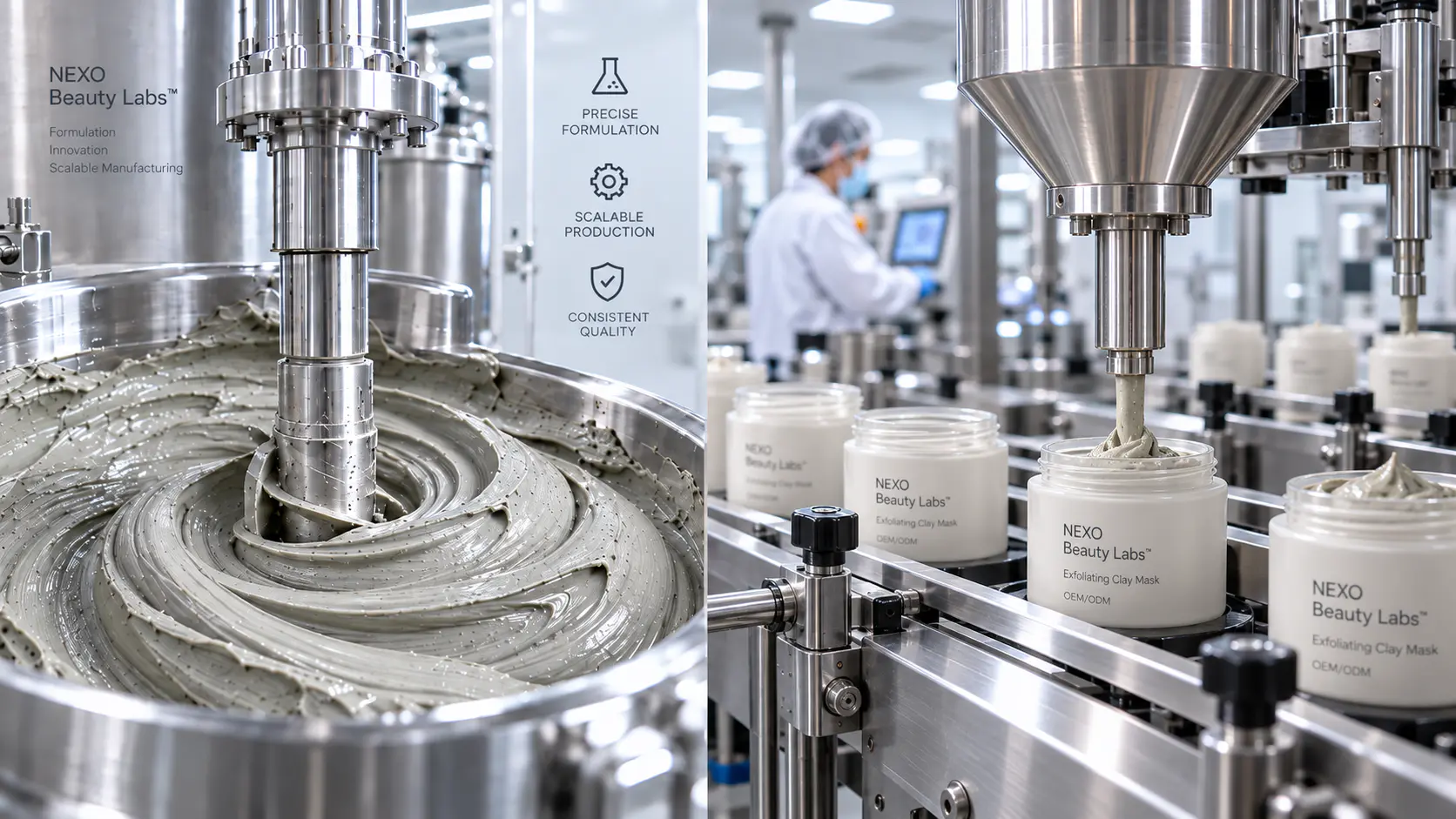
Can the approved laboratory experience be reproduced consistently at commercial scale?
19. How Do These Formats Affect MOQ & Cost?
Format can also change the commercial structure of the project.
MOQ and cost may be influenced by:
- Formula batch size
- Specialty acids or active ingredients
- Clay and powder sourcing
- Enzyme systems
- Physical exfoliating materials
- Packaging
- Jar, tube, or pump supplier minimums
- Custom decoration
- Filling requirements
- Testing
A stock-formula peeling gel in a standard tube can create a very different MOQ structure from a customized multi-acid clay mask in a premium jar.
There is no universal rule that one format always has the lowest MOQ.
For more detail, see Cosmetic MOQ Explained: What Determines Minimum Order Quantity?.
20. Private Label, ODM & Custom Exfoliating Skincare Development
Private Label
A private label project can begin with an existing manufacturer-developed clay mask, peeling gel, or exfoliating cleanser.
This can reduce original formulation-development work while allowing branding, packaging, and available customization.
Customized ODM
An ODM project can adapt an existing formulation platform through selected changes such as:
- Exfoliating ingredients
- Clay system
- Botanical ingredients
- Texture
- Color
- Fragrance
- Packaging
Custom OEM Formulation
A custom project can be built around:
- Target consumer
- Skin concern
- Usage frequency
- Exfoliation mechanism
- Formula intensity
- Sensory profile
- Packaging
- Claims strategy
- Target market
The development route should depend on how much true formula and product differentiation the brand needs.
21. Can One Brand Develop Multiple Exfoliating Formats?
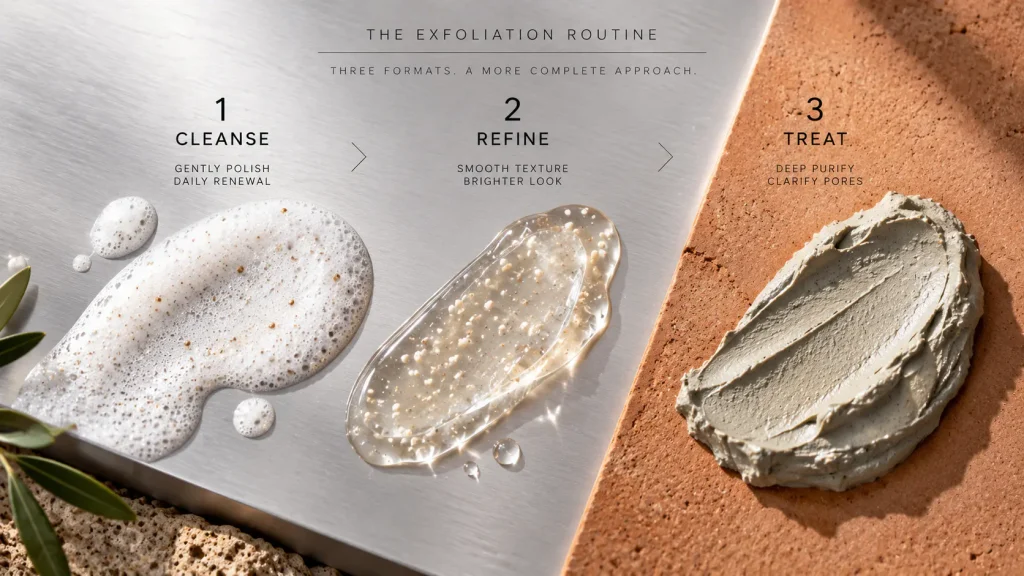
Yes.
The three formats can play different roles in one skincare portfolio.
Exfoliating Cleanser
Routine entry
↓
Peeling Gel
Periodic surface refinement
↓
Clay Mask
Weekly pore / oil-care treatment
This creates a natural:
Cleanse → Refine → Treat
portfolio structure.
The products do not need to compete if each one has a clearly defined use frequency and consumer role.
Which Exfoliating Format Should Your Brand Develop?
Choose Clay Mask If Your Priority Is:
- Weekly treatment positioning
- Pore-care routines
- Oil-control-oriented positioning
- Spa-like ritual
- High treatment identity
- Clay or mineral ingredient storytelling
Choose Peeling Gel If Your Priority Is:
- Interactive massage ritual
- Periodic surface refinement
- Tactile feedback
- Lightweight treatment
- Radiance-oriented positioning
Choose Exfoliating Cleanser If Your Priority Is:
- Routine integration
- Streamlined skincare
- Cleansing + texture-care positioning
- Oily or combination-skin routines
- Convenient category entry
A stronger development sequence is:
Target Consumer
↓
Skin Concern
↓
Usage Frequency
↓
Exfoliation Strategy
↓
Sensory Target
↓
Formula Architecture
↓
Packaging
↓
Final Product Format
Frequently Asked Questions
Is a clay mask better than a peeling gel?
Neither is automatically better. Clay masks usually support a more treatment-oriented pore and oil-care ritual, while peeling gels create an interactive massage-based surface-refinement experience. The better choice depends on the consumer and routine role.
Is clay mask the same as exfoliation?
No. Clay mask describes a product format. A clay formula may provide cleansing and oil-absorbing benefits without using a dedicated chemical or physical exfoliation system. Exfoliating clay masks add a separate exfoliation strategy.
What is the difference between peeling gel and exfoliating cleanser?
Peeling gel is generally used as a separate massage-and-rinse treatment. An exfoliating cleanser integrates exfoliation-oriented ingredients or mechanisms into a conventional cleansing step.
Are the white rolls from peeling gel all dead skin?
No. In many peeling gels, a substantial part of the visible material comes from formula polymers or fibers aggregating during rubbing. These clumps may also pick up loose surface cells, oil, and debris.
Is peeling gel the same as a chemical peel?
No. Peeling gels usually create a gommage or rub-off experience. Chemical peels rely more directly on acid-based exfoliation under defined formula and exposure conditions.
Can a clay mask contain AHA, BHA or PHA?
Potentially. The appropriate system depends on ingredient compatibility, formula pH, use level, intended frequency, consumer, claims and target-market requirements.
Can enzyme ingredients be used in peeling gels?
Yes, depending on the formulation concept. However, simply including an enzyme ingredient does not automatically prove a specific exfoliating or brightening result in the finished product.
Is an exfoliating cleanser suitable for daily use?
It depends on the actual exfoliation strategy, formulation, concentration, pH where relevant, target consumer and directions for use. Daily use should not be assumed from the category name.
Does AHA concentration alone determine exfoliation strength?
No. Acid type, concentration, final product pH, complete formulation, application format, contact time and usage frequency all influence the finished-product experience.
Do AHA products need a sun warning?
For products intended for the United States, brands should review current FDA guidance relating to AHA-containing topical cosmetics and increased sun sensitivity when preparing product labeling.
Can an exfoliating product claim to shrink pores?
The presence of exfoliating ingredients does not automatically support a proven pore-reduction claim. Claims should reflect the finished formula, intended cosmetic effect, available substantiation and target-market rules.
Can physical exfoliating particles be used in rinse-off skincare?
Potentially, but particle material and target-market requirements need to be reviewed. Physical exfoliating materials should not be selected only for their sensory effect.
Does exfoliating skincare require stability testing?
Yes. Relevant characteristics can include pH where appropriate, viscosity, appearance, suspension, active compatibility, rub-off behavior, texture and packaging interaction depending on the format.
Can one skincare brand offer several exfoliating products?
Yes. Different products can serve routine cleansing, periodic refinement and more intensive treatment if their roles and usage frequencies are clearly differentiated.
Which exfoliating skincare format has the lowest MOQ?
There is no universal answer. MOQ depends on formula batch size, active ingredients, clay or enzyme systems, packaging, decoration, filling requirements, testing and supplier minimums.
Develop the Exfoliation Strategy Before the Format
A strong exfoliating product should not begin with:
“Which acid should we add?”
or:
“Should we make a clay mask?”
It should begin with:
Who is the consumer?
What concern should the product address cosmetically?
What role should it play in the routine?
How frequently should it be used?
How should the treatment feel?
Once those decisions are clear, the exfoliation mechanism, formula architecture, texture, packaging, claims strategy, and product format become much easier to define.
At NEXO Beauty Labs, exfoliating skincare development can be approached across private label, ODM, and custom OEM pathways together with formulation, active systems, sensory design, packaging, stability evaluation, product testing, scale-up, and commercial manufacturing.
Whether you are developing a pore-care clay mask, enzyme-oriented peeling gel, or exfoliating cleanser, the strongest format is the one that supports the consumer routine and skincare strategy your brand is actually trying to build.
Request an Exfoliating Skincare OEM/ODM Consultation with NEXO Beauty Labs to discuss your clay mask, peeling gel, exfoliating cleanser, active strategy, packaging, MOQ, testing, and manufacturing requirements.