Cosmetic MOQ Explained: What Beauty Brands Should Know Before Manufacturing
Learn what affects cosmetic manufacturing MOQ, including formula customization, packaging, product format, component sourcing and production requirements.
MOQ stands for Minimum Order Quantity — the smallest quantity a manufacturer or supplier can practically support for a specific production project.
But in cosmetic manufacturing, MOQ is rarely one universal factory number.
The final order quantity can be influenced by formula batch size, raw materials, packaging, decoration, filling equipment, secondary packaging, product format, and manufacturing setup.
This means a manufacturer may technically be able to produce one quantity of bulk formula while the bottle supplier, pump supplier, carton printer, or specialty ingredient supplier requires a completely different minimum.
For beauty brands, understanding what actually determines cosmetic MOQ can help reduce unnecessary inventory, protect cash flow, choose packaging more strategically, and build a more realistic launch plan.
Quick Answer: What Determines Cosmetic MOQ?
The practical MOQ for a finished cosmetic product is usually determined by the highest minimum requirement among all the components needed to manufacture it.
For example, a project may involve:
- Formula production minimum
- Raw material purchasing minimum
- Bottle or jar minimum
- Pump, dropper, or closure minimum
- Printing or decoration minimum
- Carton minimum
- Specialized filling or manufacturing minimum
If the factory can produce 1,000 units of formula but the selected decorated bottle requires 3,000 units, the packaging may become the binding MOQ for the project.
That is why the better question is not:
“What is your factory MOQ?”
It is:
“What determines the minimum order quantity for this complete product specification?”
What Is a Binding MOQ?
A cosmetic project can contain several different minimum order quantities at the same time.
The binding MOQ is effectively whichever of these requirements becomes the limiting factor for the complete finished product.
1. Formula Batch Size Can Affect Cosmetic MOQ
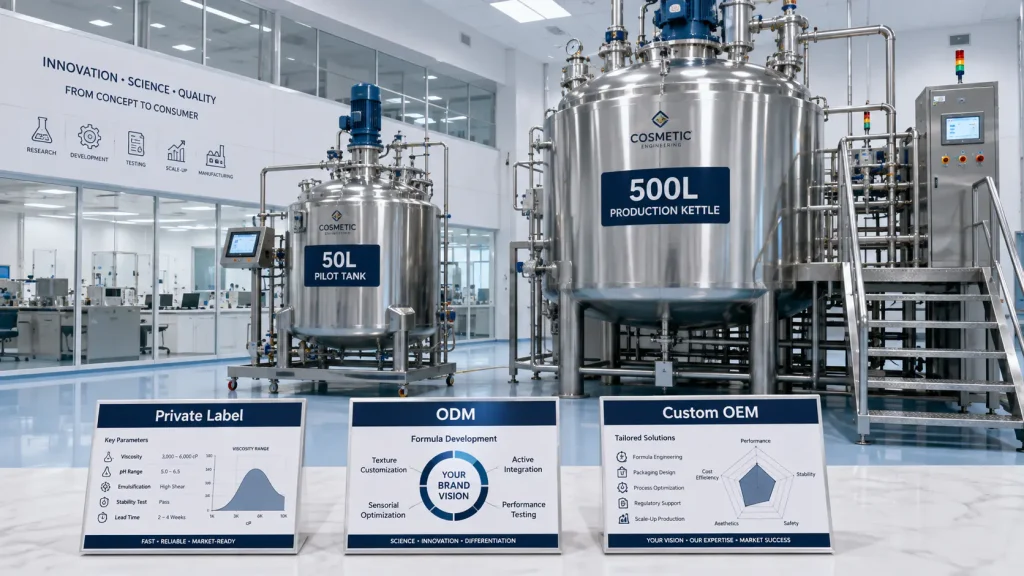
Cosmetic manufacturing equipment operates within practical production ranges.
Depending on the product, manufacturing may involve:
- Mixing
- Emulsification
- Homogenization
- Heating
- Cooling
- Ingredient dispersion
Producing far below the practical working range of the equipment may reduce efficiency or make process control more difficult.
This is one reason different product categories may have different minimum batch requirements.
A serum, rich cream, shampoo, cleansing oil, clay mask, hair oil, or sunscreen stick does not necessarily use the same manufacturing process or equipment.
Formula MOQ is therefore connected to how the formula is produced, not simply how many bottles the brand would prefer to order.
2. Raw Material Minimums Can Become a Hidden MOQ
Ingredients can create another minimum that founders sometimes overlook.
Raw material suppliers may have their own purchasing quantities, particularly for:
- Specialty active ingredients
- Imported botanical extracts
- Custom ingredient blends
- Specialized fragrance systems
- Biotech ingredients
- Less commonly stocked materials
If the required supplier pack size is much larger than the quantity needed for one small batch, the project may need to absorb additional raw material cost or reconsider the formula.
This doesn’t automatically mean the finished-product MOQ must increase.
But it can affect:
- Raw material investment
- Cost per unit
- Inventory planning
- Future reorder strategy
Brands developing custom formulas should therefore ask whether any ingredients create purchasing minimums that are significantly larger than the planned first production run.
3. Formula Customization Can Affect MOQ
The amount of customization also influences production planning.
Existing / Mature Formulas
Using an established formula means the manufacturer already understands important manufacturing characteristics such as:
- Raw material requirements
- Processing parameters
- Texture expectations
- Batch process
- Filling conditions
This can make production planning more predictable.
Customized ODM Formulas
An existing formulation platform may be adapted through changes involving:
- Hero ingredients
- Selected active ingredients
- Fragrance
- Color
- Texture
- Sensory profile
These changes can introduce new raw material, testing, or production considerations.
Fully Custom Formulation
A custom formulation may involve:
- Specialty ingredients
- New ingredient combinations
- Custom textures
- Specialized processing
- New raw material sourcing
- Additional development and testing
A custom formula does not automatically mean a very high MOQ.
But the more customized the project becomes, the more variables can influence the lowest practical production quantity.
4. Packaging Often Determines the Real MOQ
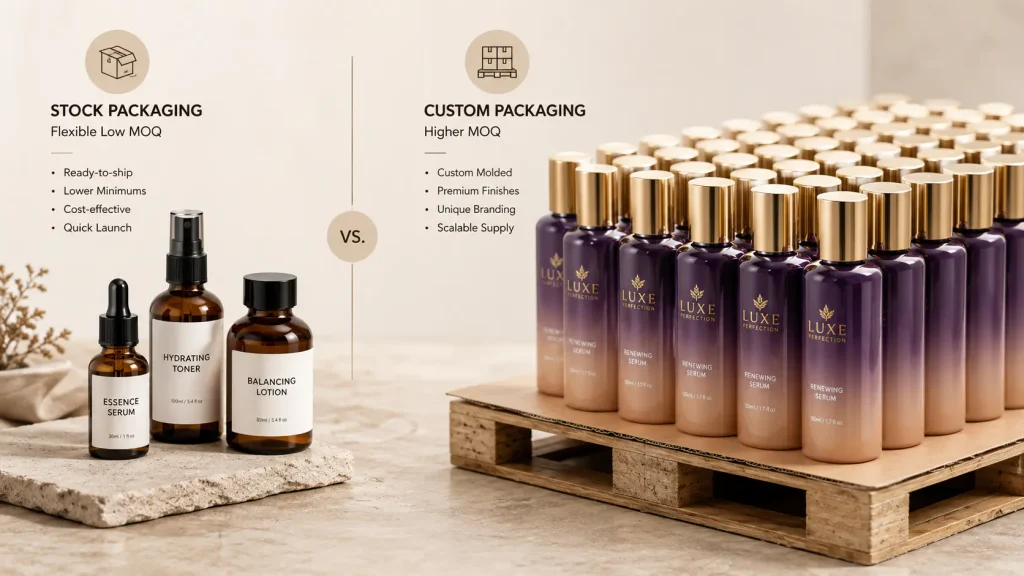
Packaging is one of the most common reasons the final order quantity becomes larger than expected.
A manufacturer may be able to produce a relatively small batch of formula, while the packaging supply chain requires larger quantities of:
- Bottles
- Jars
- Tubes
- Pumps
- Droppers
- Caps
- Applicators
- Labels
- Cartons
Stock Packaging
Stock packaging uses existing structures and molds.
It often provides more flexibility because the supplier is not creating a dedicated packaging structure specifically for one brand.
Brands can still differentiate stock packaging through:
- Labels
- Screen printing
- Hot stamping
- Coatings
- Color
- Outer cartons
Custom Packaging
Custom packaging may involve:
- New molds
- Proprietary shapes
- Custom pumps or closures
- Dedicated color production
- Complex printing
- Spraying or coating
- Metallization
- Specialized structures
Each component or finishing process can have a separate production minimum.
Packaging MOQ can therefore be higher than formula MOQ.
For emerging brands, this is one of the most important distinctions to clarify before final packaging is selected.
Related Guide: If packaging is becoming the binding MOQ for your project, the next step is evaluating which bottle, jar, tube, pump, material, decoration, or stock packaging option best fits the formula and launch strategy. See our Guide to Choosing Cosmetic Packaging →
5. Decoration & Secondary Packaging Can Create Separate MOQs
Even when the bottle itself is available at a manageable quantity, customization may introduce new minimums.
These can come from:
- Screen printing
- Hot stamping
- Custom spray colors
- Frosted or coated finishes
- Metallization
- Labels
- Printed cartons
- Inserts
- Sleeves
For example, the plain component may be available from stock while a specific decoration process requires the supplier to prepare a dedicated production setup.
Brands should therefore request the MOQ for the finished decorated packaging system, not only the undecorated bottle.
6. Different Cosmetic Formats Have Different MOQ Considerations
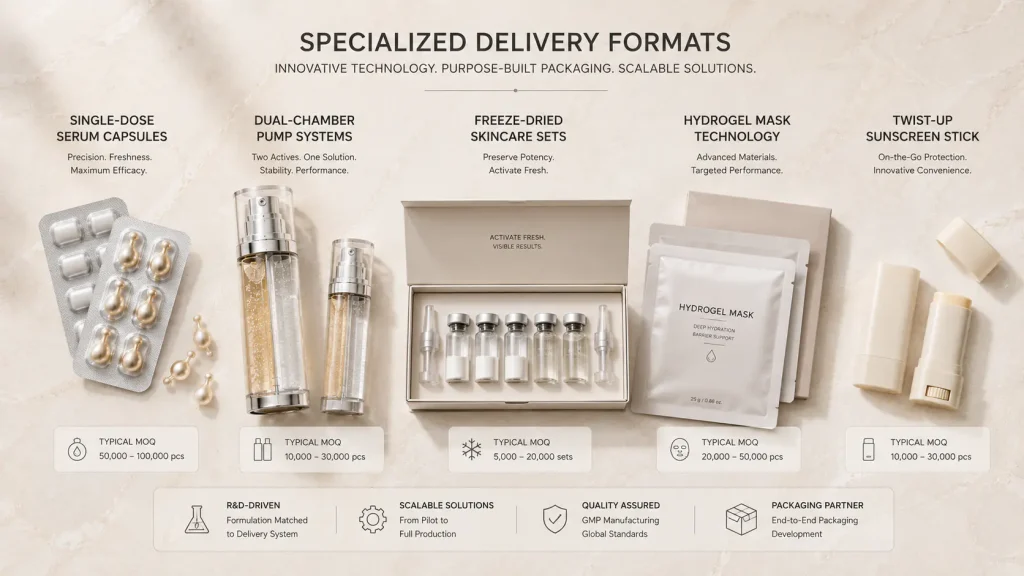
A specialized product can therefore have a higher MOQ because of its manufacturing or packaging system even when the formula itself is not unusually complex.
7. Is Cosmetic MOQ Usually Per SKU?
In many manufacturing projects, MOQ is quoted per SKU, formula, shade, fragrance, size, or packaging configuration rather than across the brand’s complete order.
For example, changing any of the following may create a separate production requirement:
- Formula
- Fragrance
- Shade or color
- Package size
- Package type
- Decoration
That means ordering three different products does not necessarily allow their quantities to be combined into one MOQ.
However, some components may potentially be shared across SKUs — for example, the same bottle, pump, or carton structure — depending on the manufacturer’s and supplier’s production setup.
Brands planning multiple products should therefore ask:
“Which minimums apply per SKU, and which components can be shared across the collection?”
8. Does Private Label Usually Have a Lower MOQ?
Often, but not always.
Private label commonly begins with an established formula and existing manufacturing process.
This can reduce some of the development complexity associated with:
- Original formulation work
- Raw material sourcing
- Process development
- Production setup
This is one reason private label can be attractive to newer beauty brands.
But packaging can still become the limiting factor.
A mature private label formula placed inside highly customized packaging may have a significantly different commercial minimum from the same formula in an available stock package.
Private Label Formula ≠ Automatically Low Total MOQ
The whole finished product specification needs to be evaluated.
9. What Does Low-MOQ Cosmetic Manufacturing Actually Mean?
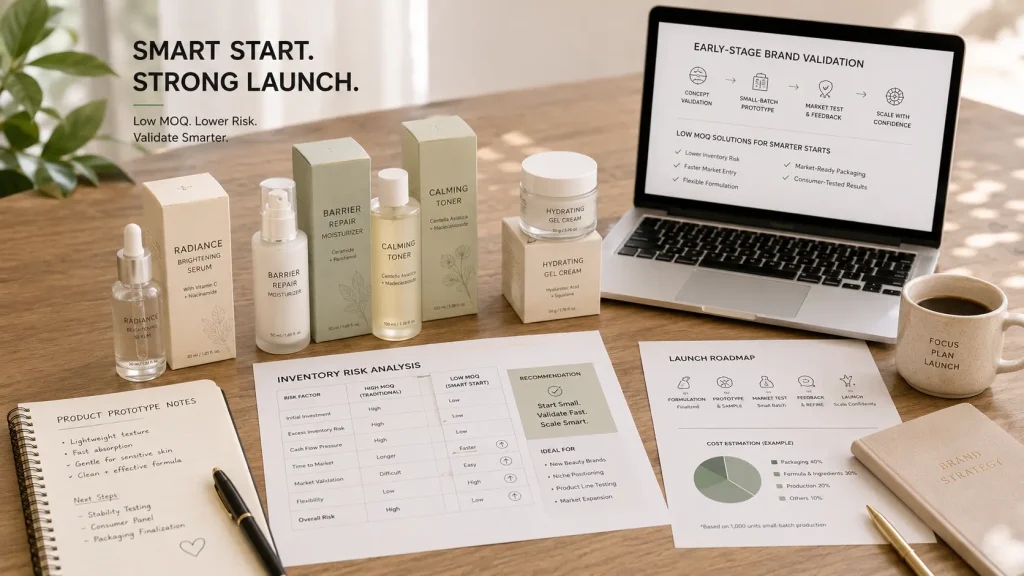
“Low MOQ” is a relative term.
It should be understood in the context of:
- Product category
- Formula
- Manufacturing process
- Packaging
- Customization
- Supplier structure
A low-MOQ route can be useful for:
- First product launches
- Market validation
- Emerging brands
- Seasonal products
- Testing a new category
- Reducing initial inventory exposure
But lower quantities can create trade-offs:
- Higher cost per unit
- More reliance on stock packaging
- Fewer custom component choices
- More limited decoration options
- Less manufacturing efficiency
- Reduced formula or packaging customization in some programs
The objective should not be to find the smallest possible number at any cost.
The better question is:
“What is the lowest practical MOQ that still allows us to create the product we actually want?”
10. How Can a Beauty Brand Reduce MOQ?
MOQ can sometimes be reduced by simplifying the project rather than negotiating only on the factory’s production quantity.
1. Use an Existing Formula
A mature private label or ODM platform can reduce the need for dedicated formula development and new raw material sourcing.
2. Choose Stock Packaging
Using an existing bottle, jar, tube, or pump can avoid the minimums associated with new molds or dedicated component manufacturing.
3. Simplify Decoration
A label or simpler printing process may support a smaller initial launch more easily than multiple coatings, metallic finishes, or highly customized decoration.
4. Launch Fewer SKUs
Instead of dividing your initial investment across six products, one or two stronger hero products may allow you to meet practical production quantities without creating excessive total inventory.
5. Standardize Packaging Across the Collection
Using the same bottle or component family across several products can simplify sourcing and future replenishment where the formulas and dispensing requirements allow it.
6. Avoid Unnecessary Specialty Ingredients
If a specialty active creates a large raw material minimum but contributes little to the product’s positioning, the formulation team may be able to consider a more practical alternative.
7. Build Customization in Stages
A brand can launch with stock packaging and a strong formula, validate demand, then introduce custom molds, advanced decoration, or more specialized formats once sales support the additional investment.
Reducing MOQ should not mean compromising product quality.
The goal is to remove complexity that does not create enough commercial value during the initial launch stage.
11. MOQ, Unit Cost & Total Investment Are Connected
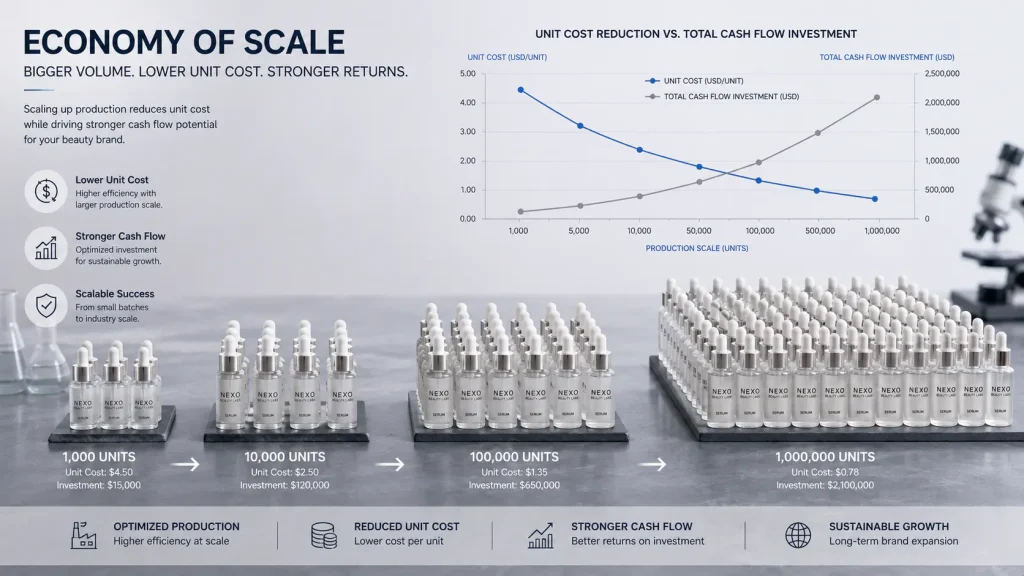
MOQ should never be evaluated by itself.
Manufacturing contains fixed or semi-fixed setup work such as:
- Production preparation
- Formula batching
- Filling setup
- Cleaning and changeover
- Quality control
- Packaging preparation
- Printing setup
When those costs are divided across a very small number of units, the cost per unit can be higher.
Larger production volumes can improve some manufacturing efficiencies.
But ordering more only to achieve a lower unit price introduces another risk:
unsold inventory.
The right MOQ should balance:
Unit Cost + Cash Flow + Inventory Risk + Expected Sales
Brands should also evaluate total project investment, including:
- Formula development
- Samples
- Testing
- Primary packaging
- Decoration
- Labels
- Cartons
- Tooling or molds
- Shipping
- Target-market preparation
Related Guide: MOQ is only one part of the investment required to launch a beauty product. For a broader breakdown of formulation, samples, testing, packaging, decoration, manufacturing, logistics, and other launch costs, see How Much Does It Cost to Launch a Beauty Product? →
12. MOQ Can Affect Product Development Timeline
MOQ decisions are closely connected with sourcing and lead time.
Projects involving:
- Custom molds
- Specialty pumps
- Imported ingredients
- Custom colors
- Complex decoration
- Specialized packaging
- Dedicated components
may require more preparation before commercial production begins.
A product using an available formula and stock package can often move differently from one requiring a custom mold and several specialized component processes.
If launch timing matters, MOQ, customization, sourcing, and packaging lead time should be considered together.
Related Guide: MOQ decisions can affect sourcing, packaging lead times, production preparation, and the overall launch schedule. To see how formulation, sampling, testing, packaging, scale-up, and manufacturing fit together over time, read our Cosmetic Product Development Timeline Guide →
13. What Happens to MOQ When You Reorder?
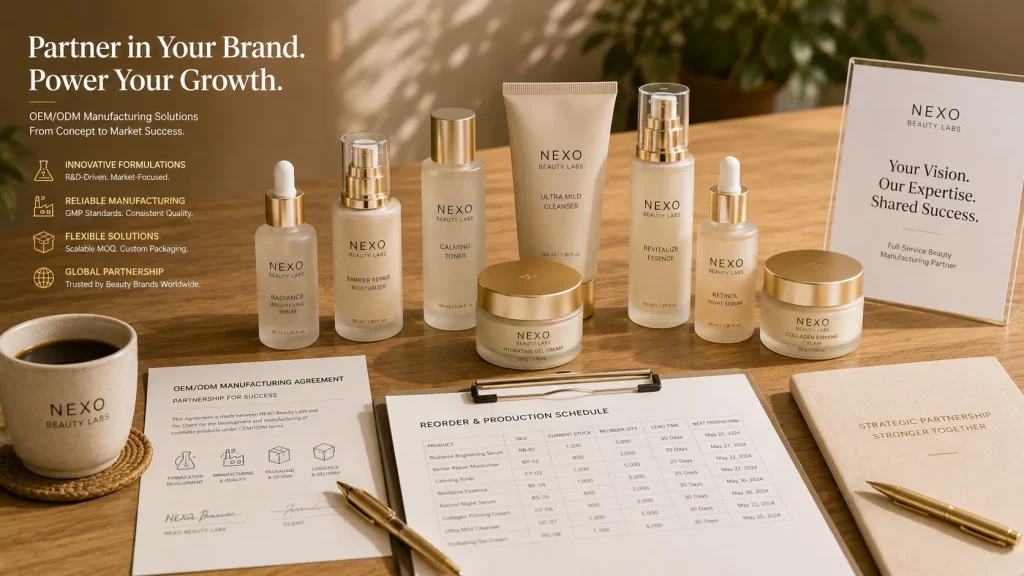
MOQ planning should not stop with the first production run.
Reorder requirements can differ because some project setup has already been completed, while other minimums remain unchanged.
Ask:
- Will the formula MOQ remain the same?
- Will the packaging MOQ remain the same?
- Can unused packaging components be carried into a future run?
- Will the same bottle, pump, or carton remain available?
- Do specialty ingredients have long replenishment lead times?
- How early should the next production run be scheduled?
- Can production quantities increase as sales become more predictable?
A successful initial product should ideally create a manufacturing system that can be repeated efficiently.
As a brand grows, reorder reliability becomes increasingly important because inventory availability directly affects sales and customer experience.
Questions Beauty Brands Should Ask About MOQ
Before approving a cosmetic manufacturing project, ask:
- What is the MOQ for this specific SKU?
- What is actually driving that MOQ?
- What is the formula production minimum?
- Are any specialty ingredients creating a separate minimum?
- What is the MOQ for the bottle or jar?
- Does the pump, dropper, cap, or applicator have a separate minimum?
- Does decoration have its own MOQ?
- What is the carton MOQ?
- Can the same packaging be shared across several SKUs?
- Does custom formulation change the minimum?
- Can stock packaging reduce the project MOQ?
- How does quantity affect unit cost?
- What happens to unused packaging?
- What are the reorder minimums?
- Does the product require specialized manufacturing or filling equipment?
- Could MOQ or packaging affect the launch timeline?
These questions provide much more useful information than simply comparing which supplier advertises the smallest MOQ.
Choosing the Right MOQ for Your Beauty Brand
The right cosmetic MOQ depends on the brand’s stage, product strategy, packaging, expected sales, available cash, and tolerance for inventory risk.
For New Beauty Brands
Early-stage brands may benefit from prioritizing:
- Cash-flow protection
- Market validation
- Inventory flexibility
- Fewer hero products
- Stock or semi-custom packaging
- Ability to reorder quickly
At this stage, achieving the absolute lowest unit price may be less important than avoiding excessive unsold inventory.
For Growing Beauty Brands
As demand becomes more predictable, priorities can shift toward:
- Lower unit cost
- Production efficiency
- Reliable replenishment
- Consistent component supply
- Inventory forecasting
- Custom packaging
- Larger production runs
MOQ strategy should evolve with the brand rather than remain fixed forever.
Frequently Asked Questions
What does MOQ mean in cosmetic manufacturing?
MOQ means Minimum Order Quantity — the smallest production or purchasing quantity a manufacturer or supplier can practically support for a specific project.
Why do cosmetic manufacturers have MOQs?
MOQs reflect production and supply-chain requirements such as formula batch size, equipment setup, raw material purchasing, filling efficiency, packaging supplier minimums, decoration, and production cost.
What is a typical cosmetic MOQ?
There is no single industry-wide cosmetic MOQ. Minimum quantities can vary substantially by manufacturer, product category, formula, packaging, level of customization, and production model. A project-specific quotation is more useful than relying on one generic number.
Is MOQ usually per SKU?
Often, yes. Different formulas, shades, fragrances, package sizes, or product configurations may each have separate minimums. Confirm which requirements apply per SKU and whether any packaging components can be shared across products.
Does custom formulation require a higher MOQ?
Not automatically. Custom ingredients, raw material purchasing, batch size, processing, and packaging can influence the minimum, but the final MOQ depends on the complete project.
Does private label have a lower MOQ?
It can, because the formula and production process are already established. However, custom packaging or decoration can still create a higher overall minimum.
Does packaging affect cosmetic MOQ?
Yes, often significantly. Bottles, pumps, jars, tubes, caps, applicators, labels, cartons, colors, printing, and other decoration processes can all have supplier minimums separate from formula production.
Is packaging MOQ the same as formula MOQ?
Not necessarily. The formula may be manufacturable at one quantity while the packaging supplier requires another. The practical finished-product MOQ needs to consider both.
What is considered low MOQ cosmetics manufacturing?
“Low MOQ” is relative to the product and production system. The useful question is whether the minimum is low enough to manage inventory risk while still supporting the formula, packaging, quality, and customization the brand requires.
Is the lowest MOQ always better?
No. A very low MOQ may come with higher unit cost, limited packaging, reduced customization, or other restrictions. The best quantity balances cash flow, expected sales, product requirements, and manufacturing efficiency.
How can I reduce cosmetic MOQ?
Possible strategies include using an existing formula, choosing stock packaging, simplifying decoration, reducing the number of launch SKUs, standardizing components across a product line, and introducing more custom packaging after demand is validated.
Can reorder MOQ be lower than the first order?
Sometimes, depending on the manufacturer, formula, packaging inventory, and supplier requirements. Other projects may retain the same minimums. Confirm both first-order and reorder requirements before launch.
Plan MOQ Around the Whole Product
Cosmetic MOQ should not be treated as one isolated factory number.
It is usually shaped by several interconnected parts of the product:
Formula + Raw Materials + Packaging + Decoration + Product Format + Filling + Manufacturing
Understanding which part of the project is actually driving the minimum allows beauty brands to make better decisions about formulation, packaging, customization, cash flow, and inventory.
At NEXO Beauty Labs, MOQ is considered alongside formula development, packaging, product format, and manufacturing requirements.
Whether you’re starting with an existing private label formula, developing a customized ODM product, or building a more differentiated OEM formulation, the most useful MOQ is the one that supports both the product you want to create and the stage your brand is currently in.
Request a Cosmetic MOQ & OEM/ODM Consultation with NEXO Beauty Labs to discuss your formula, packaging, customization, target quantity, budget, and launch requirements.