
How to Choose Cosmetic Packaging for Skincare: A Guide for Beauty Brands
Learn how to choose cosmetic packaging based on formula compatibility, viscosity, dispensing system, product format, brand positioning and manufacturing requirements.
Cosmetic packaging is not simply the container you choose after a formula is finished.
It affects how a product is filled, protected, stored, dispensed, transported, used, and perceived by consumers.
A beautiful bottle can still be the wrong choice if the formula is too viscous for the pump, the packaging materials interact poorly with the product, the applicator delivers an inconsistent dose, or the package cannot move efficiently through commercial filling and assembly.
For beauty brands, the better approach is to develop the formula and packaging as one complete product system.
This cosmetic packaging guide explains how to choose the right packaging based on formula type, viscosity, dispensing, materials, compatibility, manufacturing, MOQ, cost, sustainability, and brand positioning.
Quick Answer: How Do You Choose Cosmetic Packaging?
A practical cosmetic packaging decision usually follows this order:
- Understand the formula. Start with texture, viscosity, ingredient system, and product sensitivity.
- Choose the dispensing experience. Decide whether the product needs a pump, dropper, tube, jar, spray, airless system, capsule, or another format.
- Select suitable packaging materials. Consider formula compatibility, product protection, weight, appearance, and logistics.
- Evaluate the actual formula-package combination. Do not assume a material is suitable simply because it worked for another product.
- Confirm filling and production feasibility. Packaging needs to work on the manufacturing line as well as in the consumer’s hand.
- Compare MOQ, cost, and lead time. Stock, semi-custom, and fully custom packaging create very different commercial requirements.
- Then finalize decoration and branding. Visual design should strengthen a package that already works technically.
In simple terms:
Formula → Dispensing → Material → Compatibility → Manufacturing → Commercial Fit → Branding
1. Start With the Formula, Not the Bottle
One of the most common packaging mistakes is choosing a container primarily because it looks good in a rendering or matches a brand mood board.
The process should begin with the product itself.
Different cosmetic formats create different packaging requirements.
- Lightweight serum → dropper, pump, or airless system
- Lotion or emulsion → pump, airless bottle, or tube
- Rich cream → jar, airless jar, tube, or suitable high-output pump
- Facial or hair oil → dropper, controlled-dose pump, or compatible single-dose format
- Facial or scalp mist → compatible spray system
- Cleanser → pump, tube, bottle, or foaming system depending on the formula
- Multi-component product → dual-chamber or other specialized packaging
- Freeze-dried product → packaging designed around a dry component and activator system
These are starting points rather than fixed rules.
The final package should be evaluated using the actual formula and intended consumer experience.
2. Formula Viscosity Directly Affects Packaging Choice
Viscosity is one of the first technical characteristics to consider when selecting cosmetic packaging.
A thin serum and a rich cream may both look attractive in the same bottle on a design mockup, but they can behave completely differently during filling and dispensing.
A low-viscosity liquid may:
- Flow too quickly through an unsuitable dispenser
- Create leakage risks with some closure systems
- Produce inconsistent drops or spray patterns
A high-viscosity product may:
- Be difficult to fill efficiently
- Prime slowly in some pump systems
- Require a larger orifice
- Leave excessive product inside the package
Products containing suspended particles, visible beads, or other structures create additional dispensing considerations.
Evaluate:
- Viscosity
- Flow behavior
- Pump output
- Orifice or nozzle size
- Dip-tube or internal pathway
- Filling method
- Dose consistency
- Product evacuation or recovery
Packaging should be tested with the actual product rather than selected only from a general category recommendation.
3. Compare the Main Cosmetic Packaging Types
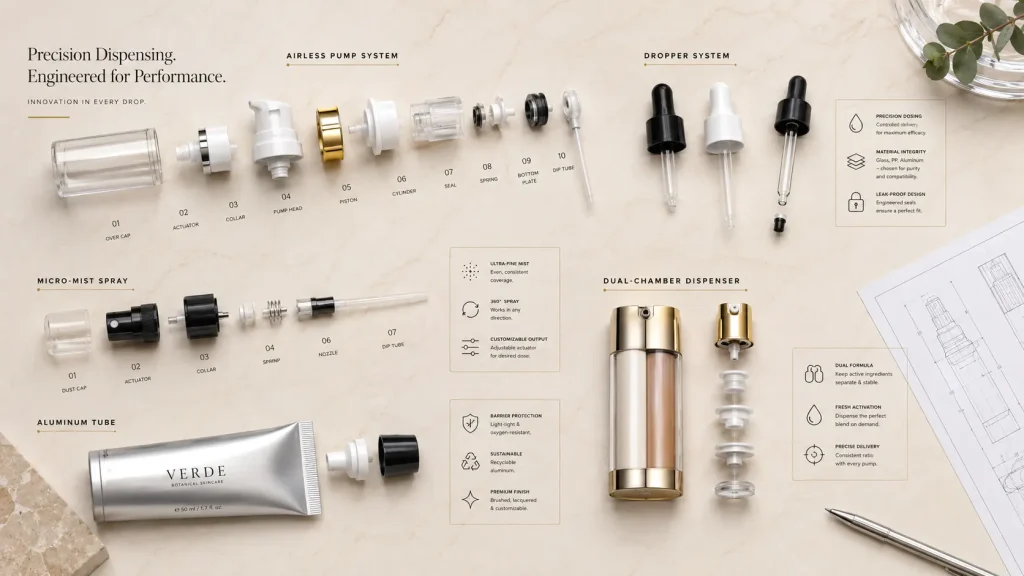
There is no universally “best” cosmetic packaging format.
The correct format is the one that works consistently with the formula while supporting the intended usage experience.
4. Understand Primary, Secondary & Shipping Packaging
Cosmetic packaging decisions happen at several levels.
Primary Packaging
The component that directly contains or dispenses the formula — for example, the bottle, jar, tube, pump system, capsule, or sachet.
This layer has the strongest direct relationship with formula compatibility and dispensing.
Secondary Packaging
The outer carton, sleeve, insert, label, or other component surrounding the primary package.
Secondary packaging can support:
- Brand presentation
- Product information
- Light protection
- Retail display
- Physical protection
Distribution & E-Commerce Packaging
Shipping cartons, inserts, cushioning, and protective systems also matter, particularly for DTC and cross-border brands.
A package that works beautifully on a retail shelf can still fail if it leaks, breaks, or activates accidentally inside a parcel.
5. Cosmetic Packaging Materials Matter
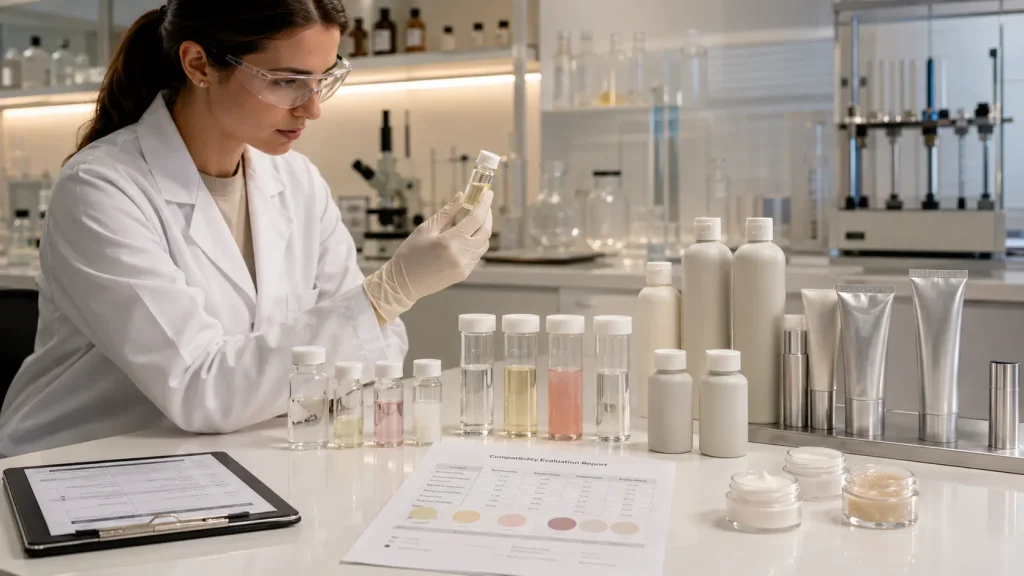
Choosing the correct structure is only part of the packaging decision.
The material and material grade also matter.
Common cosmetic packaging materials include:
- Glass
- PET
- PETG
- PP
- PE
- Acrylic-based components
- Aluminum
- Multi-material structures
Each can offer different combinations of:
- Appearance
- Weight
- Rigidity or flexibility
- Barrier characteristics
- Decoration options
- Shipping performance
- Cost
- Formula compatibility
Material names alone are not enough to approve packaging.
Different resins, component structures, liners, gaskets, springs, coatings, inks, adhesives, colorants, and other internal components can change how the complete package behaves.
This is why a formula should be evaluated with packaging that is representative of the final commercial system.
6. What Is Formula-Packaging Compatibility Testing?
Formula-packaging compatibility testing evaluates whether the actual formula and intended packaging can continue functioning together during storage and use.
It is much more than checking whether the bottle leaks on the first day.
Development teams may evaluate:
- Formula color, odor, appearance, or viscosity changes
- Package swelling or deformation
- Stress cracking
- Corrosion of relevant components
- Leakage
- Seal performance
- Pump, dropper, spray, or applicator function
- Clogging
- Dose consistency
- Decoration or label changes
- Loss of product or volatile components
- Other product-package interactions
Compatibility needs to consider both directions:
- What does the formula do to the packaging?
- What does the packaging do to the formula?
The package also needs to continue protecting and dispensing the formula appropriately.
A container that performs well with one serum should not automatically be assumed suitable for another formula.
Related Guide: Packaging compatibility is only one part of the evaluation that may be needed before commercial production. To understand how stability, microbiological quality, preservative efficacy, sensory performance, claims support, packaging compatibility, and scale-up fit into the broader testing process, read our Cosmetic Product Testing Before Mass Production →
7. When Does Airless Packaging Make Sense?
Airless packaging is popular in modern skincare because it can offer controlled dispensing and reduce repeated consumer-use exposure of the remaining formula to the external environment.
It may be useful for:
- Serums
- Lotions
- Creams
- Treatment-oriented products
- Premium skincare concepts
But airless does not automatically mean better packaging for every skincare product.
The complete system still needs to work with:
- Formula viscosity
- Filling method
- Pump output
- Priming performance
- Product evacuation
- Internal components
- Packaging cost
- Target positioning
A premium-looking airless system that cannot dispense the formula consistently is still the wrong packaging.
Packaging technology should solve a real product-development need rather than being selected simply because it sounds advanced.
8. Innovative Cosmetic Formats Need Earlier Packaging Development
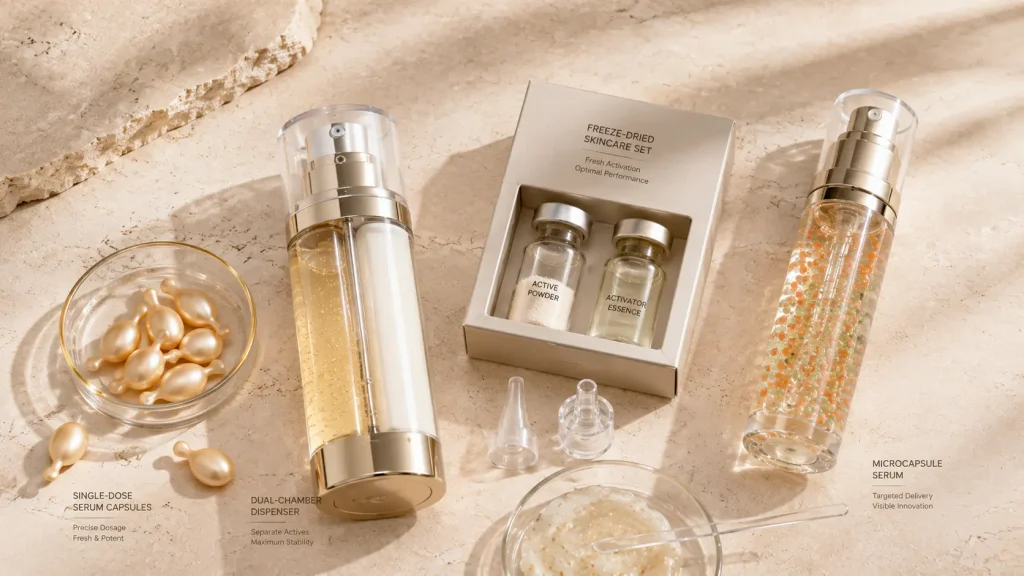
Single-Dose Capsules
Single-dose capsule development needs coordination between:
- Formula
- Capsule material
- Fill volume
- Capsule dimensions
- Sealing
- Outer packaging
The capsule is a delivery system, not simply a different-looking bottle.
Freeze-Dried Products
Freeze-dried skincare may combine a dry active component with a separate liquid activator.
The packaging needs to protect the dry material until use while making activation and dosage practical for consumers.
Dual-Chamber Packaging
Dual-chamber systems keep two product phases or formulas separated until dispensing.
They can be useful when a product concept benefits from storing components separately, but they add complexity involving:
- Filling
- Dispensing ratio
- Assembly
- Supplier sourcing
- Compatibility
- Production setup
Microcapsule & Visible-Bead Serums
Visible microcapsules or beads introduce another dispensing consideration.
Brands may want transparent packaging to show the technology, but the pump and internal pathway also need to handle the particles without crushing them or creating blockages.
9. Packaging Can Affect Commercial Filling
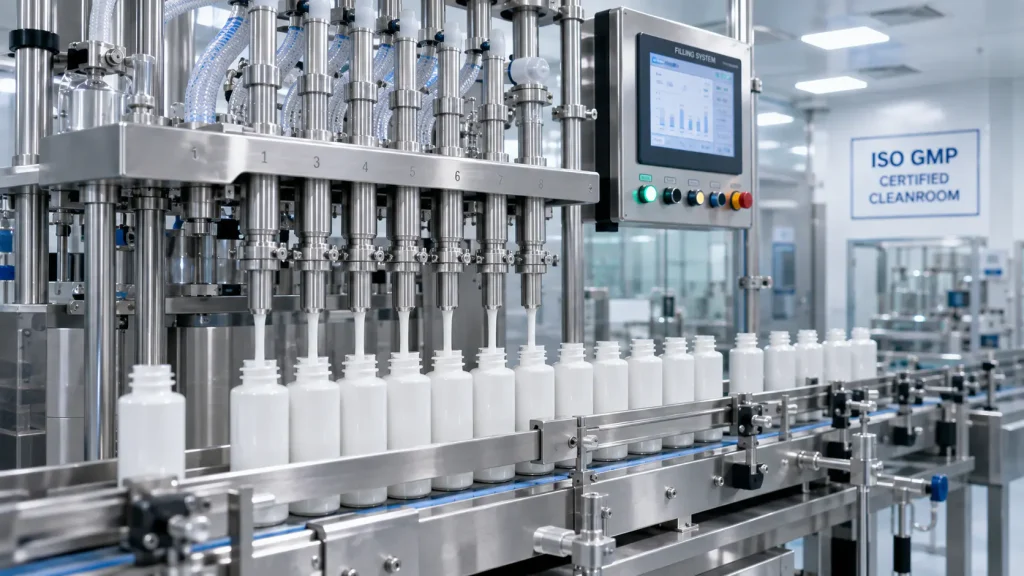
A package can work well for the consumer and still create manufacturing problems.
Commercial filling may need to consider:
- Filling accuracy
- Filling speed
- Nozzle size
- Package dimensions
- Formula viscosity
- Foaming during filling
- Component assembly
- Capping or sealing
- Production-line compatibility
Non-standard packaging may require slower filling, additional assembly, specialized fixtures, manual operations, or alternative equipment.
Packaging feasibility should therefore be reviewed with the manufacturer before a large component order is placed.
10. Packaging Decoration Affects Cost, MOQ & Lead Time
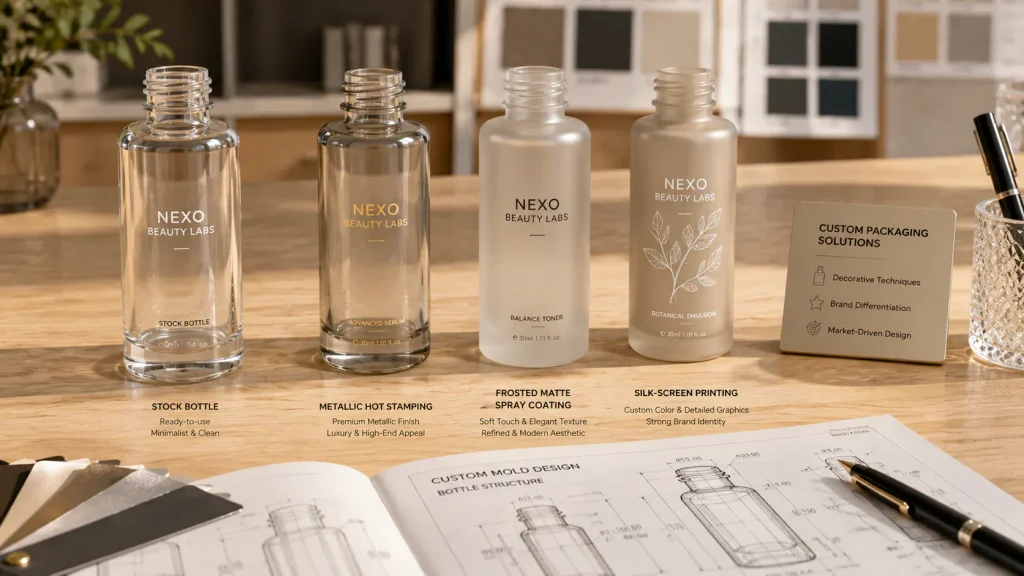
Once the technical packaging structure is selected, brands can develop the visual design.
Decoration options can include:
- Screen printing
- Hot stamping
- Labels
- Coatings
- Frosted finishes
- Metallization
- Custom colors
- Embossing or debossing
- Printed cartons
Decoration can strengthen brand identity, but additional processes can affect:
- MOQ
- Unit cost
- Sampling
- Color approval
- Production complexity
- Lead time
Brands should distinguish between visual elements that are essential to positioning and those that can be introduced later.
11. Stock vs. Custom Cosmetic Packaging
Stock packaging and fully custom packaging solve different commercial problems.
Stock packaging does not automatically mean generic-looking packaging.
Strong color, decoration, labels, cartons, and brand design can differentiate an existing structure without immediately investing in a proprietary mold.
For many growing beauty brands, this can provide a better balance between differentiation and launch risk.
12. What Affects Cosmetic Packaging MOQ, Cost & Lead Time?
There is no universal MOQ or standard packaging price.
Commercial requirements can depend on:
- Existing vs. custom mold
- Material
- Component complexity
- Packaging size
- Color customization
- Printing
- Coating or metallization
- Number of components
- Supplier production setup
- Custom cartons
- Tooling
- Shipping
When requesting a quotation, ask whether the MOQ refers to:
- The undecorated primary package
- The decorated package
- The pump or closure
- The carton
- The complete assembled system
A packaging project can contain several separate supplier minimums.
This is one reason a seemingly inexpensive bottle may become much more costly after decoration, closures, cartons, tooling, and freight are included.
13. Packaging Also Affects Shipping & Logistics
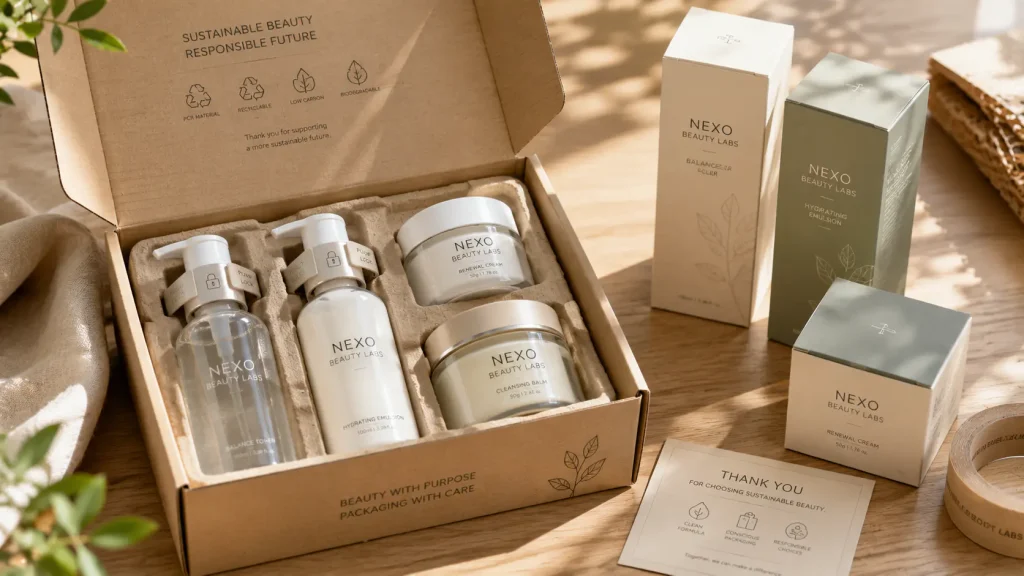
Packaging development should not stop at the filling line.
The finished product needs to survive storage, transport, fulfillment, and consumer handling.
Consider:
- Package weight
- Breakage risk
- Leakage
- Closure security
- Pump protection
- Carton dimensions
- Shipping orientation
- Secondary packaging
- Shipping efficiency
- E-commerce fulfillment
A heavy glass bottle may support premium positioning but increase freight weight and breakage risk.
A large decorative closure may improve shelf impact but increase carton dimensions.
DTC brands should evaluate how a product behaves not only on a retail shelf but inside a parcel moving through a fulfillment network.
14. Evaluate Sustainable Packaging at the System Level
Sustainability is an important packaging consideration, but it should not be reduced to one material or one marketing phrase.
Possible strategies can include:
- PCR materials
- Recyclable or simplified material structures where practical
- Refill concepts
- Lightweighting
- Reduced secondary packaging
- Alternative material choices
But every sustainability decision still needs to consider:
- Formula compatibility
- Product protection
- Manufacturing feasibility
- Material consistency
- Retail requirements
- Transportation
- Consumer use
- End-of-life practicality
A package that appears more sustainable but causes product leakage, breakage, formula degradation, or excessive waste does not necessarily create a better overall product system.
15. Cosmetic Packaging Also Shapes Brand Positioning
Once the technical requirements are satisfied, packaging becomes one of the most visible expressions of brand positioning.
Different formats can create different perceptions.
An airless pump may communicate:
Clinical / Functional / Modern
A heavy glass jar may communicate:
Premium / Luxury / Ritual
A transparent dropper bottle may communicate:
Ingredient-Led / Botanical / Minimalist
A single-dose capsule may communicate:
Precision / Innovation / Premium Treatment
But these are positioning cues, not technical guarantees.
A good packaging decision aligns:
Formula Performance + Consumer Experience + Commercial Strategy + Brand Positioning
When Should Cosmetic Packaging Be Selected?
Packaging should not necessarily be fully finalized before the formula exists.
But it also should not wait until the formulation process is completely finished.
A stronger development sequence is:
Product Concept
↓
Initial Formula Direction
↓
Packaging Direction
↓
Formula + Packaging Development in Parallel
↓
Compatibility & Dispensing Evaluation
↓
Manufacturing / Filling Review
↓
Final Packaging Confirmation
↓
Artwork & Decoration
↓
Commercial Production
This allows technical issues to be discovered while formulation and packaging changes are still relatively easy to make.
Questions to Ask Before Confirming Cosmetic Packaging
Before approving the packaging system, ask:
- Does this package work with the actual formula?
- Is the viscosity appropriate for the dispensing system?
- Does the package deliver a consistent amount?
- Has formula-packaging compatibility been evaluated?
- Can the formula be filled efficiently?
- Does the pump, dropper, spray, or applicator work throughout expected use?
- Is the package suitable for commercial manufacturing?
- What is the MOQ for each component?
- What decoration options are available?
- Does customization require tooling or a new mold?
- What is the packaging lead time?
- How will the package perform during shipping?
- What quality checks are performed on incoming packaging?
- Could packaging become the critical path for the launch timeline?
Frequently Asked Questions
What packaging is best for skincare products?
There is no single best skincare packaging format. The correct choice depends on formula type, viscosity, dispensing requirements, packaging material, compatibility, consumer experience, manufacturing process, cost, and brand positioning.
What packaging is best for a serum?
Depending on formula viscosity and product requirements, serums may work with droppers, pumps, airless bottles, sprays, or specialized single-dose formats. The dispensing system should be tested with the actual formula.
Are airless bottles better for skincare?
Airless systems can provide controlled dispensing and may reduce repeated consumer-use exposure of the remaining product to the external environment. However, they are not automatically the best choice for every formula. Viscosity, filling, dispensing performance, compatibility, cost, and positioning still matter.
Can packaging affect a cosmetic formula?
Yes. The formula and packaging can interact with each other over time. Containers, liners, closures, pumps, gaskets, coatings, adhesives, inks, and other components can all form part of the final compatibility assessment.
What is cosmetic packaging compatibility testing?
Compatibility testing evaluates whether the finished formula and intended packaging can remain stable, functional, and visually acceptable together under appropriate storage and use conditions.
Should packaging be selected before or after formulation?
Packaging should generally be considered alongside formulation. An initial direction can be selected early, then evaluated with formula samples before final confirmation.
What is the difference between primary and secondary cosmetic packaging?
Primary packaging directly contains or dispenses the formula. Secondary packaging surrounds the primary package and may provide branding, information, additional protection, or retail presentation.
Does custom cosmetic packaging take longer?
Generally, yes. New molds, specialized components, structural development, custom colors, complex decoration, sampling, tooling, and additional approval stages can extend lead times.
Is stock packaging bad for a premium beauty brand?
No. Existing packaging structures can still be customized through color, printing, coatings, labels, decoration, and secondary packaging. A well-selected stock package can support premium positioning without immediately investing in a proprietary mold.
What affects cosmetic packaging MOQ?
MOQ can depend on the component, mold, material, color, decoration, printing, pump or closure, carton, supplier, and level of customization. Ask for the MOQ of the complete packaging system rather than assuming the bottle MOQ represents the entire project.
Can a cosmetic manufacturer help choose packaging?
Yes. A full-service OEM/ODM manufacturer can often help evaluate packaging according to formula viscosity, compatibility, dispensing, filling, sourcing, MOQ, manufacturing feasibility, cost, and brand positioning.
Develop Formula & Packaging Together
Great cosmetic packaging does more than make a product look attractive.
It protects the formula, supports reliable dispensing, works with commercial filling and assembly, survives storage and transportation, creates the intended consumer experience, and reinforces the brand’s market position.
That is why packaging should not be treated as the final decorative stage of cosmetic product development.
At NEXO Beauty Labs , packaging is considered alongside formulation, product testing, scale-up, and commercial manufacturing.
Depending on the project, our OEM/ODM development process can support:
- Packaging-format recommendations
- Formula and packaging coordination
- Stock packaging options
- Custom colors and decoration
- Specialized product formats
- Packaging sourcing
- Formula-packaging compatibility planning
- Filling and manufacturing feasibility
- Private label, ODM, and custom product development
Whether you are developing a serum, cream, scalp treatment, hair oil, cosmetic capsule, freeze-dried product, or multi-component system, the right packaging should support both the formula and the commercial strategy behind it.
Request a Cosmetic Packaging & OEM/ODM Consultation with NEXO Beauty Labsto discuss your formula, packaging format, materials, decoration, MOQ, filling requirements, and product-development plan.